
My Parents Made My Kids Watch Their Cousin Open Every Christmas Gift, Then Told Me They Hadn’t Earned The Same Love—Months Later, My Brother…

My parents made my kids watch their cousin open every Christmas present while they sat there with nothing, then told me my children hadn’t earned the same love. I had spent years convincing myself their favoritism was harmless, but that Christmas Eve finally made it impossible to look away.
Tap LISTEN TO THE FULL STORY below to reveal the narrated video and start listening.
My parents made my kids watch their cousin open every Christmas gift while Nora and Eli sat beside the tree with nothing of their own. Then my parents made it even worse by suggesting their cousin had somehow earned more love than they had. I was forty, married to Leah, and still making the nearly two-hour Christmas Eve drive because I kept telling myself family traditions mattered. That night was when I finally stopped pretending my parents’ favoritism was harmless.
My older brother Marcus had always been the favorite. Everyone in the family knew it, although nobody actually called it favoritism. Marcus could forget Mom’s birthday and she’d explain that he was busy. I could spend an entire Saturday repairing shelves in my parents’ garage, only for Dad to ask why I hadn’t finished the cabinet doors too. That same imbalance had slowly passed down to our children.
Marcus’s thirteen-year-old son, Blake, wasn’t necessarily a bad kid, but he was old enough to understand where he stood. Grandma and Grandpa considered him more important than his cousins, and he knew it. When we arrived that Christmas Eve, Nora helped my mother carry appetizers into the dining room while Eli sat excitedly on the carpet, trying to guess what was inside the mountain of presents beneath the tree.
🎧 Listen to the Complete Story
Press ▶ Play below to enjoy the full narrated story.
Then I noticed the gift tags.
Blake.
Blake.
Blake.
I quietly checked several packages. Not one had Nora’s or Eli’s name on it. Even then, I tried to invent an innocent explanation. Maybe my parents had hidden their presents somewhere else. Maybe there was another pile waiting in another room. I had become very good at finding reasonable explanations for unreasonable behavior.
Marcus arrived twenty minutes late with Blake, and suddenly the evening seemed to begin.
Blake saw the enormous pile beneath the tree and asked if they were all his.
My father laughed and said the presents were for the grandchildren who had given them something to brag about that year.
Leah immediately tightened her hand around mine.
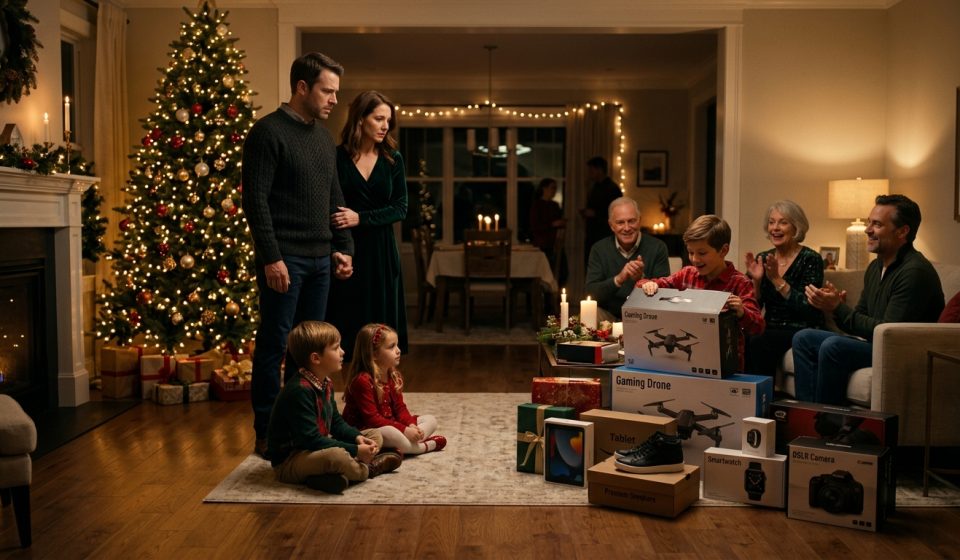
Then my mother gathered everyone into the living room and announced that they had decided to recognize “achievement” that Christmas. Blake had made honor roll, improved at basketball, and apparently helped Marcus organize his garage once.
The presents started coming.
First, a tablet.
Then an expensive pair of sneakers.
After that came a gaming headset, a smartwatch, and a camera drone.
Nora sat unnaturally still beside us.
Finally, Eli whispered the question I had been dreading.
Were they going to open their presents after Blake?
I couldn’t answer him.
When Blake lifted his new drone and joked that Nora and Eli apparently hadn’t “made the cut,” Marcus snorted. My mother smiled and lightly told Blake to stop teasing.
But nobody told him he was wrong.
Nobody reached behind the couch for another stack of presents.
Because there weren’t any.
That was the moment I looked at Nora and saw her fighting desperately not to cry. Her chin had started trembling.
I had watched my parents keep score between their grandchildren for years. Blake’s events mattered more. His achievements received more praise. His successes deserved rewards. I had tolerated it because I convinced myself my children didn’t notice.
But when my parents made my kids watch that Christmas spectacle, there was no excuse left.
I told Nora and Eli to get their coats.
My mother stared at me as if I were ruining Christmas. Dinner wasn’t even ready, she protested. Then she followed me toward the entryway, lowering her voice and warning me not to turn the situation into a production.
Marcus called from the living room that I always did this—that drama followed me everywhere.
Normally, I would have argued.
This time, I simply opened the door.
On the long drive home, Eli eventually fell asleep.
Nora leaned against the window and silently cried.
After we put both children to bed, I sent my parents one message:
Don’t invite us again.
My children would never be brought somewhere just to be humiliated.
No answer came that night.
Christmas morning arrived.
Still nothing.
And what I hadn’t yet understood was that walking out of that house wasn’t going to end the problem.