
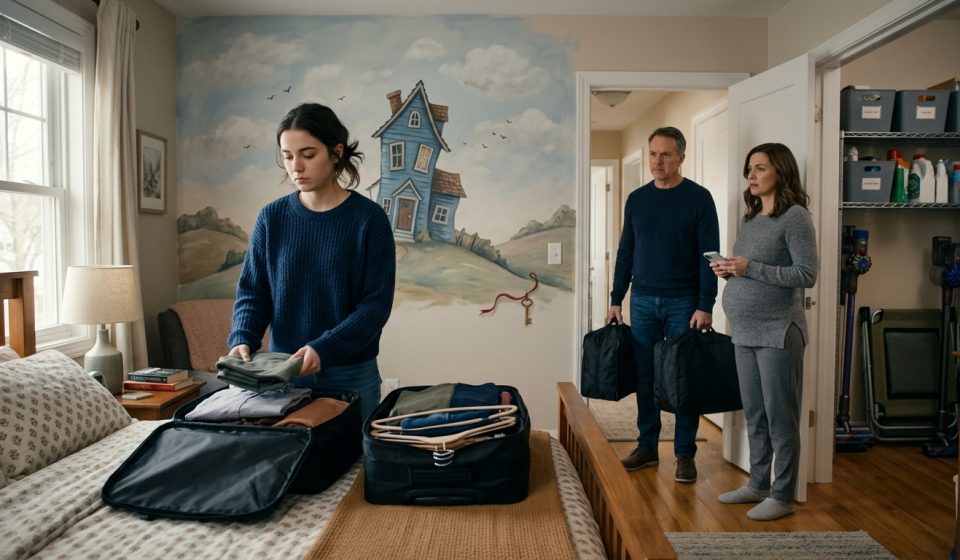
My Father Gave My Bedroom To His New Baby And Told Me, Fourteen, To Take The Storage Room.

My father gave my bedroom to his new baby and ordered me, at fourteen, to move into a storage room while my stepmother filmed everything for the family group chat. I didn’t argue—I quietly packed my things while holding onto something they had completely forgotten about.
Tap LISTEN TO THE FULL STORY below to reveal the narrated video and start listening.
My father gave my bedroom to his new baby when I was fourteen and told me I could sleep in the storage room instead. He stood in my doorway holding black trash bags for my belongings while my stepmother, Belle, filmed everything on her phone, ready to send my humiliation to twelve relatives in the family group chat. I didn’t scream or argue. I simply took the bags and started packing.
The storage room was already waiting for me. Metal shelves lined the walls beside a broken vacuum, and a narrow camping cot had been unfolded next to the furnace. There was no window. The vent clicked constantly, and the room smelled of detergent and dust. My father told me the baby needed my sunny bedroom more than I did. Belle added that what I needed was “perspective” and “gratitude.”
What hurt most wasn’t losing the room itself. My mother had painted the wall above my bed before she died. Tiny birds flew over a crooked blue house, and in one corner she’d painted a brass key tied to a red ribbon. Beneath it she’d written a message just for me: For Maren, in case she ever needs a door. Now Belle was casually asking whether they should paint over it that night or wait until tomorrow.
🎧 Listen to the Complete Story
Press ▶ Play below to enjoy the full narrated story.
I nearly spoke when Belle said she didn’t want the baby looking at “some old sadness.” That mural had been there through my childhood—fevers, birthdays, homework, and those strange quiet mornings after my mother’s funeral when my father forgot breakfast and I made toast for myself.
But my mother had taught me that silence could be useful when used carefully.
So I folded another sweater.
Eventually, my silence became too boring for Belle’s camera. She stopped recording and began typing a caption for the video instead. She called it “Making space for the real family” and suggested that some girls only learned respect when life stopped treating them like the center of everything.
The video went to twelve relatives—or at least Belle believed it did.
She had forgotten that she’d once added Nora, one of my mother’s oldest friends, to the family chat during her baby shower. Nora had known my mother since college. More importantly, Belle hadn’t considered who might actually see what she had just recorded.
My father looked at my mother’s mural and told me I had until dinner to finish moving. Then he warned me not to turn the situation into another of my mother’s “dramatic little memorials.”
“She is gone,” he said. “This is a house for the living.”
I nodded once.
That seemed to bother him more than tears would have.
My father understood crying. Crying made him feel as though he had won something. My silence made him suspicious, as if there might be something underneath it that he couldn’t see.
There was.
Two years earlier, my grandmother Lillian had handed me a yellow envelope outside the county library. She had given me very specific instructions about when I was supposed to open it: if my father ever tried to remove me from my room, my school, or my mother’s things.
Now my father had given my bedroom to his new baby, my stepmother was preparing to erase my mother’s mural, and twelve relatives had been invited to watch.
I pulled the yellow envelope from beneath the folded jeans in my laundry basket and broke the blue painter’s tape sealing it.
Inside was a copy of a note from my mother.
There was also a small brass key tied to a red ribbon.
And beneath them were three instructions.
The first told me to photograph the room they wanted me to sleep in.
The second told me to photograph anything they planned to remove from my wall.
The third was the strangest of all.
I was supposed to text one word to three people—including Nora and a quiet lawyer who had visited our house shortly before my mother died.
The word was:
Bluebird.