
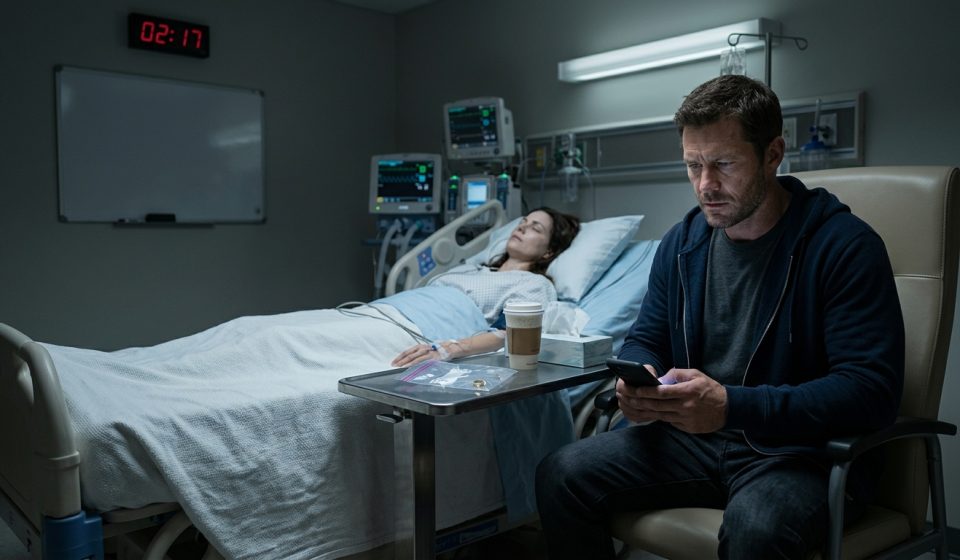
“YOUR WIFE’S IN A COMA. PERFECT TIMING -WATCH MY KIDS WHILE WE SKI” MY SISTER TEXTED. I WAS SLEEPING AT THE HOSPITAL…

My wife was in a coma when my sister decided that meant I was conveniently free to babysit her children while she went skiing in Aspen. Sitting beside Claire’s hospital bed at 2:17 in the morning, I read my sister’s messages three times before something inside me went completely still.
Tap LISTEN TO THE FULL STORY below to reveal the narrated video and start listening.
My wife was in a coma when my sister texted me at 2:17 in the morning and somehow managed to make the worst 48 hours of my life about her ski vacation. I was sitting beside Claire’s hospital bed, staring at the red numbers on the wall clock and listening to the mechanical hiss of her ventilator, when my phone buzzed against my thigh. I almost ignored it. Then I saw Melissa’s message: “Your wife’s in a coma? Perfect timing. Watch my kids while we ski.”
Three days earlier, a delivery truck had blown through a red light and struck Claire’s car on the driver’s side. Emergency surgery stopped the bleeding, and doctors stabilized her, but she hadn’t woken up. I’m a firefighter. I’ve pulled people from burning houses, carried children through smoke, and performed CPR while terrified families screamed nearby. Understanding emergencies didn’t make Claire’s condition easier. It made it worse, because I understood what every monitor and every carefully chosen word from her doctors meant.
Then another message arrived from Melissa. She and her husband were leaving for Aspen the following morning. Mom had apparently told her I was “off work anyway,” so Melissa had already decided her children could stay at my house. A third message followed: “Don’t make this difficult. The trip is already paid for.” I read those messages three times—not because I misunderstood them, but because I couldn’t believe another human being had actually typed them while Claire lay unconscious twenty inches away.
🎧 Listen to the Complete Story
Press ▶ Play below to enjoy the full narrated story.
My sister knew exactly what had happened.
My parents knew too.
Everyone knew.
Yet somehow, because my wife was in a coma, Melissa’s first thought was that my tragedy had conveniently cleared my schedule.
Something inside me became very still.
As a firefighter, I’ve seen moments when a burning room suddenly changes. The flames behave one way, then the air shifts. Heat builds overhead. Smoke drops lower.
Everything becomes strangely quiet.
Experienced firefighters know what that silence can mean.
The room is approaching flashover.
Sitting beside Claire that night, I felt something inside me reach the same point.
Melissa texted again.
“David?”
Then another message.
“I need an answer.”
I looked at Claire.
Her wedding ring had been removed because of the swelling and placed inside a small plastic hospital bag beside her bed.
Looking at it brought back memories.
I remembered sliding that ring onto her finger eleven years earlier. I remembered Melissa complaining during our wedding reception because Claire’s parents had been given a nicer table.
Later, Claire and I had laughed about it.
She’d joked that my sister could turn a funeral into a competition.
I wasn’t laughing anymore.
I picked up my phone.
Then I typed one word.
“Sure.”
Melissa responded immediately with three heart emojis.
She knew she could count on me, she said.
The children would be dropped off at seven. If I was still at the hospital, Mom had a spare key to my house.
I stared at that message for a long time.
Then I stood up.
But I wasn’t going home to prepare bedrooms for Melissa’s children.
For nearly fifteen years, I’d been the dependable one—the firefighter, the homeowner, the man everyone called whenever another “emergency” appeared.
Melissa needed $1,800 after trouble with a roommate?
I paid it.
She needed help getting a car?
I cosigned.
When she married Brad and my parents were supposedly short on money, I contributed $4,000 toward their wedding.
Every time something went wrong, I stepped in.
Every time someone needed rescuing, I answered.
But now, while my unconscious wife lay in a hospital bed and my family prepared to use my home as though nothing had happened, I finally understood something I’d refused to admit for years:
They weren’t asking whether I could help anymore. They simply assumed I belonged to them.