
What A Lovely House, She Said Sweetly. My Parents Get The Upstairs, My Sister And Her Kids Get The Downstairs. It’s Your Duty To Host Us. I Stood Up, Smiled, And Said, One Sentence.

When Sierra calmly declared, “It’s your duty to host us,” she had no idea how deeply those six words would change the atmosphere inside my home.
Tap LISTEN TO THE FULL STORY below to reveal the narrated video and start listening.
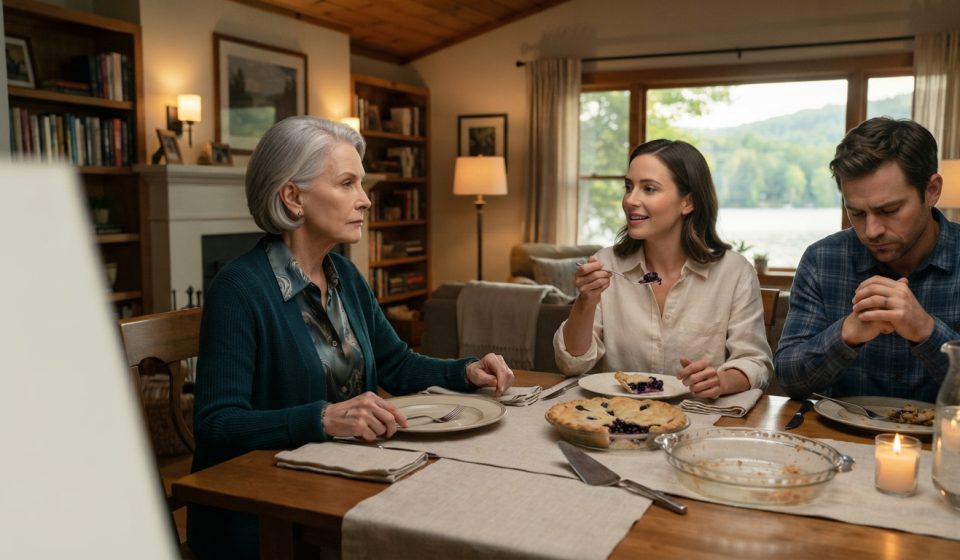
“It’s your duty to host us.” Sierra said it so calmly that for a moment I wondered whether I had misunderstood her. We were sitting around my dining table, eating pie I had baked from scratch that morning, when she casually announced how my home should be divided among her family. My parents would take the upstairs, she explained, while her sister and the children would have the downstairs. According to her, it was only fair because I had the space. I lowered my fork carefully, hearing the faint clink of ceramic against ceramic in a room that suddenly felt far too quiet.
I looked directly at her and reminded her of something that apparently needed saying: this was my home, not a hostel. For a second, nobody moved. The dining room was still warm from the oven, carrying the scent of brown butter while late-spring air drifted through the screen door. Outside, the lake lay perfectly still. I had lit candles, arranged cloth napkins, and even remembered that Sierra didn’t eat strawberries. I hadn’t expected anyone to praise the effort, but I certainly hadn’t expected them to start assigning rooms in my house.
Evan kept his eyes on his plate. His hands rested neatly in his lap, and he never looked up. Sierra’s smile tightened slightly as she explained that the arrangement would only be for a few weeks. Her family had never experienced staying at a lakehouse, she said, and besides, I wasn’t really using the entire place. I stayed silent. It wasn’t because I had nothing to say. It was because I knew that once I started, I might not stop.
🎧 Listen to the Complete Story
Press ▶ Play below to enjoy the full narrated story.
They finished dessert as though nothing unusual had happened. I cleared the plates alone while everyone else lingered on the porch drinking coffee and discussing summer travel plans. Their laughter floated through the screen door while I moved around the kitchen, trying to understand how a pleasant family gathering had somehow turned into a discussion about other people occupying my home.
After they left, I walked slowly through every room. I closed the windows, checked the locks twice, and switched off lights in spaces I had once imagined family might help fill someday. That night, I left the porch light on. I wasn’t frightened. I was simply alert, aware that something had shifted.
The house meant more to me than Sierra seemed to understand. I had spent forty years working quietly in the basement of a university library, preserving manuscripts, letters, photographs, and other people’s memories. When my husband died, Evan was only twelve. There had been no time for me to fall apart. I packed lunches, paid bills, worked more hours, and kept our lives moving.
I never remarried. Instead, I saved whatever I could. I moved us into a smaller apartment, bought used clothes, skipped vacations, and tried to give Evan what I could afford. Little by little, my savings grew.
Eventually, I found this house.
I bought it myself, paying in full with a cashier’s check. For the first time in decades, I had the quiet I’d dreamed about: water, trees, sunlight, and enough space to hear my own thoughts. For an entire year, the house felt like the reward for everything I had sacrificed.
Then came Sierra’s smile and her calm declaration: “It’s your duty to host us.”
I thought the uncomfortable dinner had ended when everyone drove away.
Seven days later, I saw the moving truck.