
We Didn’t Order Anything For You. My Daughter-In-Law Said, Passing, Me A Basket Of Bread, While Her Family Ate $100 Steaks. My Son Added, You Should Have…

When my own son said you should have eaten before coming, I realized the expensive family dinner I’d been invited to had never really included me at all.
Tap LISTEN TO THE FULL STORY below to reveal the narrated video and start listening.
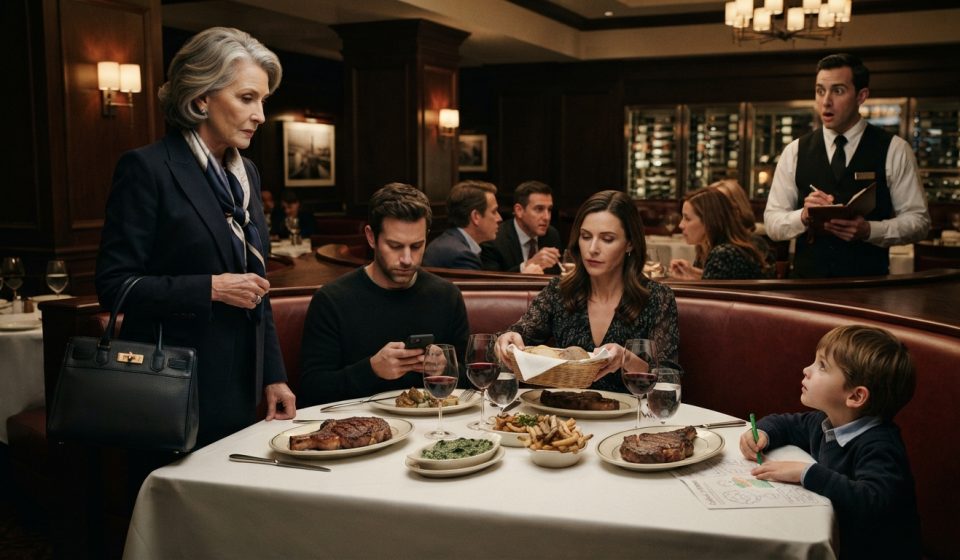
The words you should have eaten before coming came from my own son while I stood beside a crowded booth at an upscale steakhouse with nowhere to sit. My daughter-in-law Sarah had just slid a half-empty basket of bread toward me and announced that they hadn’t ordered anything for me. Around the table, her family sliced into hundred-dollar steaks while the air carried the smell of roasted garlic, expensive red wine and charred beef. David had invited me there, calling it a rare family dinner, yet there wasn’t an empty chair, silverware or even a folded linen napkin waiting for me.
Sarah’s parents laughed together across the table while my grandson Sam sat quietly at the end clutching a green crayon. His confused little eyes found mine. He tried pushing his small plate toward me, but Sarah gently tapped his hand away. Then David, without even bothering to look up from his phone, told me I should have eaten beforehand. He slowly swirled the amber drink in his glass as though what he’d just said was perfectly normal.
I didn’t cry. I didn’t shout or create a scene. Life had taught me that dignity wasn’t found in begging for a place at a table where I clearly wasn’t wanted. I looked at the breadbasket, Sarah’s smug smile, and finally my son, who couldn’t meet my eyes. Then the waiter returned with a leather notepad. Seeing me standing awkwardly beside the booth, he politely offered to bring me a chair and menu. I adjusted my purse and smiled at him.
🎧 Listen to the Complete Story
Press ▶ Play below to enjoy the full narrated story.
“No thank you,” I told him.
I wouldn’t be staying.
But before leaving, I stood a little straighter and told the waiter to close out the tab for the drinks that had already been ordered.
The rest of the table would be opening their own tab for the meal.
For the first time that evening, David’s attention snapped away from his phone.
I walked out of the restaurant.
The heavy oak doors closed behind me, replacing the sounds of clinking glasses and jazz music with crisp evening air.
I took a deep breath.
Strangely, I didn’t feel broken.
I felt awake.
I started my car and drove home without turning on the radio. The silence gave me time to think about the previous forty-five minutes—and the years that had led to them.
I’d made excuses for David for far too long.
His demanding job explained why he seemed distant.
Sarah’s aggressive personality was simply her way of protecting their family.
At least, those were the explanations I’d repeatedly given myself.
I’d bitten my tongue because I wanted peace.
But driving beneath the glowing streetlights that night, I began thinking about something else.
The credit card sitting in David’s wallet.
It was a platinum card under my name.
Two years earlier, I’d given it to him when his car needed a new transmission, specifically telling him it was for emergencies.
Over time, however, the definition of “emergency” had quietly expanded.
First came groceries.
Then gasoline.
More recently, I’d noticed restaurant charges from places with wine lists longer than my arm.
And every month, I’d paid the balance because I’d convinced myself that helping my son was simply part of being his mother.
Then the truth of that evening landed differently.
Those hundred-dollar steaks weren’t merely being eaten in front of me.
They were being eaten on my dime.
By the time I pulled into my garage and the dashboard lights faded into darkness, one question had become impossible to ignore:
How much of their comfortable life had I been quietly paying for?