
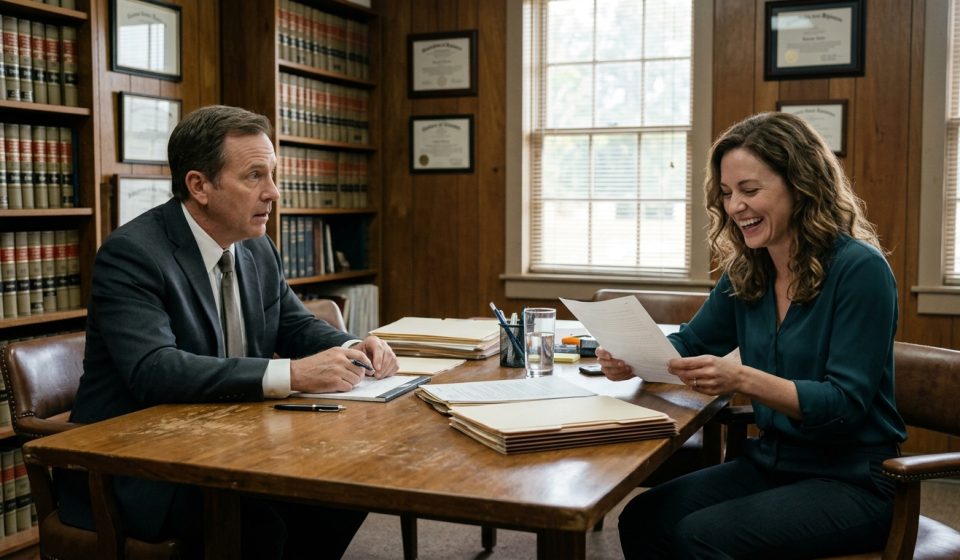
Three Days Ago, I Sat In A Lawyer’s Office, Read One Single Document, And Laughed So Hard The Attorney Actually Put Down His Pen And Asked If I Needed Water.

After two years of silence, my parents contacted me through a lawyer and demanded that I surrender my rights to my grandfather’s lakehouse. They had no idea what he had done to protect me.
Tap LISTEN TO THE FULL STORY below to reveal the narrated video and start listening.
My parents hadn’t spoken to me in two years when a lawyer suddenly contacted me about my grandfather’s lakehouse. There had been no phone calls, birthday cards, holiday greetings, or attempts to repair our relationship. Then, without warning, they wanted my signature on a document giving up whatever rights I had to the one place from my childhood that had ever felt safe. Three days ago, I sat in a lawyer’s office and read a document that made me laugh so hard the attorney stopped writing and asked whether I needed water. My parents believed they were about to take something precious from me. They had no idea my grandfather had anticipated the possibility years before his death. But to understand why that moment mattered, you need to understand the family I grew up in.
My name is Paige Afton, and I’m thirty-two years old. I grew up outside Knoxville, Tennessee, in a small town where people smiled warmly in public and discussed one another behind closed doors. My father, Gerald Afton, managed a local bank branch and had a reputation for being respectable and dependable. My mother, Diane, organized church gatherings and ran a women’s Bible study. To anyone looking from the outside, we appeared to be an ideal Southern family. But inside our home, attention and affection were not distributed equally. My parents and my younger sister, Meredith, seemed to form a family of three. I was the extra person, useful when someone needed help but rarely the person anyone celebrated.
Meredith received piano lessons while I was told there might be money for mine next year. On her sixteenth birthday, she received a used Honda Civic. I received a bus pass and encouragement to find a part-time job. She had the larger bedroom because she supposedly needed more space, while I slept beside the laundry room and learned to ignore the washing machine at night. My parents didn’t shout at me or physically hurt me. Their favoritism was quieter than that. They simply offered Meredith more attention, more opportunities, and more consideration. Whenever I questioned the difference, my father explained that Meredith needed more help because I was the strong one. For years, I mistook that description for praise. Eventually, I began to understand what it really meant.
🎧 Listen to the Complete Story
Press ▶ Play below to enjoy the full narrated story.
Being the strong daughter meant working double shifts at a diner during high school. I paid for my prom dress, schoolbooks, gasoline, and anything else I could manage without asking my parents for assistance.
I continued working through college, spending twenty-five hours each week at a tax preparation office while earning an accounting degree. I was exhausted much of the time, but I persevered.
When graduation approached, my parents promised they would attend. I imagined looking into the audience and finally seeing them proud of something I had achieved.
Instead, my father called on the morning of the ceremony. Meredith was moving into a new apartment, and they needed to help her with furniture.
I walked across the graduation stage without them.
Afterward, I balanced my phone on a bench and used its timer to take my own graduation photograph. I’d become the first college graduate in my family, but the achievement felt painfully lonely.
That afternoon, my grandfather Howard called. Unlike everyone else, he had always made me feel important. He told me he was proud of me and said something I didn’t fully understand.
He said he’d already taken care of it.
At the time, I assumed he meant a graduation gift or perhaps a card. I couldn’t imagine anything more significant.
Seven years would pass before I understood those words.
And when my parents hadn’t spoken to me in two years, the meaning of my grandfather’s promise would finally become impossible to ignore.