The Fire Alarm Was Still Going Off When My Shift Manager Chained The Back Exit And Told Us Nobody Leaves Until The Trucks Are Loaded. The Padlock Clicked…

The fire alarm was screaming, smoke was spreading across our warehouse, and my manager locked the nearest exit—but one small detail on that padlock would eventually expose something much bigger.
Tap LISTEN TO THE FULL STORY below to reveal the narrated video and start listening.
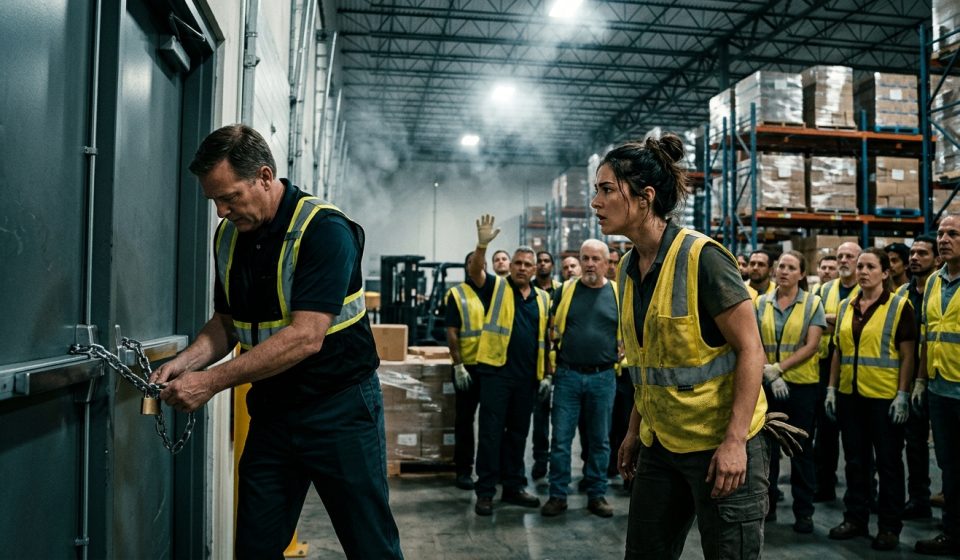
The fire alarm was still going off when my shift manager chained the back exit and ordered twenty-three workers to stay inside until the trucks were loaded. I watched Darren Mobley snap the padlock shut, slip the key into his jeans pocket, and pat it twice. Behind him, alarm horns screamed while white emergency lights flashed across the warehouse ceiling. Somewhere near the loading docks, I smelled burning plastic. The air already felt wrong. We were standing beside the closest exit, but Darren insisted that nobody could use it. Then I noticed a small yellow sticker attached to the lock.
My name is Tasha, and I’m twenty-seven years old. For four years, I’ve operated a reach truck at Calder Freight Solutions Distribution Centre in Shepherdsville, Kentucky. My job involves spending ten hours each night lifting heavy pallets thirty feet into the air and moving them safely through a busy warehouse. I’m experienced, properly certified, and careful about following company rules. I also have responsibilities waiting at home. My grandmother, whom everyone calls Gran, raised me from the age of six. She’s eighty-one now, with painful knees and a heart condition requiring several medications. Most of my paycheck goes toward keeping her house warm and paying our expenses. Losing my job would affect both of us. That’s why I always arrive early, rarely miss work, and take the company’s strict attendance policy seriously. Until that night, I’d never imagined deliberately disobeying my manager.
Darren had managed our second shift for approximately two years. He wasn’t someone who behaved cruelly every day. He remembered employees’ children, brought homemade chili to work each Halloween, and often talked proudly about his son serving in the Army. But corporate pressure had been weighing heavily on him. A whiteboard in our break room tracked departure times, and late trailers could cost the company hundreds of dollars in penalties. Darren had already received two written warnings during peak season. He frequently reminded us that if his position was threatened, ours could be too. Then, during the second week of June, a shipment arrived from corporate containing heavy chains, keyed padlocks, and instructions. Each lock carried a yellow barcode sticker with a corporate identification number. Darren hung one beside door fourteen and claimed the company wanted tighter control over side exits.
🎧 Listen to the Complete Story
Press ▶ Play below to enjoy the full narrated story.
The explanation was that employees had been using side doors to sneak outside for cigarettes or possibly remove products without permission.
But Luis Escobar, an experienced outbound dock worker with asthma, immediately pointed out something Darren seemed determined to ignore.
Door fourteen was a fire exit.
Darren dismissed the concern and said the order had come from corporate.
For weeks, the chain remained hanging beside the door. Occasionally, Darren locked it when regional management was expected to visit.
I noticed something unusual about the equipment. Most items at our Shepherdsville facility carried white identification stickers beginning with SHV.
These locks had yellow stickers beginning with CFS, the company’s corporate abbreviation.
The lock beside door fourteen was marked CFS0417, a number I remembered because 417 matched my grandmother’s birthday.
At the time, it seemed like an insignificant detail.
Then came Thursday, July ninth.
We were experiencing one of the busiest nights of peak season. Three trailers had to leave before midnight, the warehouse was unbearably hot, and workers were struggling to keep up.
Luis had already needed his inhaler twice.
Shortly before eleven, while lowering a pallet near dock thirty-eight, I heard a sudden popping sound from the charging area.
I turned and saw smoke pouring from an electric pallet jack.
A second pop followed.
Then orange sparks flew toward the plastic wrapping on a nearby pallet.
Within seconds, flames began climbing the stacked boxes.
The sprinklers activated, but black smoke continued spreading across the ceiling.
And suddenly, the fire alarm began screaming.