The CEO’s Daughter Fired Me In Front Of My Entire Team And Called My Lab Obsolete. I Held 11 Patents Worth $38 Million. The Day Of Their Big Demo…

The CEO’s Daughter Fired Me in front of fourteen engineers, dismissing seventeen years of dedication as obsolete, but she had no idea how deeply the company’s future depended on the work she was throwing away.
Tap LISTEN TO THE FULL STORY below to reveal the narrated video and start listening.
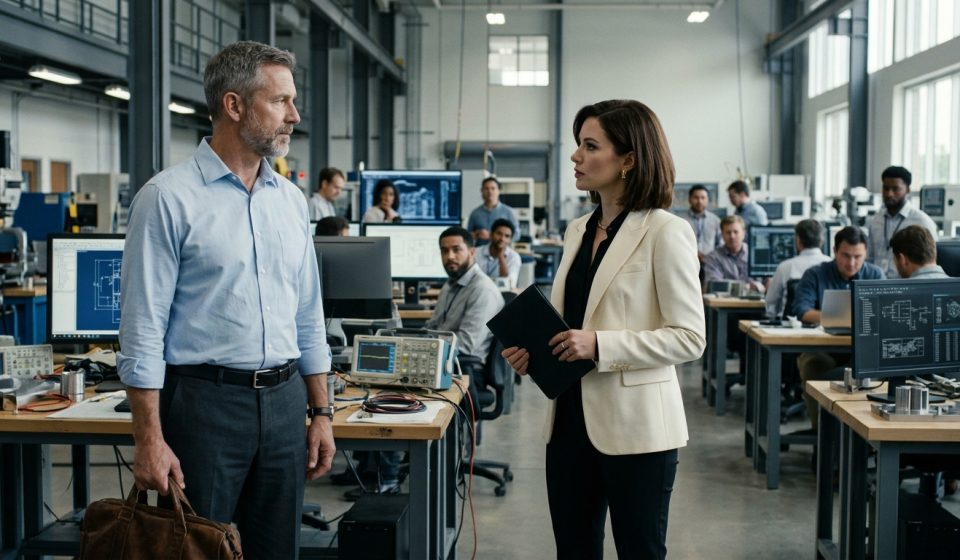
The CEO’s Daughter Fired Me in front of the very engineers I had trained, inside the laboratory I had spent seventeen years building from almost nothing. My name is Marcus Ballard, and at fifty-four years old, I had dedicated much of my professional life to Garrett Lyle Technologies. I held eleven patents generating approximately $38 million annually for the company. Yet there I stood, surrounded by fourteen engineers pretending to concentrate on their computer screens, while a twenty-nine-year-old executive told me I was finished. She was the CEO’s daughter, Victoria, and she had been vice president of innovation for only a few months. She didn’t lower her voice or show the slightest hesitation. To her, I was apparently just another employee whose services were no longer needed. But she had no idea what seventeen years of engineering had actually built.
Seventeen years earlier, Garrett Lyle Technologies had been a tiny operation working out of a garage in Ohio. Frank Garrett and his college roommate, Dave Lyle, were building something they believed could change the future of structural engineering. I became their third employee after leaving a comfortable research and development position at a defense contractor. What convinced me to join wasn’t the salary or the promise of corporate success. It was a simple sketch Frank showed me on a napkin. He wanted to develop a sensor array capable of detecting structural fatigue in bridges before cracks became dangerous. I immediately recognized that the idea could become something far greater. The same technology could potentially protect pipelines, aircraft, wind turbines, and countless other structures. Frank saw an innovative product. I saw an entirely new technological platform.
Those early years demanded sacrifices that most people never witnessed. I frequently slept on an air mattress in the laboratory, working through nights that blurred into mornings. My wife, Diane, was a nurse who worked night shifts at the local hospital. Our schedules rarely aligned, and sometimes the only communication we shared came through handwritten notes left on the kitchen counter. She would remind me about food waiting in the refrigerator and tell me she loved me. Those small messages meant more than she probably realized. I kept one folded inside my wallet. While the company slowly grew, our personal lives continued around the demanding work. Diane understood my ambition, even when it meant spending far too many hours apart. I believed those sacrifices were helping us build something meaningful.
🎧 Listen to the Complete Story
Press ▶ Play below to enjoy the full narrated story.
Then life delivered a loss that no amount of professional success could repair.
Six years earlier, Diane had been diagnosed with pancreatic cancer.
Within eight weeks, she was gone.
I had been conducting a field test in Alaska when the hospital called. I took the earliest flight available, desperately hoping I could make it home in time.
But I arrived too late.
My daughter was sitting in the hospital hallway when I reached her. She was twenty-two, devastated, and unable to say anything.
Her silence communicated everything.
It took her nearly three years to forgive me for not being there when her mother died.
I wasn’t certain I had forgiven myself.
After losing Diane, I buried myself even deeper in the laboratory.
Work became the place where I could escape memories that were too painful to face.
I developed sensor arrays, calibration algorithms, and predictive failure models, one invention after another.
Nearly every major product the company launched carried the results of my work.
My name rarely appeared in public announcements, but my engineering was inside the machines.
Frank Garrett understood what I contributed.
When he retired four years earlier, he invited me into his office and reminded me that the company belonged to my life’s work too.
I believed him.
Unfortunately, the company I helped build was changing.
A new CEO had taken control, and his daughter had been placed in charge of innovation.
At first, Victoria appeared interested in understanding the laboratory.
She asked questions, toured the facility, and listened as I explained our technology.
I even introduced her to Sentinel, the next-generation sensor system that had consumed five years of development.
It could detect extraordinarily small structural fractures from a remarkable distance.
Government agencies and international customers were already interested.
For the first time in years, I believed we were approaching our greatest technological achievement.
But as I watched Victoria listen to my explanations, something about her attitude unsettled me. And I had no idea how quickly the future of my laboratory was about to change.