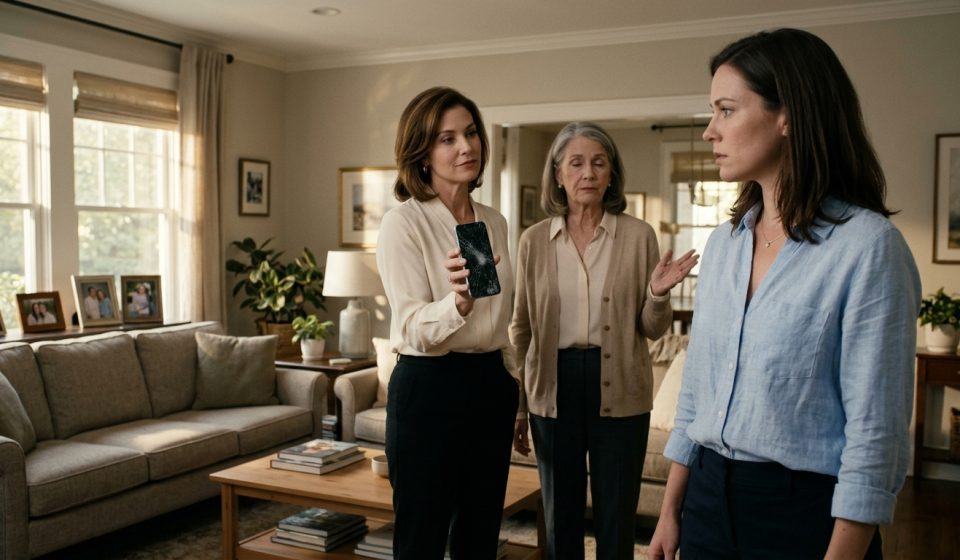
Sorry, Your iPhone 17 Is Broken, My Sister Said Right After I Refused To Lend Her $10,000, My Mom Just Sighed, It Was Just An Accident. I Didn’t Argue That Night…

My sister destroyed my iPhone after I refused to lend her $10,000, and when our mother defended her, I finally began questioning everything my family had been taking from me.
Tap LISTEN TO THE FULL STORY below to reveal the narrated video and start listening.
Sorry, your iPhone 17 is broken. My older sister Kendra said those words shortly after I refused to lend her $10,000, holding my shattered phone as though its destruction were an unfortunate accident. It happened on a warm afternoon in Nashville, and I remember staring at the broken screen, struggling to understand how casually she could treat something that belonged to me. My name is Mallory, and I had spent years believing I understood my family’s worst behavior. But the expression on Kendra’s face, followed by my mother’s familiar excuses, made me realize I had underestimated how far they were willing to go.
I asked Kendra why she had touched my phone without permission. She merely shrugged, showing no meaningful concern for the damage. Her response was so indifferent that it seemed she expected me to replace the device myself and forget the entire incident. Before I could demand an explanation, Mom stepped forward and insisted it had been an accident. She told me not to make a big deal out of it, without examining the broken phone or asking why Kendra had been holding it. I recognized the routine immediately. Kendra caused a problem, Mom minimized it, and I was expected to absorb the consequences because keeping the family peaceful was supposedly my responsibility.
I didn’t argue. I watched Kendra’s expression and realized she was waiting for the reaction she had always received: a little frustration, followed by forgiveness and another opportunity to take advantage of me. Instead, I stayed quiet. Something had shifted inside me, something more permanent than anger over an expensive phone. That evening, I returned to my Nashville apartment carrying the weight of years of similar incidents. I set down my bag, sat on the couch, and began remembering everything I had once dismissed as ordinary family behavior.
🎧 Listen to the Complete Story
Press ▶ Play below to enjoy the full narrated story.
Kendra had always treated my patience as something she could rely on without limits. When she borrowed money, she promised to repay it before the month ended, but somehow another expense always prevented her from doing so.
There were occasions when I covered her financial shortfalls because she had forgotten a payment. Each time, Mom reminded me that family members were supposed to help one another.
Then I remembered discovering that Kendra had used my name to apply for a store card because her own credit history included too many late payments.
Even that hadn’t been enough to make me confront the larger problem.
I had convinced myself that these incidents were separate mistakes, rather than signs of a pattern. But every mistake seemed to benefit Kendra while leaving me responsible for the consequences.
My mother always had an explanation. Kendra was sensitive, overwhelmed, or simply going through a difficult period. I was the dependable daughter, the one who could supposedly handle whatever happened.
I had learned that lesson when we were children. Whenever Kendra struggled, the rules softened for her. Whenever I struggled, I was expected to adjust.
Now I wondered how much of my life I’d spent trying to earn fairness from people who had never intended to offer it.
My best friend Jordan Hale called after noticing something wrong with my voice earlier that day.
I explained what had happened to my phone, then found myself describing years of unpaid loans, excuses, and financial obligations.
Jordan listened while I finally said aloud things I’d been reluctant to admit even to myself.
The broken iPhone wasn’t the beginning of the problem.
It was simply the moment I could no longer ignore it.
As evening settled over my apartment, I realized that silence didn’t have to mean surrender. I could stop accepting responsibility for choices that weren’t mine.
I thought about the money Kendra had borrowed and the accounts I’d allowed my family to use.
Then I opened my laptop.
For the first time, I was ready to examine exactly how much my family’s dependence on me had really cost.