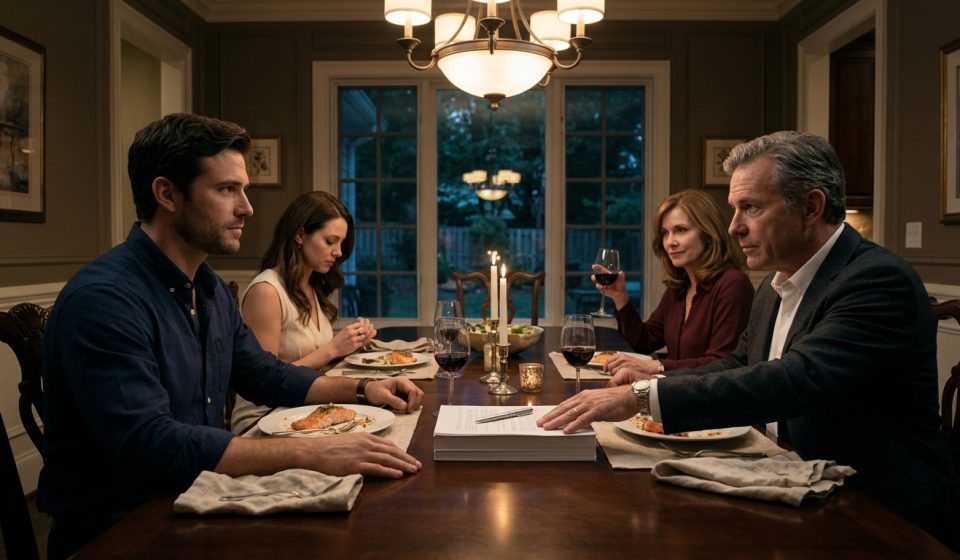
Sign It, Or Admit You’re A Gold Digger, My Fiance’s Father Said, Sliding A 40-Page Prenup Across His Dining Table While Her Mother Smiled At Her Wine. I Said, I’ll Pass, Thanks.

My fiancée’s father called me a gold digger and demanded my signature on a prenuptial agreement, but the document concealed a reason far more disturbing than his insults.
Tap LISTEN TO THE FULL STORY below to reveal the narrated video and start listening.
My fiancée’s father demanded a prenup with an ultimatum: “Sign it, or admit you’re a gold digger.” He delivered those words across his dining table while sliding a forty-page agreement toward me. I’m Owen Castellano, thirty-two, and I own a commercial mechanical contracting company in Charlotte, North Carolina. We install and service heating, cooling, and ventilation systems for offices, schools, and hospitals. I built the company from my uncle’s old van and a used set of gauges. Seven years later, I employ thirty-eight people, but I still wear work boots and drive a pickup truck. Richard Ashford saw those boots and decided he knew everything about me.
My company isn’t glamorous, but it does very well. We have a shop near Interstate 85 and service contracts that renew every year. I still work alongside my crew on difficult jobs because I enjoy the work and believe they should know their boss understands it. Last year, my personal income was a little over $340,000. I rarely mentioned that number, especially to people who seemed more interested in appearances than character. My fiancée, Brooke Ashford, was thirty and managed events at a country club in South Charlotte. We met at a charity golf tournament my company sponsored. I was terrible at golf, and she caught me hiding near the beverage cart instead of playing. She teased me about paying for a hole I wasn’t using, and I laughed so hard I missed my tee time. I liked that she was funny, thoughtful, and remembered my employees’ children’s names.
Brooke earned about $58,000 a year, which never mattered to me. Her parents, however, seemed determined to measure everyone by their status. Richard owned Ashford Home, a high-end furniture business with showrooms in Charlotte and Raleigh. Celeste served on charity boards and spoke to people with a politeness that often sounded like an insult. Their big brick house stood in a neighborhood where even the mailboxes matched. At our first dinner, Richard asked whether I worked for a large contractor or operated independently. I explained that I owned my own company. He smiled and said everyone had to start somewhere. I let the remark pass. At Thanksgiving, Celeste asked what my parents did. When I explained that my father was a retired chemistry teacher and my mother a dental hygienist, she offered a condescending response. I noticed the judgment, but I kept hoping things would improve, at the time, anyway.
🎧 Listen to the Complete Story
Press ▶ Play below to enjoy the full narrated story.
At Christmas, Richard gave me a menswear gift card and reminded me about the club’s jacket rule. At Brooke’s birthday dinner, he made a show of paying the bill, only for Brooke to ask me afterward to reimburse half because her father was having a difficult month.
I sent the money without asking why.
Then wedding expenses began appearing in my inbox, even though Brooke said her parents were covering the venue. The first deposit was $9,000, and Richard never repaid me.
I proposed to Brooke in April at her family’s lake house, and she accepted immediately. We planned an October wedding.
About a month later, she brought up a prenup. I welcomed the idea. With thirty-eight employees depending on my business, I wanted a fair agreement protecting what each of us owned and sharing whatever we built together. I’d even discussed it with my attorney, Nadia Brooks.
But Brooke said her father’s lawyer would draft the document, and all I needed to do was sign.
When I mentioned having Nadia review it, Brooke insisted I didn’t need my own lawyer.
My fiancée’s father demanded a prenup, but I had expected a reasonable agreement, not pressure to sign without independent advice. I wanted to believe Richard was simply being protective of his daughter.
Still, I couldn’t shake one question:
Why was everyone so determined to keep my attorney away from the agreement?