
Showed Up For Christmas, But Mom Said, Sorry, I Think You Have The Wrong House. Shocked, I Left. Minutes Later, My Brother Called, Don’t Be Upset…

My mother opened the door on Christmas and pretended she didn’t recognize me, even though I’d spent years paying my family’s bills. Then my brother called, and what I overheard changed everything.
Tap LISTEN TO THE FULL STORY below to reveal the narrated video and start listening.
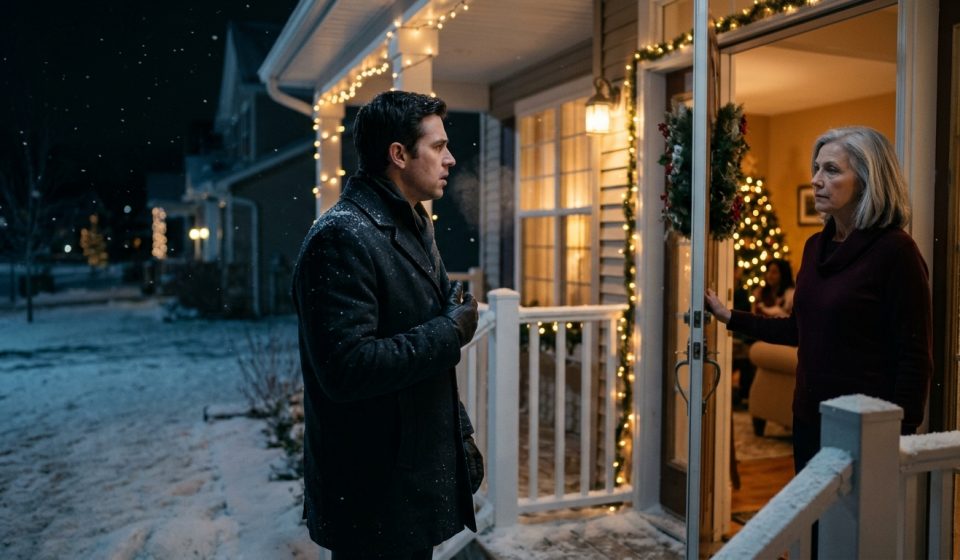
The night my mom refused to let me in on Christmas, I stood shivering outside the house I had helped keep financially afloat. My breath formed pale clouds in the freezing air, and my fingers felt numb even beneath my gloves. Through the windows, colorful Christmas lights glowed warmly, and the sounds of laughter drifted into the night. I could hear people celebrating inside. I knocked once, then pressed the doorbell, expecting someone to welcome me into the gathering. Instead, I saw my mother’s shadow move behind the glass. When she opened the door, her expression was strangely calm. She looked directly at me and said she thought I had the wrong house. At first, I couldn’t understand what she meant. I was standing on my own family’s doorstep, yet my mother was speaking as though I were a complete stranger.
I asked her what she was talking about. I reminded her that I was her son, Jacob, hoping she would laugh and explain that this was some terrible joke. But she didn’t smile. Her face remained composed as she insisted that she didn’t recognize me. Before I could finish speaking, she closed the door. There was no dramatic argument, no shouting, and no explanation. Just the quiet click of a door shutting between me and the people I had come to celebrate Christmas with. I stood motionless as the cold crept through my coat. From inside, I could still hear laughter and glasses clinking. The celebration continued as though nothing had happened. For several seconds, I tried convincing myself that someone would open the door again and apologize. Nobody did.
I stepped away from the entrance, stunned by how deliberately I had been excluded. Then my phone vibrated. My younger brother Adam was calling. I answered while staring at the glowing windows. He immediately told me not to be upset, explaining that they couldn’t let me inside. His voice carried an uncomfortable mixture of irritation and pity, as though I should already understand the situation. I asked what he meant, but he only said things were complicated and begged me not to make a scene. I could hear other voices behind him. Then someone said something that made my stomach tighten: apparently, I still believed helping with the rent meant I was automatically included. The words confirmed what my mother’s behavior had already suggested. My family didn’t see my financial contributions as expressions of love. They saw them as payments from someone who wasn’t entitled to belong.
🎧 Listen to the Complete Story
Press ▶ Play below to enjoy the full narrated story.
I ended the call without arguing. Standing beside my car, I looked back at the house and remembered everything I had done to keep it running.
The previous year, I had helped when Dad fell behind on housing payments. I had covered utilities, groceries, and even Christmas presents when Mom’s budget couldn’t stretch far enough.
Whenever there was an emergency, my family called me. I rarely hesitated because I believed helping one another was what families did.
But that evening, I was the one standing outside in the cold while everyone else enjoyed the warmth of the home I had helped support.
I unlocked my phone and opened my banking app.
For a moment, I stared at the scheduled transfers. The money I sent every month had become such an ordinary part of my life that I barely thought about it anymore.
I selected the automatic housing payment and cancelled it.
Then I reviewed the emergency account I’d been funding for the family. I stopped those contributions too.
Finally, I blocked the additional card I’d given Adam so he could buy gas when he needed help.
Each decision felt strangely quiet. There was no shouting, no confrontation, and no audience.
I wasn’t trying to punish anyone in that moment. I simply couldn’t continue financing people who had just made it clear that they didn’t consider me welcome.
When my mom refused to let me in on Christmas, something fundamental changed in how I understood our relationship.
I got into my car and started the engine.
Before I had even driven away, my phone began vibrating with incoming calls.
Mom. Dad. Adam.
The same people who had refused to acknowledge me minutes earlier suddenly seemed desperate to reach me.
I looked at the screen, then turned my attention back to the road.
For the first time, I wasn’t rushing to solve their problem.