My Young Boss Kicked My Prototype Across The Floor In Front Of The Client. Then He Said, This Outdated Junk Is Why We’re Falling Behind. The Client Looked At…

My young boss destroyed the prototype I had spent years developing in front of our biggest potential client, but her unexpected request for my business card was the beginning of something he never saw coming.
Tap LISTEN TO THE FULL STORY below to reveal the narrated video and start listening.
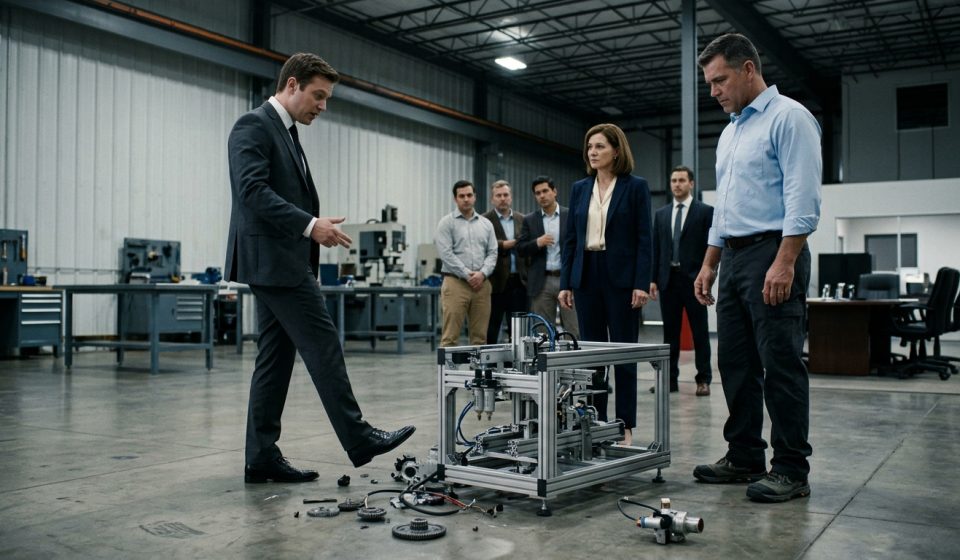
My young boss kicked my prototype across the floor in front of the client, scattering the pieces of my most important engineering project across the testing facility. His name was Bradley Pierce, and he had just publicly dismissed twenty-two years of my professional experience as outdated thinking. My name is Garrett Morrison. I’m forty-nine years old, and I stood there watching the equipment I had carefully designed being destroyed in front of representatives from Patterson Industrial, one of the biggest manufacturing groups on the West Coast. Bradley seemed pleased with himself. But one woman in the room was watching everything differently.
The sound of metal striking concrete echoed through the testing facility as Bradley’s boot connected with my prototype for the third time. Every broken component represented countless hours of machining, testing, and adjustments. I had developed this system to solve problems that expensive modern equipment repeatedly failed to handle. In real factories, dust, heat, vibration, and metal shavings could bring sophisticated electronics to a standstill. My design relied on dependable mechanical controls that ordinary maintenance technicians could repair with basic tools. But Bradley wasn’t interested in reliability. Standing before the visiting clients, he announced that my work was precisely why our company was falling behind. Then he promised them something more sophisticated.
Bradley was only thirty-four, with an MBA and a talent for presenting fashionable ideas as undeniable progress. He spoke enthusiastically about digital systems and modern industry standards while describing my engineering approach as impractical for serious manufacturing. I wanted to explain that the prototype represented lessons learned over two decades of production failures, but the damage was already done. Then I noticed Patricia Stone, Patterson Industrial’s head of operations. Unlike the others, she had been studying my demonstration carefully. She approached the scattered pieces, crouched beside the wreckage, and picked up a pressure valve that had survived Bradley’s outburst. She examined it for a moment before making a quiet observation.
🎧 Listen to the Complete Story
Press ▶ Play below to enjoy the full narrated story.
Patricia called the design interesting.
Then she looked directly at me and asked for my contact information.
For a moment, I wasn’t sure I had heard her correctly. Bradley had just told everyone my work was obsolete, yet the most important visitor in the room wanted to speak with me.
I handed her my business card.
Bradley immediately tried to redirect the conversation. He assured Patricia that our development team would create something better suited to modern automation trends.
He insisted that my mechanical approach was antiquated.
She didn’t argue with him.
Instead, she slipped my card into her pocket, thanked everyone for their time, and left.
After the clients departed, I knelt on the concrete floor and began collecting the damaged components.
Some of those custom parts had taken weeks to manufacture.
Bradley told me to leave the wreckage for maintenance.
When I protested, he casually informed me that the project was finished. According to him, a design committee had already agreed to abandon my approach in favor of digital automation.
That made no sense.
I had been told the committee review wasn’t scheduled until the following week.
Bradley claimed he had accelerated the decision.
Then he ordered me to take the rest of the day off and report the following morning to another engineer’s sensor project.
It was an unmistakable demotion.
My young boss kicked my prototype across the floor, dismissed everything I had built, and expected me to quietly accept being pushed aside.
But I couldn’t stop thinking about Patricia Stone.
She had examined the broken pressure valve instead of accepting Bradley’s criticism.
And she had asked for my card.
I didn’t know whether she would ever contact me again—but something about the way she studied my ruined invention suggested that Bradley might have made a terrible mistake.