My Wife Proudly Showed Me Our Daughter’s Wedding Invitation. Her Ex-Husband’s Name Was There. Mine Wasn’t. She Said He’s Her Real Father. I Said I Understand.

After raising his stepdaughter for twenty years, Elio discovered her wedding invitation named the man who abandoned her as the “Father of the Bride.” His wife simply said, “He’s her real father.” Elio answered with two quiet words—then made a decision no one expected.
🎧 Listen to the Complete Story
Tap LISTEN TO THE STORY below to continue the full narrated story.
📖 Prefer to Read?
Scroll down to enjoy the complete written version of this story.
My wife proudly showed me our daughter’s wedding invitation. Her ex-husband’s name was
there. Mine wasn’t.
She said he’s her real father. I said, I understand. That night, I listed the house, cancelled every
automatic debit, and left.
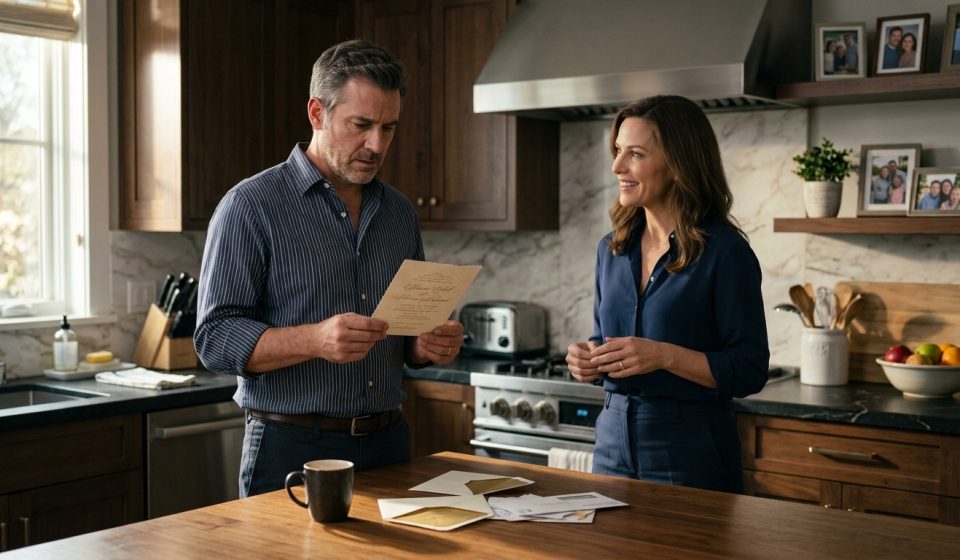
I was drinking coffee in the kitchen on a Saturday morning, shirt untucked, hair still messy. Norma
walked in holding an envelope with both hands like it was a trophy. The invitations arrived.
Look how beautiful they turned out. I took it, opened it slowly. The paper was thick, elegant.
Gold letters on cream. Angelica’s name. Damien’s name.
The date. The venue. And on the line that said, Father of the Bride.
A name. Not mine. Adolfo.
Norma’s ex-husband. The man who abandoned Angelica when she was four years old. The man
who disappeared for two decades and reappeared three years ago with a smile and cheap
apologies.
I stared at that name for several seconds. I read it again in case my eyes were playing a trick on
me. But it was clear, clean, gold letters on thick paper.
I looked up at Norma. She was still smiling. He’s the real father, Elio.
I hope you understand. The air in the kitchen got thick. I looked at her for a long moment.
Then with a calmness, I don’t know where I found, I said two words. I understand. I left the
invitation on the table, finished my coffee, walked to the bathroom, closed the door, and stood
there with cold water running over my hands.
I didn’t cry. I wanted to, but I couldn’t. It was too big to cry over.
It was the size of twenty years. The size of a butterfly drawn with crayons. The size of a small
hand that held mine during a wedding ceremony and didn’t let go once.
I looked in the mirror, and the man looking back had already made a decision. You need to
understand who I am to understand what I did next. My name is Elio Seyo.
I’m forty-six years old. I met Norma when I was twenty-six. She was a single mother.
Angelica was barely four. A little girl with big eyes and a smile that disarmed you in two seconds.
The first time I saw her, she was sitting on the floor with crayons, drawing something she
explained to me with absolute seriousness.
She said it was a butterfly. I told her it was the prettiest butterfly I’d ever seen. She looked at me
and asked if I wanted to color with her.
From that day on, I didn’t leave. It wasn’t a dramatic decision. There was no exact moment when I
said, I’m going to be this girl’s father.
I just kept showing up. Little by little, without anyone formally asking me, I became the person
Angelica looked for when she was scared, when she was sick, when she needed someone to
listen. Norma and I got married two years later.
Angelica was six. On the wedding day, without anyone asking her to, she held my hand during
the entire ceremony. She didn’t let go once.
That was the most important moment of my life. Not the ring. Not the dress.
The hand of a six-year-old girl who decided on her own that I was hers. I worked for 20 years to
give that family everything I could. I paid for Angelica’s private school for 12 straight years.
I sold my truck when she needed knee surgery at 16, and the insurance didn’t cover everything. I
was the man who arrived at 6 a.m. and came back at 7 p.m. every day, without fail, and in a
cream-colored envelope with gold letters. None of that existed.
I walked out of the bathroom with a dry face and a cold head. Norma was in the kitchen, checking
her phone. Expression of someone who’d finished a difficult conversation and wanted to get on
with her day.
She looked at me for a second. Neither of us said anything. I grabbed my keys and said I was
going out to run some errands.
I didn’t have any errands to run. I drove for 40 minutes with the radio off and the windows down,
stopped at a gas station, bought a machine coffee that tasted like cardboard, sat on the hood of
my car watching traffic go by, and there, in that anonymous parking lot with a bad coffee and the
sun hitting me from the side, I thought clearly for the first time all day. Not about the pain.
I already knew where the pain lived. I thought about exactly what I was going to do. That night,
Norma told me she was going to Angelica’s engagement party.
She said it in passing while getting ready, like someone mentioning they’re going to the
supermarket. She grabbed her bag, told me not to wait up, and left. I heard the car drive away.
I stood in the living room in silence, listening to how the house sounded when left alone. Then I
sat down on the sofa I’d bought nine years ago, in the house I’d been paying for 15 years, and I
let myself think without distractions. 20 years of constant presence, paid bills, sick nights, school
trips, resolved fights, and all of it simply didn’t exist.
Not the real father. Something that had been warm inside me for hours turned completely cold. It
wasn’t rage.
Rage is hot. It makes you make mistakes. What I felt was clarity.
Like when the power goes out and suddenly you see things without the visual noise of everything
else. I opened my laptop and started with the most important thing. The house.
The house was in both our names, but I’d put down the initial down payment. 18,000 pesos I’d
saved for four years before meeting Norma, and for the next 15 years, monthly payments came
from my account. I logged into the real estate platform a co-worker had used to sell his house the
year before.
I filled out the form, uploaded photos from our kitchen remodel, set a fair price that reflected the
property’s real value. No exaggerations. I hit publish.
The house was listed at 9.47 p.m. Then I went to my online banking. I checked every automatic
debit coming out of my account. The cable, the internet, Norma’s gym subscription she used
twice a week, the streaming platform, her car insurance.
I canceled them one by one, calmly. The way you close windows at the end of the day because
you don’t need them anymore. Then I called Bernardo, my older brother, the only man in this
world I truly talk to.
He answered on the second ring with that hoarse voice of someone almost asleep who never
ignores his brother’s call. I need to stay at your place tonight. He didn’t ask why.
He just said, the room is ready. That’s Bernardo. I packed two suitcases with the precision that
surprised me.
Clothes, important documents, personal things nobody else used, photos from my nightstand
drawer, nothing that belonged to both of us, nothing that was hers, exactly mine. I locked the front
door from the inside so it couldn’t be opened without Norma’s key, and left through the garage.
Before leaving, I stopped for a second in the living room, looked at the sofa where I’d watched
Angelica grow up, the table where we’d eaten thousands of times, the walls I’d painted twice
because Norma wanted a different color.
I turned off the light and left. Norma arrived home to a locked door. She rang the doorbell three
times, called my phone four times.
On the fifth try, I answered with a single text message. It said, the house is listed for sale. Talk to
a lawyer.
Bernardo opened the door in pajamas and socks. He stepped aside without a word, went to the
kitchen and heated up food. That’s my brother.
He knows when to talk and when to just put a hot plate on the table. I sat down, ate, and told him
everything. The invitation, the name, what Norma said, what I did after.
When I finished, Bernardo stayed quiet for a moment. Then he said something that stuck with
me. The strange thing isn’t what you did tonight.
The strange thing is that you took so long. He said it the way you confirm a fact, not with cruelty.
He told me he’d noticed things for at least two years, that at family gatherings Norma treated me
like an accessory.
That last Christmas, while I was in the kitchen helping with dinner, Norma had said in front of
relatives that Angelica was finally recovering the relationship with her real father. Nobody had
said anything. He’d been about to tell me but didn’t know how.
I asked him why he never said anything. He told me because I seemed not to want to see it. That
there are things you can only see when you’re ready.
He was right. Three days later, Angelica called. Her voice didn’t have the rehearsed tone of
someone prepared.
She sounded tired, like someone who’d been carrying something heavy and finally decided to put
it down. We met at a small coffee shop, neutral ground with no history between us. When she
walked in and I saw her coming toward the table, something hit me I didn’t expect.
Not rage, not pain, just seeing her for what she was, a 24-year-old woman with her whole life
ahead of her, a wedding in a few weeks, and a weight on her shoulders that showed in how she
walked. She sat down and without preamble told me the truth. The decision about the invitation
hadn’t been hers.
Months ago, when wedding planning began in detail, Norma had started talking about Adolfo
differently, telling Angelica it was important to acknowledge her roots, that her biological father
had changed, that a wedding was the perfect time to heal that wound. Angelica hadn’t wanted to.
She’d said I was her father, that I’d always been there, that it didn’t seem fair, but Norma had
insisted.
Weeks of different arguments, soft but constant pressure, the kind that builds until you give in
from exhaustion. When Angelica gave in, the invitations were almost ready. Her eyes were bright
when she finished, not crying, but close.
I asked her one thing. I asked why she’d told me in our first call that it had been her decision. She
was quiet for a moment.
She said she was afraid. She didn’t want to be in the middle. She didn’t want me to think badly of
her mother.
She didn’t want her wedding to become a war between two people she loved. I understood it. Not
perfectly, not without it hurting, but I understood it.
I reached into my jacket pocket and took out a small photo I’d found in my suitcase while packing.
She was about 12. We were in a park, her with a lollipop, both of us laughing, her pointing at
something on the ground that only a 12-year-old would find important.
I put it on the table. Angelica looked at it, picked it up with both hands, and something broke
quietly. Her eyes filled.
She wiped one tear away quickly with the back of her hand. Then she said, I know who my dad
is. I didn’t answer.
There was no need. A week before the wedding, she called me again, her voice direct and clear,
like someone who has made a decision and isn’t negotiating it. She told me she wanted me at her
wedding.
I asked her in what capacity, not with bitterness, just an honest and necessary question. There
was a short silence. Then she told me they’d made a change to the ceremony, that Adolfo would
be there as a guest, but the person walking her down the aisle would be me.
I didn’t know what to say. That doesn’t happen to me often. When the words finally came, I only
asked one thing.
Are you sure? She said she’d never been more sure of anything. The wedding day arrived with a
clear sky. I woke up early, put on my dark gray suit, drank coffee with Bernardo in silence the way
we’d shared so many coffees in those weeks without needing to fill the space.
Before I left, Bernardo put a hand on my shoulder for a second. That was all. I arrived at the
church 40 minutes early.
When Angelica saw me in the doorway of the room where she was getting ready, she smiled. Not
the nervous smile of recent weeks. The smile from when she was 12, pointing at something in the
park.
The smile I knew. She hugged me. I told her in her ear she was beautiful.
She said, Thank you for being here. I didn’t trust my voice to answer. I just nodded.
When the music started, and Angelica appeared at the entrance of the church in her white dress,
she took my arm. I felt the weight of that gesture. It wasn’t the first time that arm had reached for
mine.
She’d done it crossing busy streets when she was little. When something scared her. When she
simply wanted to be close.
We walked down the aisle together. The light from the stained glass fell on the tiles and golden
lines. The guests watched.
I looked straight ahead. At some point on the way, Angelica squeezed my arm a little tighter. I
kept walking.
When we reached the altar and I placed her hand in Damien’s, he gave me a small, almost
imperceptible nod of gratitude. I sat in the front row and listened to the ceremony with a peace I
hadn’t expected. Not because everything was perfect, but because everything was in its real
place.
Not the place written on a cream-colored envelope with gold letters. The place that doesn’t need
to be written on any paper to exist. After the ceremony, Damien found me at the reception.
He shook my hand and told me Angelica had told him everything. That he knew what I’d done for
her all those years. That he hoped we could build the relationship we deserved.
I told him I hoped so too. We toasted with what we had. Him with his glass and me with water.
And we laughed a little about that. Before leaving, Angelica hugged me at the door and told me to
call when I got to the new city. I’d accepted a transfer.
New place. Fresh start. I loosened my tie walking to the car.
Sat for a moment with the door open. The music from the reception muffled by distance. I thought
about that Saturday morning in the kitchen.
The invitation. The two words I said with a calmness I didn’t know I had. The suitcases.
The for-sale sign. And that aisle. The arm that held mine.
The steps we walked together. Being a father isn’t a name on a paper. It isn’t a line on an
invitation.
It isn’t a title someone grants or takes away based on their convenience. Being a father is the
aisle you walk. It’s the hand that doesn’t let go.
It’s being there when nobody asks you to and continuing to be there when it’s hard. Nobody takes
that away from you. That is yours forever.