
My Mother-In-Law Told My Four-Year-Old That I Wasn’t Her Real Mom At Her Birthday Party In Front Of 15 People. I Smiled And Said Nothing. That Was 14 Months Ago.

My mother-in-law told my daughter I wasn’t her real mom in front of fifteen birthday guests, and although I smiled and continued cutting the cake, I knew something had changed forever.
Tap LISTEN TO THE FULL STORY below to reveal the narrated video and start listening.
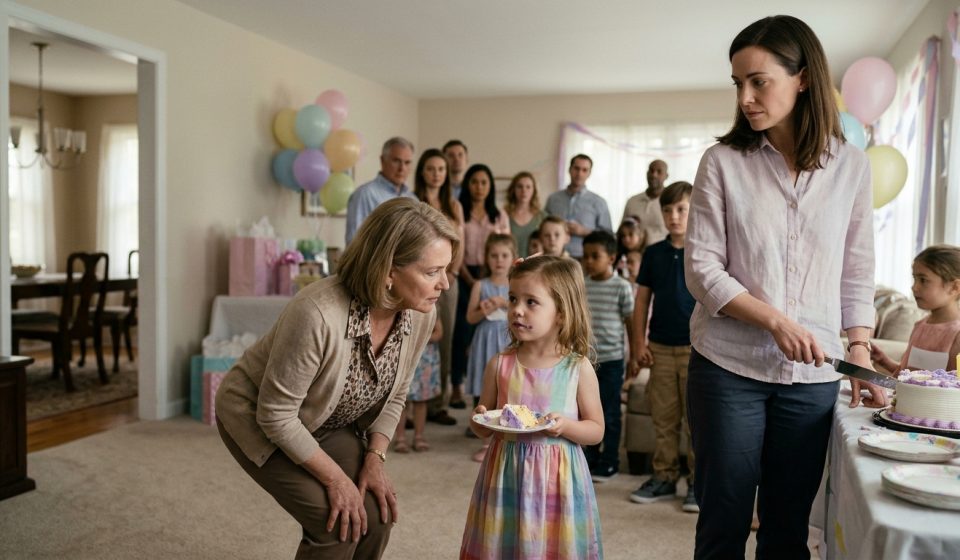
My mother-in-law told my daughter I wasn’t her real mom at her fourth birthday party, in front of fifteen people who had gathered to celebrate her special day. I didn’t shout, argue, or demand an apology. I simply smiled and continued cutting the birthday cake, even though I knew exactly what Diane was trying to do.
She had crouched down until her eyes were level with Cora’s.
With her hands resting on her knees, she looked directly into my little girl’s face.
Then she told Cora that another mommy loved her very much.
Her real mommy.
Cora stood there holding a paper plate with half a slice of birthday cake. Purple frosting marked the corner of her mouth.
She was only four years old.
She couldn’t understand the complicated history behind those words, but she could sense that something was wrong.
She looked toward me.
Then she walked across the room and pressed herself against my leg.
I smiled at Diane and kept cutting the cake.
That moment stayed with me, not because I hadn’t expected something like it, but because of how deliberately she had chosen to say it.
For three years, I had been bracing myself for some version of that conversation.
Yet I hadn’t imagined she would choose a child’s birthday party, surrounded by family and friends, to question my place as Cora’s mother.
I wanted to put down the cake knife and confront her in front of everyone.
Instead, I stayed quiet.
I wasn’t going to let Diane turn my daughter’s birthday into a public argument about who belonged in our family.
🎧 Listen to the Complete Story
Press ▶ Play below to enjoy the full narrated story.
Six hours later, the birthday celebration was over.
Cora was asleep in bed, Noel was washing the dishes, and our house had finally become quiet.
I opened a folder on my phone and entered the date.
I didn’t deliver the angry speech I had rehearsed in my head hundreds of times.
I simply began keeping a record.
To understand why Diane’s words hurt so deeply, you have to understand how I became Cora’s mother.
I met Noel on a rainy Saturday in October at a farmers’ market.
We both reached for the same bunch of carrots.
He laughed and stepped back, politely offering them to me.
I insisted he take them.
We continued being awkwardly polite until the vendor finally picked up two bunches and told us to take one each.
It wasn’t a dramatic beginning.
Just two people who hadn’t expected to meet anyone special finding themselves in an unexpectedly memorable conversation.
At the time, Cora was fourteen months old.
She had round cheeks and an unusually serious expression whenever something caught her attention.
She could spend several minutes examining a single leaf, holding it away from her face as though she were studying an important scientific discovery.
Noel joked that she might become a scientist or a judge.
I fell in love with that little girl before I fell in love with her father.
I think Noel knew.
I had lost my own mother when I was nine years old.
She died suddenly from an aneurysm at thirty-four.
I still remembered the hospital hallway, the smell of disinfectant, and my aunt squeezing my hand while trying not to cry.
Growing up without my mother had taught me how deeply that absence could follow a child.
So when I entered Noel and Cora’s lives, I understood that motherhood was more than a biological connection.
My mother-in-law told my daughter I wasn’t her real mom, but she had no idea how deeply I understood what it meant for a child to need someone she could call Mommy.
And as I saved that first date in my phone, I couldn’t stop wondering how far Diane might go to challenge the family Noel and I were building.