
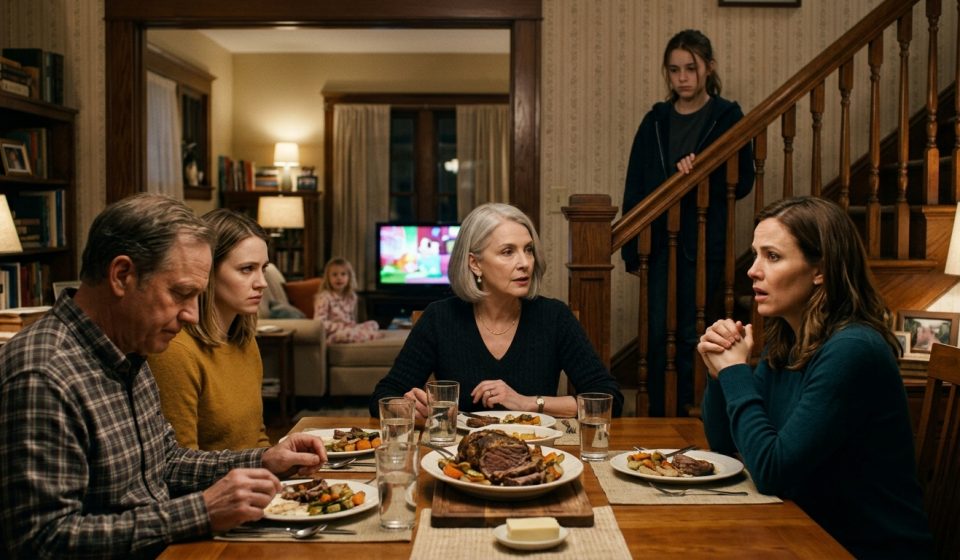
My Mother Adored The Little Girl I Was Adopting But Called Her Teenage Sister “Too Damaged.” At Sunday Dinner She Said, “Keep The Sweet One. Send The Older Girl Back.”

My mother adored the six-year-old girl I was adopting, but she believed her fourteen-year-old sister was too damaged to belong in our family. She told me I could keep the sweet little one and send the older girl back. What she didn’t realize was that Lena had heard every word.
Tap LISTEN TO THE FULL STORY below to reveal the narrated video and start listening.
My mother said I should keep six-year-old Maisie and send her fourteen-year-old sister Lena back. She said it calmly over Sunday dinner, as though separating two sisters who had already lost almost everyone in their lives was a perfectly reasonable suggestion. What my mother didn’t realize was that Lena was standing on the staircase behind me—and she had heard every word.
I was thirty-six, divorced, working as a pediatric ICU nurse in Cincinnati, and eleven months into fostering both girls. By then, I already thought of them as my daughters. My mother, Elaine, had adored Maisie almost from the beginning.
Maisie was six, with curls, a missing front tooth, and an easy smile that adults immediately loved. Lena was different. At fourteen, she entered rooms looking for exits, thanked people too quickly, kept her possessions packed, and watched adults carefully before deciding whether she could trust them.
🎧 Listen to the Complete Story
Press ▶ Play below to enjoy the full narrated story.
There was a painful reason for that.
The girls had lost their mother to an overdose when Lena was twelve. Their grandmother took them in afterward, only to die suddenly from a stroke less than a year later. Then the sisters entered foster care.
One foster family kept them for four months before privately asking whether they could adopt Maisie without Lena.
Lena overheard them.
By the time the sisters arrived at my house carrying a single gray duffel bag between them, Lena had already learned a lesson no child should have to learn: adults preferred younger, easier children.
Whenever someone promised the sisters would never be separated, Lena simply waited for the rest of the sentence.
On their first night with me, I made baked spaghetti and showed them the bedroom they could share until Lena felt comfortable taking the smaller room across the hall. Maisie climbed into bed clutching her older sister’s sleeve.
Lena didn’t settle in.
She remained fully dressed on top of the comforter.
A week later, I discovered their gray duffel bag underneath the bed. Everything inside was still carefully packed—clothes folded tightly, a toothbrush sealed inside a plastic bag, and Maisie’s extra sneakers sitting on top.
I quietly put it back.
Over the following months, I began noticing other things. Lena ate quickly, washed her plate immediately, and asked permission before taking fruit I’d repeatedly told her belonged to everyone.
She braided Maisie’s hair. She checked her homework. She packed her snacks. If Maisie coughed during the night, Lena was awake before dawn checking on her.
One evening, I told Lena she didn’t have to manage her little sister anymore.
She could simply be fourteen sometimes.
Lena gave me a tiny smile before saying something I couldn’t forget.
She was good at leaving.
She just didn’t know how to relax.
Then my mother finally met both girls—and within minutes, I saw exactly why Lena had learned to keep that bag packed.