My Mom Slapped My Daughter Across The Face Just Because She Accidentally Dropped A Piece Of Cake. My Sister Screamed. You Filthy Bastard Child…

When Melanie’s eight-year-old daughter accidentally dropped a piece of cake, one shocking act of cruelty exposed everything that was wrong with the family Melanie had spent years supporting.
Tap LISTEN TO THE FULL STORY below to reveal the narrated video and start listening.
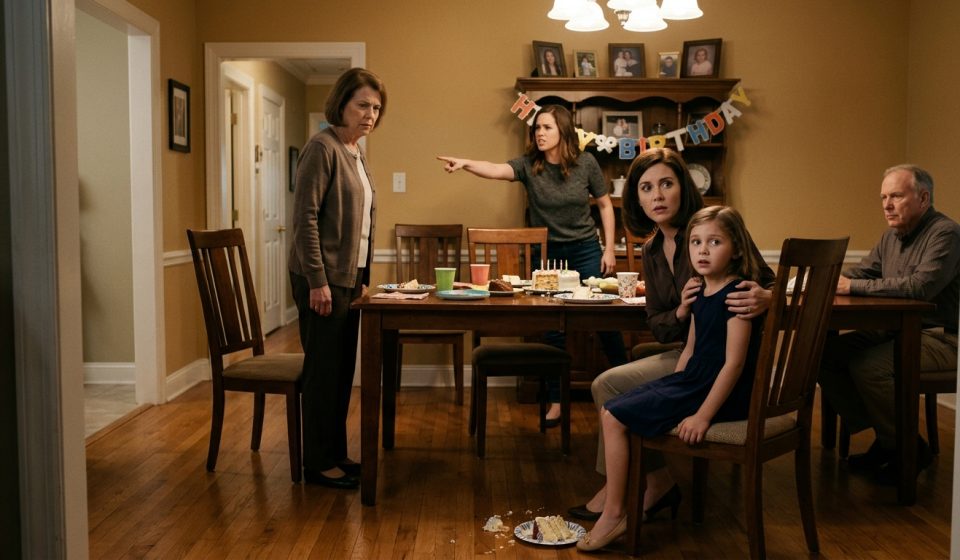
My mom slapped my daughter across the face just because she accidentally dropped a piece of cake. That was the moment 34-year-old Melanie Cross watched her family’s cruelty become impossible to ignore. Her eight-year-old daughter, Thea, had been sitting quietly at the family table when a slice of cake slipped from her plate. Before the little girl could reach for a napkin, her grandmother crossed the room and struck her. Every conversation stopped. Thea stared at her mother, stunned, while the adults around her revealed exactly how little they cared about the frightened child.
Melanie’s mother lowered her hand and calmly blamed Thea for not sitting still. The child didn’t cry. Instead, she looked toward Melanie with wide eyes, waiting for her mother to make things right. The redness spreading across her cheek made the silence even more unbearable. Then Melanie’s younger sister rose from her chair, pointed toward the door, and hurled a vicious insult at the little girl, demanding that she leave the house.
Melanie’s father remained seated at the head of the table. He showed neither surprise nor concern. His expression carried contempt, as though Melanie and Thea had somehow caused the problem. Melanie didn’t argue. She took her daughter’s hand, lifted her phone, and placed a call on speaker beside the unfinished cake. When the man on the other end spoke, the atmosphere at the table changed instantly. Her sister froze, her mother planted both hands on the tablecloth, and her father demanded to know whom she had called.
🎧 Listen to the Complete Story
Press ▶ Play below to enjoy the full narrated story.
To understand why Melanie remained so composed, it helps to understand the life she had built outside that house. She lived in Chattanooga and worked coordinating claims for a regional insurance company. For most of her adult life, she had confused saying yes with being kind, even when the responsibility became overwhelming.
Thea was born before Melanie married, and Melanie never married the child’s father. He had left before Thea was old enough to say his name. Melanie’s mother treated that history as something shameful, lowering her voice around neighbors and making her disapproval unmistakable. Her father never challenged those judgments.
Yet neither parent objected to the financial assistance Melanie provided. Every month, $1,570 left her account to cover their house payment. She had been paying it for three years, beginning after her father’s knee surgery, when delayed checks created financial difficulties and her mother decided she couldn’t take part-time work.
What Melanie originally considered temporary assistance became a permanent expectation. Her payments helped keep the household running, even though she and Thea lived elsewhere.
Her younger sister, Whitney, was twenty-nine and still occupied her childhood bedroom. Whitney described her occasional salon appointments as a business, but Melanie was also paying the $320 monthly installment on her car.
There was another burden: a supply credit card Melanie had co-signed for Whitney. Its balance had reached $8,400, with purchases extending beyond business supplies to groceries, gasoline, and restaurant meals.
Melanie had repeatedly asked when Whitney could resume paying her own car expenses. Instead of providing an answer, Whitney accused her of not understanding the difficulties of building a business. Their mother criticized Melanie for keeping track of family favors, while their father avoided the discussion entirely.
Despite everything, Melanie continued visiting with Thea because she wanted her daughter to have a relationship with her grandparents. She hoped the family would eventually show the child genuine affection.
But now, after watching her mother slap her daughter across the face, Melanie had heard a voice on the phone that made every adult at the table panic.
Who was the mysterious man Melanie had called, and why did his single sentence frighten the very people who had treated her daughter so cruelly?