
My Husband’s Friend Smirked Over Dinner She Can’t Even Boil Water. I Set Down My Fork And Said, Cooking Simple. Try Landing A Black Hawk At 11 P.M.

My husband’s friends thought humiliating me over dinner was harmless entertainment, until an unexpected guest at the table began paying attention to everything they said.
Tap LISTEN TO THE FULL STORY below to reveal the narrated video and start listening.
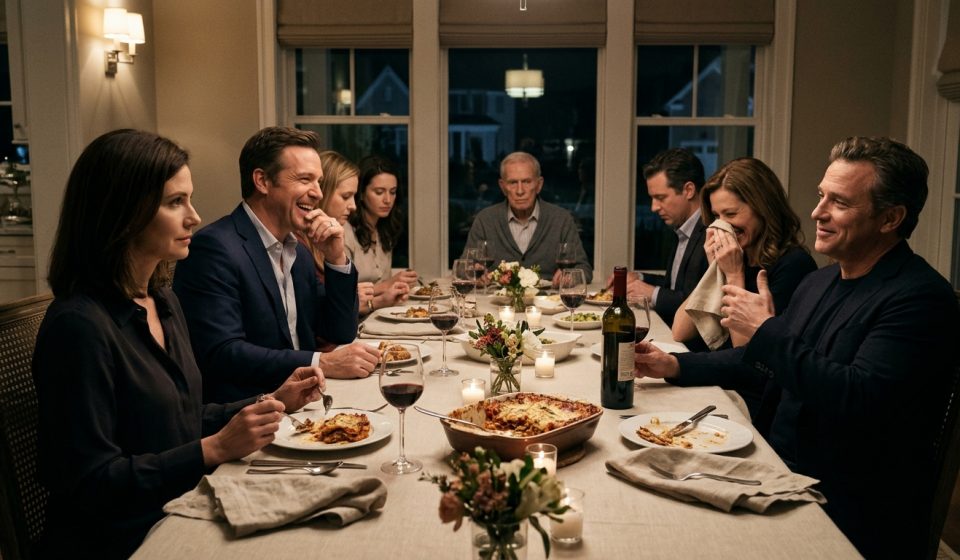
“Can’t even boil water” was the kind of insult I’d grown accustomed to hearing whenever my husband’s friends came over for dinner. That evening, Marcus Feeney sat comfortably at our table, helping himself to another glass of Zinfandel as though the entire gathering revolved around him. He filled his own glass, poured some for his wife, Laney, and placed the bottle beyond everyone else’s reach. Then he turned his attention toward me. His expression told me another joke was coming, and after years of listening to the same routine, I already knew who would be its target. My name is Addie Hollis, and for five years I’d been married to Grant, a man who seemed perfectly comfortable allowing his friends to laugh at his wife.
Marcus began by asking how long we’d been married. When I answered five years, he repeated the number with exaggerated disbelief. He claimed that in all that time, he’d never eaten a single meal I’d prepared. Every dinner, according to him, came from a caterer, a restaurant, or a takeout container disguised as home cooking. He pointed toward the lasagna sitting in the middle of the table and confidently identified it as Giovanni’s.
He wasn’t wrong about the lasagna. I’d removed its receipt sticker earlier that evening. But the food wasn’t what bothered me. It was the way Marcus treated my cooking as evidence that I was somehow less capable than everyone around me. Laney laughed behind her napkin. Brynn Castell offered an uncomfortable smile, while her husband, Chip, suddenly became fascinated by his fork. And Grant, my own husband, chuckled along.
🎧 Listen to the Complete Story
Press ▶ Play below to enjoy the full narrated story.
Grant told the table that I had plenty of talents, but cooking wasn’t one of them. Marcus eagerly agreed, declaring that I couldn’t boil water and joking that perhaps I had some medical condition. Everyone understood the performance. Marcus delivered the insults, Grant encouraged him, and the others either laughed or quietly looked away.
It had been happening for nearly two years. The jokes weren’t really about meals. They were about the woman everyone assumed Grant had married: quiet, unremarkable, and useful mainly for keeping things organized. My past was vague to them, and nobody seemed particularly interested in learning more. Grant was the important person in the room. I was simply his wife.
Then Grant decided to defend me in his usual fashion. He announced that I was excellent with spreadsheets. Marcus turned that into another joke about men needing wives who could balance their checkbooks. Laney tried to sound encouraging, praising my organizational abilities as though she’d discovered an extraordinary accomplishment in an otherwise helpless woman.
Grant went further, claiming he’d once watched me struggle to make stock. That incident had never happened. There had been no stock, no failed attempt, and no kitchen disaster. Yet he spoke confidently, adding another invented detail to a story his friends already believed.
I didn’t correct him. I’d learned that challenging Grant in front of his friends could create problems later. Remaining silent had become the easier choice, even when that silence cost me something.
But there was one unfamiliar guest that evening: Roland, Brynn’s father. He was an older man visiting from Texas, dressed in a simple gray cardigan. He spoke little, ate quietly, and seemed almost invisible to everyone discussing real estate and expensive properties.
While Marcus continued enjoying his performance, Roland watched the room without drawing attention to himself.
I had spent years calculating when silence was worth its price. But as I listened to another invented story about my supposed incompetence, something about that evening felt different. For once, there was someone at the table who hadn’t already decided who I was.
And I began to wonder what would happen if I finally stopped letting them tell my story for me.