My Husband Laughed In Court, She’s Broke, Let Her Keep The Dog. His Attorney Smirked As I Signed Away The $770,000 Colonial, Both Cars, And Every Account.

My husband thought taking every valuable asset in our divorce meant he had won, but he had no idea why I was willing to sign everything away without a fight.
Tap LISTEN TO THE FULL STORY below to reveal the narrated video and start listening.
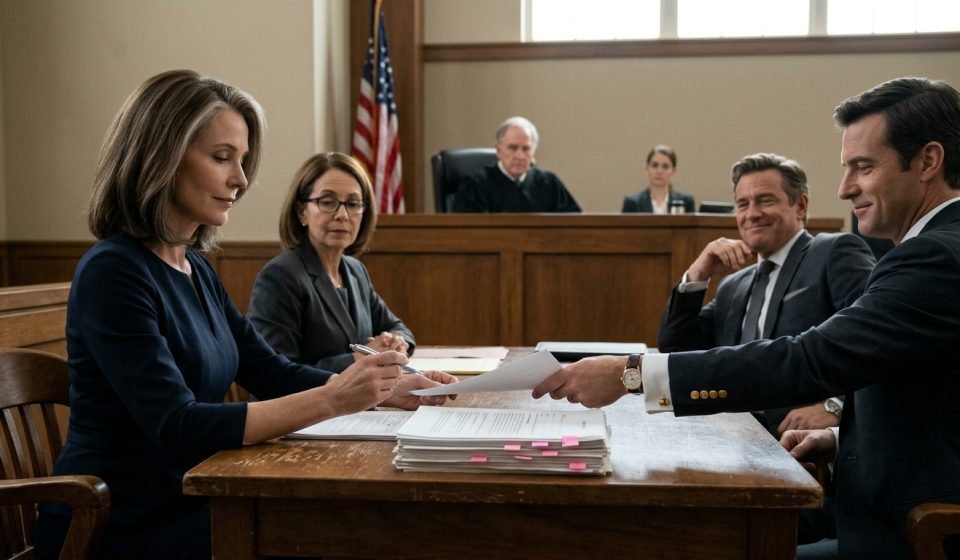
My husband laughed in court as though our divorce had already become his greatest victory. Desmond sat beside his attorney, smiling while I prepared to sign away our $770,000 colonial house, both luxury cars, and every shared financial account. He even joked that I was broke and should be allowed to keep the dog. Everyone seemed to believe I had lost everything. But I watched the settlement papers move across the table without protesting, because the assets Desmond wanted so badly were not the things I was trying to protect.
The courtroom was on the third floor of the Halverson County Judicial Centre, an ordinary room with harsh fluorescent lighting and a judge who seemed ready for the proceedings to end. Desmond wore his best charcoal suit and the expensive watch he reserved for occasions when he wanted to impress people. His lawyer, Lyle Ostrander, had carefully marked every place where I needed to sign. He slid each page toward me with the satisfaction of someone watching a difficult negotiation turn into an easy win. Earlier, he had described Desmond’s offer as generous because my husband would release me from the mortgage obligation. My own attorney, Nadia Bishop, didn’t challenge his presentation. She simply confirmed that I had reviewed the agreement and was prepared to sign. Her calmness bothered Ostrander, who seemed disappointed that we weren’t fighting over the value of the house.
Then the documents came one after another. The four-bedroom colonial had a slate roof, a wraparound porch, and a recent appraisal of exactly $770,000. Next were the titles to a black Audi Q7 and a white Porsche Macan. Then came our checking and savings accounts, a money market account, and the brokerage account Desmond liked to call the family’s while treating it as his own. I signed every page. Desmond looked increasingly pleased, as though each signature proved I had finally accepted defeat. When the personal property schedule appeared, it contained just one item for me: Roscoe, our four-year-old shelter dog with a crooked ear and a habit of sleeping on warm radiators. Desmond mocked that choice too. He told me to take the dog and find somewhere to rent, then questioned whether I could even keep Roscoe’s crate.
🎧 Listen to the Complete Story
Press ▶ Play below to enjoy the full narrated story.
My husband laughed in court, but Nadia never joined the performance. When Desmond’s attorney raised the crate issue, she calmly said he could keep it. The exchange seemed ridiculous beside the property and money I had surrendered.
The judge still needed to confirm that I understood the settlement. He explained that I was waiving my claims to the house, vehicles, and listed accounts, and that the agreement was intended to be final.
I told him I understood and was signing freely. Nadia rested her hand beside my elbow, steady and reassuring. For a moment, Desmond studied my face as though my lack of distress made him suspicious.
He glanced toward my attorney and the legal pad in front of her. Something about our silence seemed to unsettle him, but he said nothing. Perhaps he decided that I was simply too defeated to argue anymore.
The judge signed the order, and Desmond left believing he had secured everything we had accumulated together. He had spent months insisting that I was broke, and the settlement appeared to confirm his story.
But during the divorce, Nadia had asked for financial records that Desmond’s attorney resisted producing. The records concerned Kroll Meridian Capital, the advisory business behind much of our expensive lifestyle.
The requests had gone nowhere in family court. There were reasons I couldn’t explain openly why those business records mattered, and reasons I had accepted a settlement that looked so one-sided.
Desmond walked out with the house, the cars, and the accounts. I walked out with Roscoe. What nobody in that courtroom knew was that another legal proceeding was already underway—and its records could change the meaning of everything I had just signed.