
My Daughter Spent $450,000 On Her Mil, Then Came To My House With A Residency Agreement As If It Were Hers.

My daughter tried to take my house, arriving in the rain with a moving truck, her husband, her mother-in-law, and a residency agreement I had never approved. They had even decided which bedroom I would be allowed to keep—and expected me to simply move aside.
Tap LISTEN TO THE FULL STORY below to reveal the narrated video and start listening.
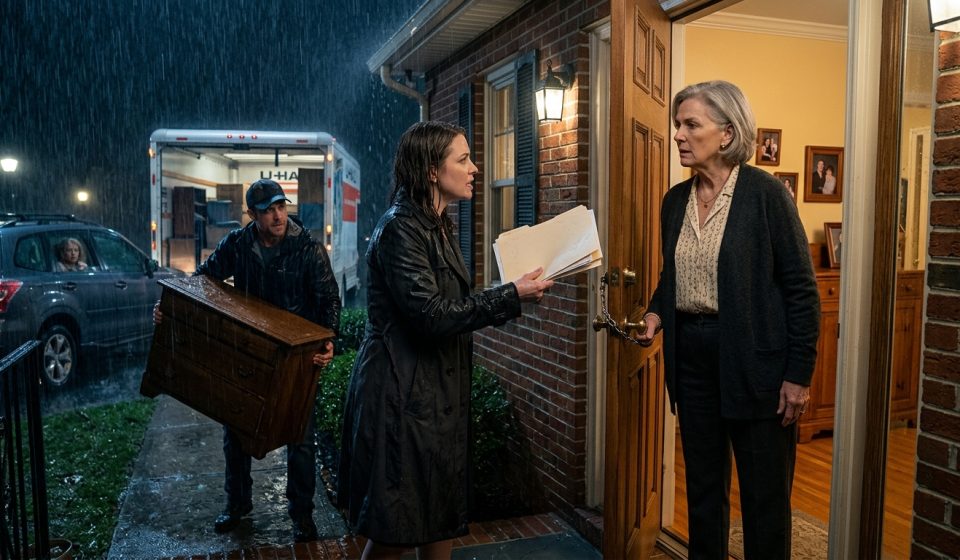
My daughter tried to take my house on a stormy Friday night, arriving with a rented moving truck, her husband Ryan, and his mother Diane. I watched from behind my living-room curtain as Ryan began dragging boxes onto my porch as though permission had already been granted. Diane remained dry inside the SUV. This wasn’t a family visit. They had arrived expecting to move into the four-bedroom Pennsylvania home my late husband and I had spent thirty years paying for.
My name is Patricia “Patty” Bennett. I’m 68 and have been a widow for seven years. This house is the last place that still feels completely mine. My husband’s workshop still carries the faint smell of sawdust. Our kitchen table bears a scratch our children made years ago, and every morning I drink coffee on the back porch and sometimes talk to my husband as though he can still hear me. Apparently, none of that mattered to Lauren.
The doorbell rang hard twice. I opened the door only halfway and kept the security chain attached. Lauren didn’t even say hello. Instead, she pushed a thick folder toward me and announced that they had already signed everything. When I asked what exactly they’d signed, she called it a “family residency agreement.”
🎧 Listen to the Complete Story
Press ▶ Play below to enjoy the full narrated story.
According to Lauren’s plan, she and Ryan would take the downstairs bedrooms. Diane would have the east room. I would be moved into the small bedroom beside the kitchen.
Behind her, Ryan hauled a heavy wooden dresser onto my porch while rain poured from his jacket. He impatiently told me to move aside before their belongings were ruined.
Then I looked at the paperwork.
My address appeared at the top.
There were room assignments, garage access, permission to use my late husband’s workshop, and even a quiet provision about using my personal savings for shared household expenses.
They had created a contract governing a house they didn’t own.
And they expected me to accept it.
I put my hand firmly against the door and gave Lauren a one-word answer.
No.
She seemed genuinely surprised.
I made myself perfectly clear: they were not moving into my house.
Lauren’s expression hardened. She argued that I lived alone in a four-bedroom home and claimed that didn’t somehow make it mine. Then came the justification I had heard throughout my life.
Family helps family.
I looked directly at her and reminded her of the part she’d conveniently forgotten.
Family asks.
Ryan stepped closer, his muddy boots already marking my welcome mat. He said they’d loaded half the moving truck and warned me not to make things difficult.
But I wasn’t moving aside.
Lauren called me selfish.
That word hurt because I had spent most of my life doing the opposite. I helped Lauren through college when money was tight. I contributed toward her first car. When she and Ryan struggled during the early years of their marriage, I covered bills without demanding repayment.
I had always been their soft place to land.
Somewhere along the way, generosity had become expectation.
And expectation had become entitlement.
What Lauren didn’t realize was that when my daughter tried to take my house, I wasn’t completely surprised.
Three days earlier, she’d called me in the middle of the afternoon and casually announced that she and Ryan were “changing” their living arrangements.
They were moving into my house Friday.
She didn’t ask.
She informed me.
When I asked what had happened to their own house, Lauren answered too quickly: nothing.
Then I asked where Diane would be staying.
There was a pause.
With them.
Three adults were planning to arrive at my home with a moving truck because Lauren had decided all my unused space could be put to better use. She said combining expenses would make things easier for everyone.
Everyone except me.
When I challenged her, Lauren accused me of being dramatic and hung up.
But I knew my daughter.
I knew when she was hiding something.
So the next morning, I drove to the county records office. Property records were public, and I didn’t need a private investigator to discover whether something had happened to Lauren’s house.
Twenty minutes later, a clerk handed me several pages.
I read them once.
Then I read them again.
And suddenly, I understood why my daughter was so determined to move three adults into my home without ever asking my permission.