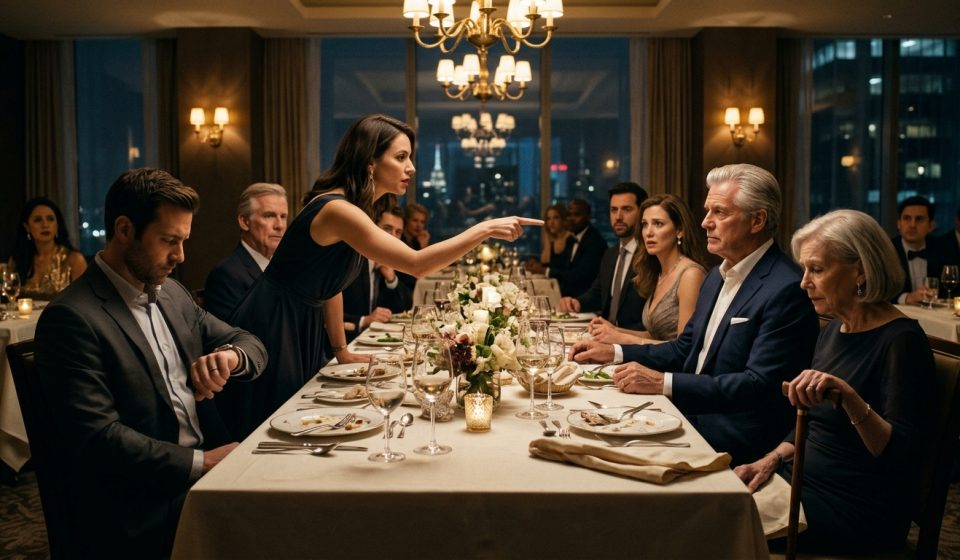
My Daughter-In-Law Stood Up, Pointed At My Wife And Said, Get Up And Leave. I Didn’t Argue, I Simply Took My Wife’s Hand And Walked Away From The Table.

My daughter-in-law thought she could humiliate my recovering wife in front of everyone, but she never expected the people she wanted to impress to walk away with us.
Tap LISTEN TO THE FULL STORY below to reveal the narrated video and start listening.
My daughter-in-law stood up, pointed at my wife and said, “Get up and leave.” Those words shattered what should have been an elegant birthday celebration. My wife, Megan, had arrived fifteen minutes late because she was still recovering and needed a wooden cane to walk. Her steps were slow and uncertain, but she had made the effort to attend. Instead of receiving a warm welcome, she found herself being publicly humiliated. I stood beside her, watching the room fall silent, while our daughter-in-law, Mia, behaved as though she had every right to decide who belonged at her party.
At nearly seventy years old, I had learned that silence often reveals more about people than arguments ever could. The room was beautifully decorated, with warm lighting reflecting off crystal glasses and expensive clothing. Everything had been arranged to create an atmosphere of wealth and sophistication. Yet beneath those carefully prepared smiles, something ugly had just surfaced. Megan held her cane tightly, her free hand trembling as she lowered her head. She had spent her life teaching children kindness, and now she seemed to be questioning whether she had somehow done something wrong.
Mia sat back down almost immediately, adjusted her dress, and glanced around as though expecting everyone to approve. Across the table sat the Miller family, watching without speaking. I turned toward my son, Ethan, hoping he would recognize how cruelly his mother had been treated. Instead, he avoided my eyes and checked his watch. Then he calmly explained that Megan had arrived late and that Mia was right. According to him, our presence did not suit the atmosphere of the celebration. His words hurt almost as much as Mia’s command.
🎧 Listen to the Complete Story
Press ▶ Play below to enjoy the full narrated story.
I looked around the table, struggling to understand how our own son could speak about his parents that way.
Several of my oldest friends were seated among the guests. Some had worked beside me for more than thirty years, while others had relied on my help during difficult periods of their lives.
They weren’t people who enjoyed public confrontations.
But I could see disappointment spreading across their faces.
Megan gently squeezed my hand and whispered that perhaps we should simply go home.
That quiet suggestion hurt more than the insults.
My wife had always been someone who stepped aside to preserve peace. She rarely demanded explanations or made herself the center of attention.
Now, even while recovering, she was prepared to accept humiliation rather than inconvenience anyone.
I couldn’t allow that moment to define her worth.
My daughter-in-law stood up, pointed at my wife and said, “Get up and leave,” but I refused to respond with the anger Mia seemed to expect.
Instead, I rose slowly from my chair.
I didn’t raise my voice, tap a glass, or make a speech.
I placed my hand behind Megan’s chair and helped her stand.
Then I looked directly at Ethan.
I told him that if our presence was making everyone uncomfortable, we would leave.
For a moment, nobody moved.
I thought Mia might feel relieved that we were going without an argument.
But then something unexpected happened.
One of my oldest friends stood.
Another followed.
Without saying a word, they reached for their coats and nodded respectfully toward Megan and me.
Chairs scraped against the floor. Drinks remained untouched. Conversations stopped.
The Miller family began exchanging confused looks.
Mia turned toward her mother, then toward Ethan, forcing a smile that no longer looked convincing.
More guests quietly stood up.
Nobody shouted accusations or demanded explanations.
They simply decided they would not remain at a celebration where someone had treated Megan so cruelly.
Within two minutes, half the table was empty.
As we approached the exit, I heard someone whisper that they shouldn’t stay.
Outside, the cool New York evening air made Megan shiver, so I draped my coat over her shoulders.
She said nothing, but I could tell she was trying to hold herself together.
Behind us, the restaurant remained brightly lit, and the birthday party continued.
Yet something important had changed.
Mia had expected our departure to demonstrate her authority.
Instead, the people whose approval mattered most had chosen to leave with us.
And as I helped Megan toward the car, I began to understand that this humiliation had revealed far more about our son and his new family than either of them realized.