
My Brother Told The Entire Thanksgiving Table That I Was Adopted, And Not Blood. He Froze Mid-Sentence When Grandma Stood Up, Looked Him Dead In…

When my brother announced I was adopted at Thanksgiving dinner, thirteen relatives fell silent—but the moment my grandmother stood up and challenged him, I realized our family had been hiding something far more complicated than his cruel accusation.
Tap LISTEN TO THE FULL STORY below to reveal the narrated video and start listening.
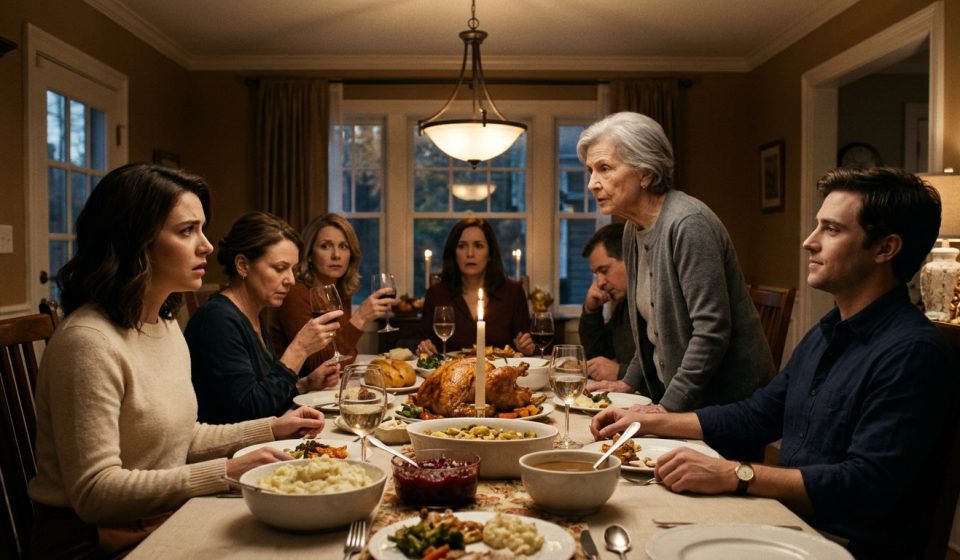
My brother said I was adopted, and not blood, as though humiliating me in front of thirteen relatives was perfectly acceptable holiday entertainment. Corwin set his fork down with deliberate precision, almost like he had rehearsed the moment. The gravy was still moving when he looked across the table and told me I wasn’t really part of the family. Everyone froze. My aunt stopped raising her wine glass, my teenage cousin suddenly became fascinated with his phone, and my mother pressed her napkin against her lap without saying a word. I felt heat rise behind my ears as my own fork struck the plate. For a moment, the sound seemed impossibly loud in the silence that followed. Corwin looked completely comfortable, as though he had finally said something everyone else had been thinking.
The worst part wasn’t that I had never heard the accusation before. For years, relatives had made strange comments about how different I was from everyone else. There were jokes during Christmas gatherings, awkward remarks at weddings, and uncomfortable pauses whenever someone mentioned family resemblance. People would say I was simply built differently, then change the subject before I could ask what they meant. I had spent twenty-six years trying to ignore those little moments. Asking questions felt dangerous because I worried that giving the rumor attention might somehow make it real. But Corwin had never been so direct before. This time, he announced it publicly, with absolute confidence, while everyone watched my reaction.
I couldn’t think of anything to say. My face burned, and my stomach tightened as I reached for the coat hanging behind my chair. I had decided that leaving was better than sitting through another minute of humiliation. Then a chair scraped violently against the hardwood floor. It was my grandmother’s chair. Helena Renborg was eighty-four years old, small in stature, and usually careful with her words. I had never seen an entire room become so attentive simply because she stood up. She looked directly at Corwin with the patient but unmistakably serious expression she used when someone had done something wrong and still had one opportunity to correct it.
🎧 Listen to the Complete Story
Press ▶ Play below to enjoy the full narrated story.
Corwin didn’t apologize. He remained seated, apparently believing Grandma would eventually let the conversation pass.
But she wasn’t looking away.
Instead, she questioned why he was so eager to discuss birth records when there were things about his own family’s paperwork he apparently didn’t understand.
The atmosphere changed instantly.
My mother’s face turned pale. Corwin opened his mouth, but for the first time I could remember, he couldn’t find anything to say.
I remained standing between the dining table and the doorway, clutching my coat, uncertain whether I should leave or listen.
Grandma had never spoken like this during a family gathering. Her words carried a seriousness that made even the smallest movements around the table feel inappropriate.
Until that evening, I had always believed I was the outsider. Nobody had officially told me I didn’t belong, but I had grown up noticing the hesitation before relatives included me in conversations.
I was the quiet child who preferred books to backyard games, and I had convinced myself that my different personality explained the uncomfortable comments.
Grandma’s home had always been filled with familiar holiday traditions. She baked cardamom rolls using a recipe she kept mostly in her head, and the family gathered around the same table year after year.
My father, Anders, had died suddenly three years earlier. Since his death, Grandma had become noticeably quieter, and she had begun keeping an unlabeled photograph of a young man in military uniform on her mantel.
Nobody ever asked who he was.
Now, standing in that silent dining room, I wondered whether all those strange family moments were connected.
My brother had wanted everyone to question where I belonged.
But Grandma’s unexpected response had turned the question back toward him. And judging by the expression on my mother’s face, there was something about our family’s past that nobody at the table was prepared to explain.