
I Was Baking In My Own Kitchen When My Daughter-In-Law Turned Off My Oven And Said This Is My Kitchen Now, Ask Me If You Want To Eat, My Son Looked At His Phone…

I was baking in my own kitchen when my daughter-in-law turned off my oven, but what hurt more was watching my grown son sit only six feet away and refuse to stop her.
Tap LISTEN TO THE FULL STORY below to reveal the narrated video and start listening.
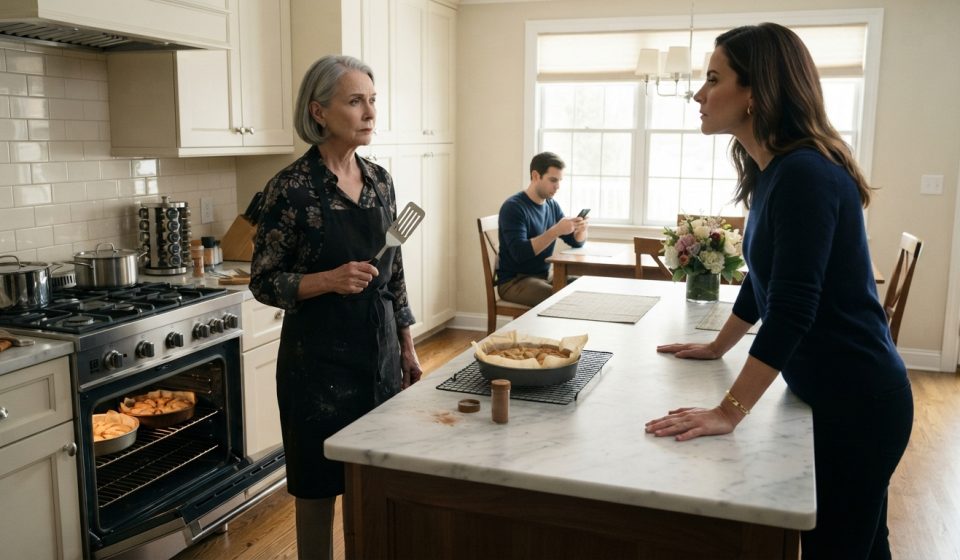
I was baking in my own kitchen when my daughter-in-law reached past me and turned off the oven while two pans of apple cake were still baking. Cinnamon already filled the room, and the cakes were about forty minutes in, their edges beginning to pull away from the pans. Renata did not touch the burner or the timer. She deliberately turned the main oven dial to zero, as casually as if she were switching off a television. I stood there holding my spatula and staring through the oven window, trying to understand what had just happened.
When I said her name, Renata answered mine with a flatness that made it sound like a correction. She moved to the kitchen island, placed both palms against the marble, and told me we needed to discuss how things worked in the house. My 34-year-old son, Christopher, was sitting only six feet away at the breakfast table. He held his phone in both hands and kept his eyes lowered, either reading something or pretending to. The back of his neck had already turned red.
I told Renata we could talk, but my cake was going to fall. Her response made my hands begin to shake. She repeated the words “your cake” as though that was exactly the problem. I had lived in this house for eleven years. I moved in when Christopher was 23, after my husband Leonard died and the Connecticut property needed to be consolidated. Christopher had asked me to come live with him, telling me there was room. I had believed he meant there was room for me in his life, not merely space for me inside a house.
🎧 Listen to the Complete Story
Press ▶ Play below to enjoy the full narrated story.
Renata had entered the picture three years earlier. Since then, the kitchen had changed—new countertops, new appliances, even a pot rack over the island that I had never requested.
But I still knew where everything belonged.
And I still baked every Thursday morning.
Now Renata told me I used the kitchen as though it were mine.
I answered that I used it to make food.
She accused me of using it without permission and rearranging things. Then she said it plainly: this was her kitchen, this was her house, and she and Christopher owned the property.
According to her, if I wanted to use the kitchen, I needed to ask.
If she said no, I wasn’t supposed to use it.
Then came the sentence that changed the atmosphere completely.
If I wanted to eat something—if I wanted a meal prepared in the house—I was supposed to ask her first.
The refrigerator hummed in the silence.
Outside the window, a neighbor’s car backed out of a driveway, its warning beeps sounding strangely ordinary compared with what was happening inside.
I turned to Christopher.
Instead of defending me, my son placed his phone face down and looked at Renata rather than at me. He tried to soften what she had said, explaining that she wasn’t saying I couldn’t eat, only that there needed to be more communication.
But I had heard her perfectly.
I reminded him that she had just told me to ask permission if I wanted to eat.
Christopher picked his phone back up.
Something inside me became very quiet.
I removed the two apple cakes from the oven. They had not collapsed completely, but they had stopped rising and their tops were flat where they should have been domed.
I carefully folded the oven mitts and placed them beside the cooling rack.
Then I wiped my hands on the dish towel.
I looked directly at Renata and said only one word.
“Okay.”
Then I walked out of the kitchen, crossed the dining room and front hall, went upstairs to the bedroom they had told me to call mine, and quietly closed the door behind me.
But “okay” did not mean what they thought it meant.