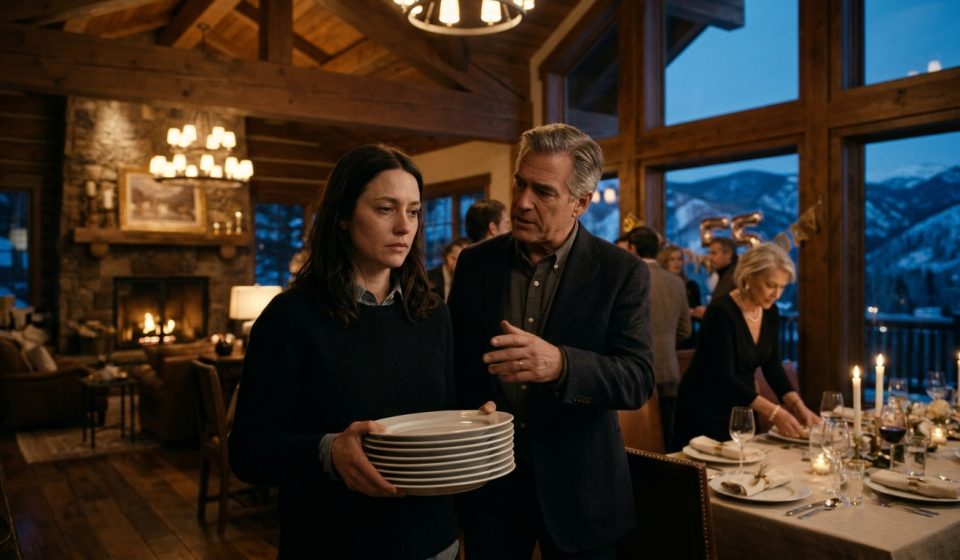
I Spent Five Hours Getting To My Dad’s Birthday Dinner. When I Arrived, He Pushed A Stack Of Plates At Me. Your Brother’s Girlfriend Will Be Here In 20 Minutes.

After five hours getting to my dad’s birthday dinner, I expected to be welcomed as his daughter, but his first words made me question why I’d come at all.
Tap LISTEN TO THE FULL STORY below to reveal the narrated video and start listening.
After five hours getting to my dad’s birthday dinner, Cassidy expected a family celebration, perhaps even a rare moment of warmth from the people who had spent years underestimating her. Instead, her father pushed a stack of plates into her hands and warned her not to embarrass the family before her brother’s girlfriend arrived. Cassidy had traveled so far hoping to belong, yet once again, she was being treated as someone whose only purpose was to make everyone else’s evening easier.
At 32, Cassidy lived in Denver and led the bioengineering division of a private research center. She had earned a PhD, managed a team of 30 researchers, and helped develop a cellular regeneration matrix associated with a patent valued at approximately $60 million. Her professional achievements were extraordinary, but almost nobody in her family knew what she had accomplished.
To her parents, Cassidy was still the disappointing daughter who had abandoned a respectable marketing career to work in a laboratory. Her father dismissed her scientific research as washing test tubes, while her younger brother enjoyed endless praise for his successful public relations career. Cassidy had learned that defending herself only invited more criticism, so she stopped explaining.
🎧 Listen to the Complete Story
Press ▶ Play below to enjoy the full narrated story.
Five years earlier, Cassidy had walked away from a prestigious marketing agency and returned to science. It was a decision that demanded sacrifices, long hours, and years of determination. She had built something remarkable, but the people who should have celebrated her ambitions continued treating her choices as embarrassing mistakes.
There was another reason her family knew so little about her professional life. At work, Cassidy used her mother’s maiden name, Dr. Cassidy Moore. That name created a boundary between her accomplishments and the relatives who seemed determined to diminish everything she valued.
Under that name were scientific papers, conference presentations, and evidence of years spent building a reputation through difficult research. Under her father’s surname, however, the family spotlight belonged almost entirely to her brother.
At 29, her brother was the golden child. His work involved managing reputations and shaping public narratives, skills that seemed to extend naturally into family life. Somehow, he always emerged as the impressive son, while Cassidy remained the disappointing sister.
But two months before their father’s 55th birthday, Cassidy’s professional world was shaken by something far more serious than family criticism.
Her attorneys arrived with troubling information about a competing pharmaceutical company. The company was preparing to announce a medical breakthrough that appeared disturbingly similar to research conducted inside Cassidy’s closed clinical trials.
Initially, she wanted to believe the similarities were innocent. Scientific discoveries sometimes followed comparable paths, and she understood that researchers could independently arrive at similar conclusions.
Then she examined the company’s pre-launch presentation.
The lattice geometry matched. The peptide binding ratios matched. Even an instability problem from an earlier phase of Cassidy’s research appeared in the competing company’s materials.
That particular detail was difficult to explain away. Cassidy’s team had already corrected the problem in later research, yet the competing presentation still reflected the earlier version.
What looked like an exciting pharmaceutical announcement now raised alarming questions about how confidential information had reached another company.
The lead researcher was a woman named Amelia Wexler.
Over the following weeks, Amelia repeatedly contacted Cassidy at her professional email address. The messages began formally, requesting a meeting with Dr. Moore. Gradually, their tone changed.
Amelia sounded increasingly desperate. She insisted there had been misunderstandings and begged Cassidy not to pursue legal action. She feared losing her career, her future, and possibly her freedom.
Cassidy refused to respond. Instead, she allowed her attorneys to assemble the evidence.
Meanwhile, her brother announced an exciting plan for their father’s birthday celebration in Aspen. He would be bringing his girlfriend, a brilliant scientist whom the family was already eager to meet.
Then he revealed her first name.
Amelia.
Cassidy stared at the family group chat, suddenly unable to dismiss the possibility forming in her mind. Was it merely a coincidence, or was her brother’s new girlfriend connected to the professional nightmare unfolding around her?