‘Delete Her Access And Escort Her Out,’ New CFO Snapped During Our 400 Million Dollar IPO Roadshow. I Just Smiled, Signed Nothing, And Watched. Three Hours Later…

The new CFO ordered security to escort me out during our $400 million IPO roadshow, never realizing that the entire offering still depended on a signature he hadn’t bothered to check.
Tap LISTEN TO THE FULL STORY below to reveal the narrated video and start listening.
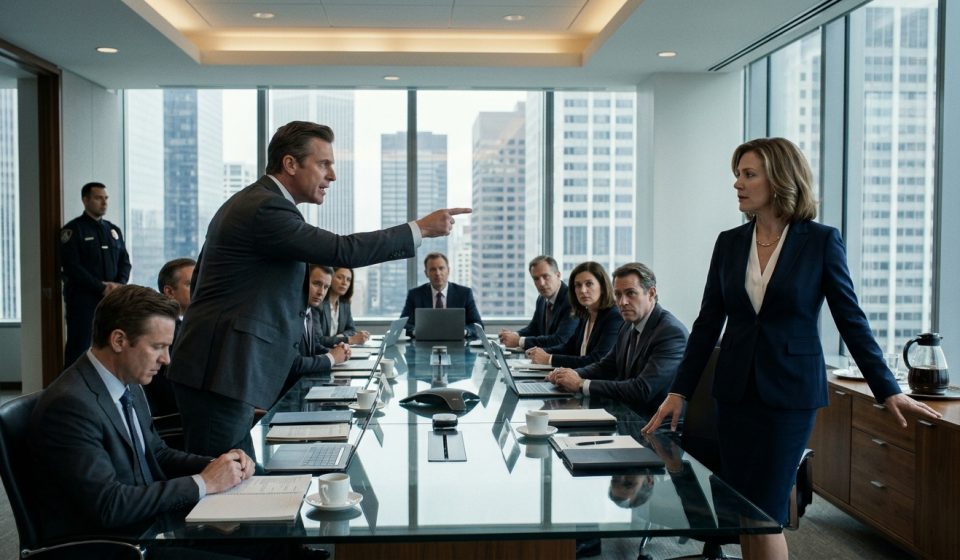
Delete her access and escort her out. Those were the words Marcus Thorne, our newly appointed chief financial officer, delivered across a crowded boardroom on the morning Vantique Diagnostics was preparing for its $400 million IPO roadshow. I had known Marcus for only six weeks, yet he spoke as though removing me was an ordinary administrative decision. Eleven people were present, including investment bankers, analysts, outside counsel, and senior executives. Nobody immediately challenged him. I stood near the coffee station, set down the carafe, and looked across the glass conference table. I didn’t argue or demand an explanation. Instead, I smiled and calmly told Marcus that he should do whatever he believed was best. What nobody in that room understood was that his decision had created a problem far larger than an embarrassing dismissal.
The confrontation happened on the forty-second floor of the Callaway-Renner building, where the atmosphere was already tense with anticipation. Vantique Diagnostics was preparing to enter the public market, and everyone understood how much money was involved. The company had spent eighteen months preparing its offering, arranging investor presentations, and building expectations around approximately $400 million in proceeds. Marcus had joined only weeks earlier, supported by board members who believed my cautious approach was slowing the company’s progress. He wanted to demonstrate that the organization could move forward without depending on its founder. During the meeting, he made that ambition unmistakably clear. By ordering security to remove me in front of the bankers, he appeared determined to show that he now controlled the company’s future.
What made the moment especially painful was that I had founded Vantique eleven years earlier. The business began in a leased laboratory with two used centrifuges and a line of credit secured against my own home. I developed the assay platform that became our flagship product and hired the first forty employees. Many of those people still worked for the company. But as the IPO approached, certain board members began treating my experience as an obstacle rather than an asset. Marcus repeatedly described me as the company’s legacy voice, a phrase that sounded respectful until I understood what he meant.
🎧 Listen to the Complete Story
Press ▶ Play below to enjoy the full narrated story.
For weeks, I had noticed small changes in how decisions were being made. Meetings took place without me, organizational charts were quietly revised, and conversations about the company’s future increasingly happened behind closed doors.
Gerald Pruitt, a private-equity board member who supported Marcus, wanted the founder’s role reduced before the public offering. He believed investors would respond better to a modern institution than to a business still visibly connected to the person who built it.
The language sounded polished: clean, modern, scalable.
But the people pushing those changes had overlooked something important.
The company’s S-1 registration statement contained the financial disclosures, risk factors, and certifications required for the public offering. It was one of the most consequential documents Vantique had ever prepared.
And buried within its execution pages was a signature that carried legal responsibility.
Mine.
When the amended filing had been prepared three weeks earlier, Marcus was still too new to serve as the credible certifying officer. Rather than delay the offering to change the authorization arrangements, the board had allowed the filing to proceed under my name.
Outside counsel had structured the offering around that authority remaining active through the closing process.
Marcus apparently believed my signature was nothing more than a formality. He had reviewed the executive summary but hadn’t fully understood the document’s execution requirements.
To him, removing me was another demonstration of decisive leadership.
To me, it revealed how little he understood about the machinery supporting the transaction.
So when he ordered security to escort me out, I cooperated.
Thomas Okafor, the building’s security lead, approached me near the elevators looking deeply uncomfortable. He had worked in the building for six years and apologized quietly as he explained that he had been instructed to collect my badge.
I handed it over without resistance and assured him that he was simply doing his job.
Then we entered the elevator together.
As we descended forty-two floors, Thomas kept glancing at my reflection, perhaps expecting me to become angry or demand that someone intervene.
But I remained calm.
I had no intention of signing anything or making an emotional scene.
Because Marcus had taken away my building access without understanding the authority attached to my name—and the people responsible for the IPO were about to examine that distinction very carefully.