
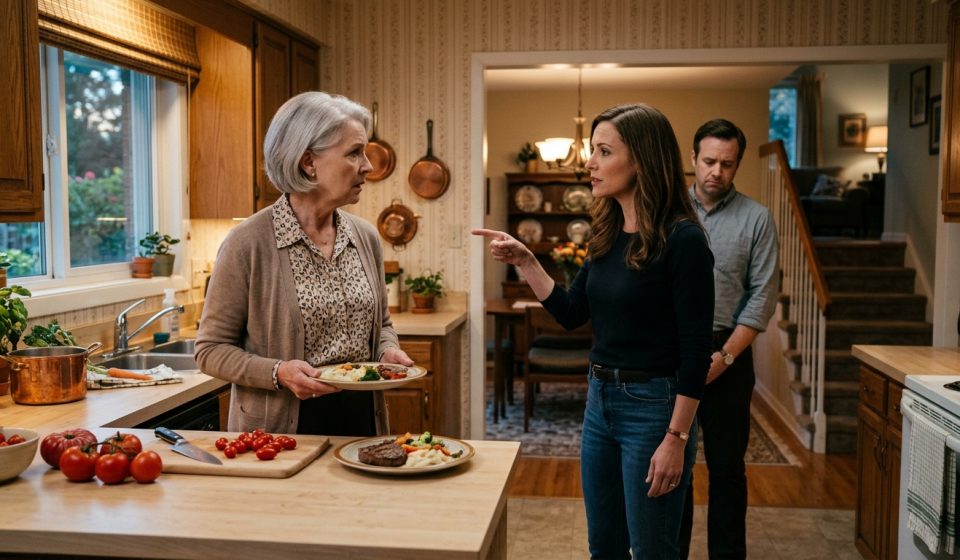
I Was Making Dinner In My Own Kitchen When My Daughter-In-Law Turned Off The Light And Said “Go Eat In Your Room. We’re Having A Private Dinner.”

My daughter-in-law took over my house so completely that one night she told me to take my dinner and eat alone in my bedroom. My son stood there and said nothing—and that was when I realized how much of my own home I had already surrendered.
Tap LISTEN TO THE FULL STORY below to reveal the narrated video and start listening.
My daughter-in-law took over my house so gradually that I didn’t fully understand what was happening until she turned off the kitchen light and told me to eat in my room. I was standing at my own counter, slicing tomatoes from my garden, when Kristen announced that they were having a private dinner. My son Daniel looked away. I didn’t argue. I picked up my plate, walked down the hall, and sat on the edge of my bed in the dark. That was the night I finally understood that something had gone terribly wrong—not just with them, but with me.
My name is Margaret. I was sixty-seven, living in a detached house in Oakville, Ontario, about forty minutes outside Toronto. It wasn’t a mansion, just a 1970s split-level with original hardwood floors, a sunny backyard, and a kitchen I had renovated with money saved during thirty-one years of teaching. I had paid off the mortgage the year my husband died, twelve years earlier. The house was unquestionably mine, yet somehow I had reached a point where I no longer felt entirely welcome inside it.
It had started eighteen months earlier when Daniel called. He and Kristen were struggling financially. Their Mississauga condo rent had increased by $400 a month, and groceries, gas, and daycare for my granddaughter Lily were stretching them thin. Daniel asked whether they could stay with me for a few months while they got back on their feet. I said yes immediately. I didn’t demand conditions or ask for time to think. He was my son, and helping him felt natural.
🎧 Listen to the Complete Story
Press ▶ Play below to enjoy the full narrated story.
When they arrived, I did everything I could to make them comfortable. I prepared the guest room, cleared closet space for Lily, bought extra towels, and even placed a little step stool by the bathroom sink so my granddaughter could reach it herself.
The first month was fine.
During the second month, however, small things began changing. Kristen started rearranging my kitchen. At first, it seemed harmless. Mugs moved to another shelf. Cutting boards were stacked differently. Then she reorganized the pantry and packed my canned goods into a box because she thought they were cluttering the shelves.
One day, I discovered my mother’s ceramic bread bin sitting on the garage floor.
When I gently mentioned it, Kristen explained that she was simply trying to make the house more functional. She smiled when she said it, and I let the matter go.
That became the pattern.
By the fourth month, the rhythm of my home had quietly become theirs. Daniel and Kristen liked cooking together and eating dinner late, sometimes at eight-thirty or nine. I began eating earlier and disappearing during their evenings.
Nobody explicitly ordered me to do that.
I simply started feeling as though I were in the way.
Looking back, that’s one of the hardest parts to admit. As my daughter-in-law took over my house, I watched the boundaries around my own life shrink and kept finding explanations for it. Daniel was stressed. Kristen was adjusting. Lily needed stability. They weren’t staying forever. I was helping my family.
I convinced myself that avoiding conflict was kindness.
By the seventh month, I was effectively living in the back third of the house I owned.
My bedroom, the small sitting room beside it, and the garden became my world. The living room, main kitchen, and front hall increasingly felt like theirs. In the evenings, I could hear Daniel and Kristen laughing, the television playing, and Lily having her bath.
They sounded like a family completely at ease in their home.
Except it wasn’t their home.
It was mine.
Still, I sat quietly in my room with a book and told myself I should be grateful that the house was full of life.
Then August arrived.
My tomatoes were thriving that year—beefsteak, cherry, and a heritage variety I had been trying for the first time. One afternoon, after working in the garden, I carried some inside and began preparing a simple supper.
And soon I would find myself standing in the kitchen I had paid for, looking at the son I had welcomed home, while his wife told me where I was allowed to eat.
This time, something about it would finally force me to ask how I had become a guest in my own house.