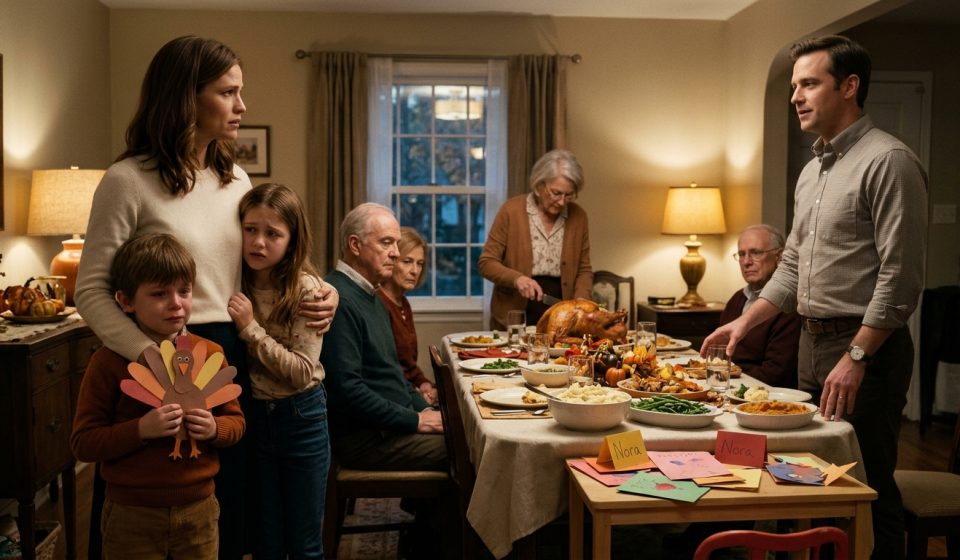
At Thanksgiving, My Brother Stood Up And Announced, My Sister’s Kids Eat After The Favorite Grandkids Finish. My Six-Year-Old Started Crying. I Quietly Took Their Hands And Left.

When my brother announced that my children would eat after the favorite grandkids at Thanksgiving, I realized just how little my family valued the children I had spent years trying to protect.
Tap LISTEN TO THE FULL STORY below to reveal the narrated video and start listening.
At Thanksgiving, my brother announced that my children would eat after the favorite grandkids finished, and I watched my six-year-old son struggle to hold back his tears. Brandon stood before the family, tapped his fork against his glass, and delivered the announcement as though he were sharing wonderful news. He explained that our parents wanted certain grandchildren served first. My children would have to wait. I had spent years helping this family, paying expenses and making sacrifices whenever someone needed support. Yet there I stood, listening to my brother divide the grandchildren into favorites and everyone else.
The dining room fell silent after Brandon announced that his children and June’s boys would eat first. Everyone else, including Lucy’s children, would have to wait. The Thanksgiving food was already spread across the sideboard: steaming turkey, mashed potatoes, green beans, and yams topped with browned marshmallows. At the children’s table, handmade leaf shaped place cards showed where everyone belonged. Nora had a card. Six year old Theo did not. Lucy watched him standing on tiptoe near the pies, his hands tucked into his corduroys. He blinked hard, trying not to show how much the announcement hurt. Brandon dismissed the awkward silence, claiming they simply wanted to avoid running out of food as they supposedly had the previous year. Lucy knew that excuse was especially painful. She had purchased the turkey last year, and she had paid for this year’s bird too. The receipt was still folded inside her purse.
Their mother called the arrangement a system and promised everyone would get something. She did not look up from the carving knife. Nora moved closer to Lucy and whispered to her, her voice already thick with tears. Theo stared down at the floor. He had made a paper turkey for his grandmother’s refrigerator and carried it carefully in the car, proud of the gift. Now he held it under his arm as though he no longer knew whether it would be welcome. Lucy felt her hands shaking and her mouth drying. She wanted to respond, but the words would not come. Instead, she told her mother she had forgotten something in the car and asked the children to get their coats. Nobody challenged the decision. Nobody offered to change the arrangement. As the family remained at the table, Lucy prepared to lead Nora and Theo away from the Thanksgiving dinner.
🎧 Listen to the Complete Story
Press ▶ Play below to enjoy the full narrated story.
Outside, the family’s Thanksgiving decorations moved in the wind. Lucy walked her children past the illuminated maple tree and the inflatable turkey on the lawn. Nora gathered their coats without speaking. Theo looked at his mother with confused, watery eyes.
Lucy buckled him into the car while he held his handmade turkey against his chest. Only after she sat behind the steering wheel did she finally allow herself to breathe.
Lucy was a 37-year-old fourth-grade teacher from Columbus, Ohio. Her daughter Nora was ten, thoughtful and affectionate. Theo was six, quiet, careful, and generous. He had joined their family through adoption at age four.
Lucy had always been the dependable one in her family. When her father’s health problems prevented him from working nine years earlier, she established a shared savings fund to help her parents through financial difficulties.
She contributed regularly from her teaching salary, increasing her payments whenever summer school provided additional income. The money helped cover essential household expenses, including electricity and property taxes.
What began as temporary assistance had become a long-standing responsibility. Her parents and siblings had access to the account, while Lucy continued providing much of the financial support.
As she drove away from Thanksgiving dinner, her children sat quietly behind her. The humiliation was still fresh, but so was the memory of everything she had done for the family.
And somewhere beneath her shock, one question was beginning to form: how long could she continue supporting people who made her own children feel unwelcome?