Your Access Ends Today, The VP Said As Security Waited Outside The Conference Room. They Had Already Removed Me From Payroll, But They Forgot The…

Being removed from payroll was humiliating enough, but Eleanor’s executives had overlooked one crucial detail about the technology keeping their company operational.
Tap LISTEN TO THE FULL STORY below to reveal the narrated video and start listening.
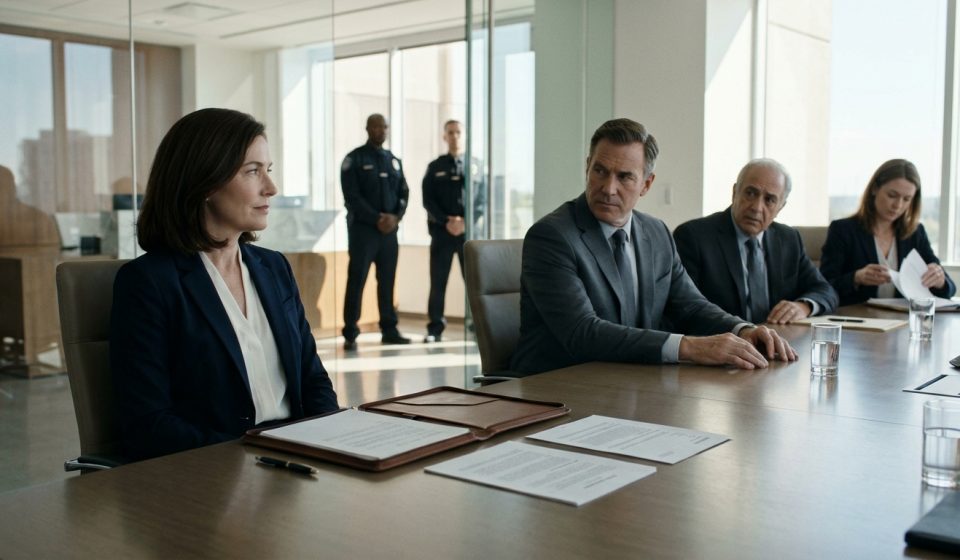
Being removed from payroll was only the beginning of Eleanor Mitchell’s unexpected confrontation with the executives at Apex Solutions. Lawrence Bennett sat across the conference table beside Richard Castellano, while Beth Hammond from human resources quietly organised paperwork. Through the glass wall, Eleanor could see two security employees waiting near reception. Her laptop had already been disabled, her company phone had stopped receiving emails, and her salary had been removed that morning. Everything suggested that the executives had carefully prepared for her departure, but Eleanor had an important question they seemed unwilling to answer.
Lawrence folded his hands and explained that Apex Solutions was restructuring its technology operations. Eleanor’s position was being eliminated immediately, but rather than defending her employment, she asked about the transition plan for the systems running on Mitchell Technical LLC infrastructure. Richard glanced at Lawrence, who dismissed the question by saying that the new provider would handle everything. Eleanor knew that his answer failed to address the issue she had raised. When Lawrence accused her of making the situation complicated, she opened the leather folder in front of her and placed three documents on the table. One contained server serial numbers, another listed software licences, and the third outlined an infrastructure service schedule she had prepared months earlier. She had never been allowed to formalise that schedule. Despite their different purposes, the documents shared one important detail: every resource belonged to the same owner, her own company, Mitchell Technical LLC.
Lawrence leaned back and pointed out that Apex had been using those systems for more than a year. Eleanor agreed, but when he suggested dealing with the paperwork later, she recognised how little he understood about the situation. The paperwork was not the problem. Ownership was. For eighteen months, Eleanor had carefully documented expenses, servers, renewals, and executive decisions. Her attention to detail had roots in her childhood. Her father ran a small garage and kept receipts for parts, tools, equipment, and customer deposits. He taught her that people might eventually claim something belonged to them if its rightful owner could not prove otherwise. Her mother was equally organised, keeping employment records, insurance papers, bills, taxes, and contracts in labelled folders. Eleanor once considered their habits excessively cautious, but by the time she became Chief Technology Officer at Apex Solutions, she understood why those seemingly ordinary lessons mattered so much.
🎧 Listen to the Complete Story
Press ▶ Play below to enjoy the full narrated story.
For six years, Eleanor had worked at Apex Solutions in Austin, Texas. When she first joined, the company was ambitious and growing rapidly, but its operations were poorly organised. Technology was something executives expected to function without necessarily understanding the resources required to maintain it.
Long before being removed from payroll, Eleanor had recognised the dangers of that attitude. She had spent her career working with executives who appreciated successful results but rarely wanted to discuss the infrastructure responsible for delivering them.
The situation at Apex had become particularly serious when one of its largest customers began considering moving its account elsewhere. The company’s platform had become too slow, threatening a business relationship worth nearly eighteen million dollars in annual revenue.
Eleanor approached Richard with a proposal explaining what the company needed. New servers, improved database tools, additional software licences, and sufficient capacity to rebuild the backend were essential to addressing the performance problems.
Richard wanted to know how much the upgrades would cost.
Eleanor estimated approximately two million dollars. Richard immediately pushed the proposal back toward her, refusing to approve the expenditure.
She warned him that failing to address the problem could cost Apex one of its most valuable customers.
The company desperately needed a solution, but its leadership was unwilling to provide the necessary resources.
What could Eleanor possibly do to protect an eighteen-million-dollar account when the executives responsible for the company refused to fund the technology it needed?