
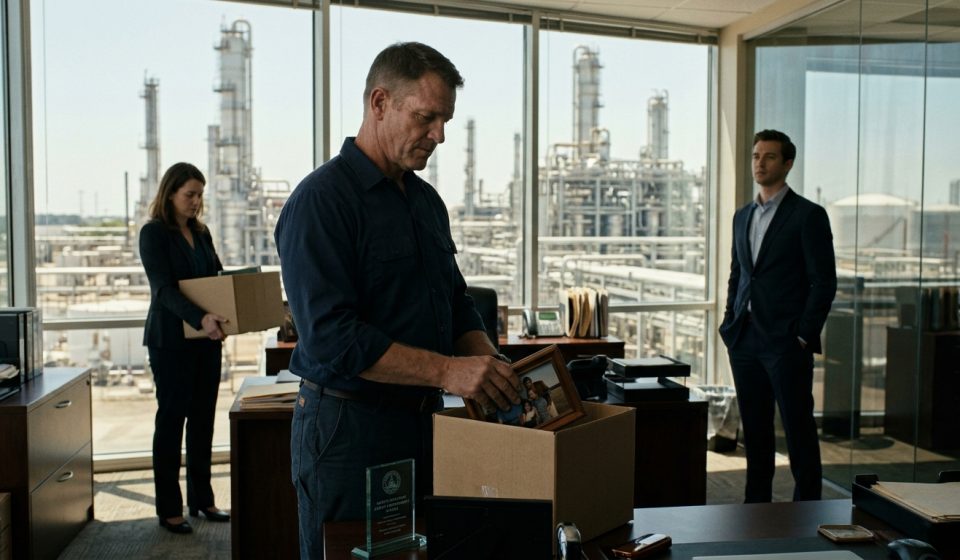
He Has A Harvard MBA. You’ll Understand, HR Said, Handing Me Boxes To Clear My Corner Office. I Packed, Without A Word. By 12.30, I Was Gone.

After twenty years of protecting an entire refinery, I was being replaced by a Harvard MBA, and the people making that decision had no idea what they were throwing away.
Tap LISTEN TO THE FULL STORY below to reveal the narrated video and start listening.
After twenty years of keeping a Texas oil refinery safe, I was being replaced by a Harvard MBA, and HR expected me to understand. Andrea stood inside my corner office holding cardboard boxes while a young man named Brandon Shaw examined the room as though it already belonged to him. My safety award from the Texas Oil and Gas Commission had just hit the wall with a sharp crack. Two decades of service, countless dangerous situations, and years of dedication suddenly seemed worthless to the people making this decision. I was Frank Pearson, forty-eight years old, a former Navy machinist’s mate who had worked his way up from the refinery floor. I had no prestigious business degree, but I knew the machinery, the workers, and the dangers that could turn an ordinary shift into a catastrophe.
I joined Lone Star Petroleum in 1999 after leaving the Navy. Those first years meant night shifts, grease beneath my fingernails, and long hours learning every pipe and valve in the facility. I watched experienced employees make dangerous mistakes and saw what happened when production targets mattered more than safety procedures. By my third year, I was writing incident reports designed to prevent accidents rather than merely explain them afterward. Bill Rodriguez, the company’s longtime safety manager, noticed my attention to detail and began inviting me to OSHA meetings. He believed I understood the refinery in a way few others did. When Bill retired in 2008, I became his natural successor, despite lacking the qualifications that corporate executives usually admired.
Over the following years, I built something more valuable than an impressive résumé. I earned the trust of inspectors, engineers, and the people working beside dangerous equipment every day. I remembered their families, respected their responsibilities, and treated regulatory compliance as a commitment to human lives rather than a bureaucratic obstacle. Those relationships helped our facility stay informed about changing requirements and prepare for inspections. By 2015, our safety record was spotless, with no major violations and only minimal minor findings. Other refineries faced enormous fines while our operations continued smoothly. Executives celebrated the results, and workers trusted me to protect them. Everything seemed secure until the morning Andrea entered my office carrying those boxes.
🎧 Listen to the Complete Story
Press ▶ Play below to enjoy the full narrated story.
Andrea could barely look me in the eye. She explained that Brandon had an MBA from Harvard and that the board wanted fresh perspectives, modern risk assessment, and new approaches to safety management. The message was unmistakable: my experience was no longer enough. Brandon entered wearing an expensive suit and confidently introduced himself as a graduate from the top five percent of his Harvard Business School class. He was eager to modernize our protocols with predictive analytics and data-driven methodologies. He spoke as though the systems I had spent decades maintaining were waiting for someone like him to finally make them effective.
I listened while remembering everything those systems represented. I knew every valve and pressure point, but I also knew the inspectors who walked through our gates and the employees whose families depended on them returning home safely. I had attended important family occasions, remembered personal hardships, and helped workers when circumstances demanded understanding. These were not simply professional contacts. They were relationships built through years of responsibility and mutual respect.
I had prevented twenty-three major safety incidents that could have shut down the refinery permanently. According to my calculations, that work had saved the company more than $150 million in potential fines and remediation costs. Yet the board had decided that someone with a prestigious degree was better suited to protect everything we had built.
As Brandon continued talking about modernizing the department, one question kept returning to my mind: did anyone making this decision truly understand what it took to keep a refinery safe?