My Father Always Said Money Was The Only Measure Of A Man’s Worth. On The Day I Left Home, He Made Sure To Demonstrate Exactly How Little He Thought I Was Worth.

When my father proved that money was the only measure he respected, I walked away from everything my family could offer with just one suitcase and an engineering degree they considered worthless.
Tap LISTEN TO THE FULL STORY below to reveal the narrated video and start listening.
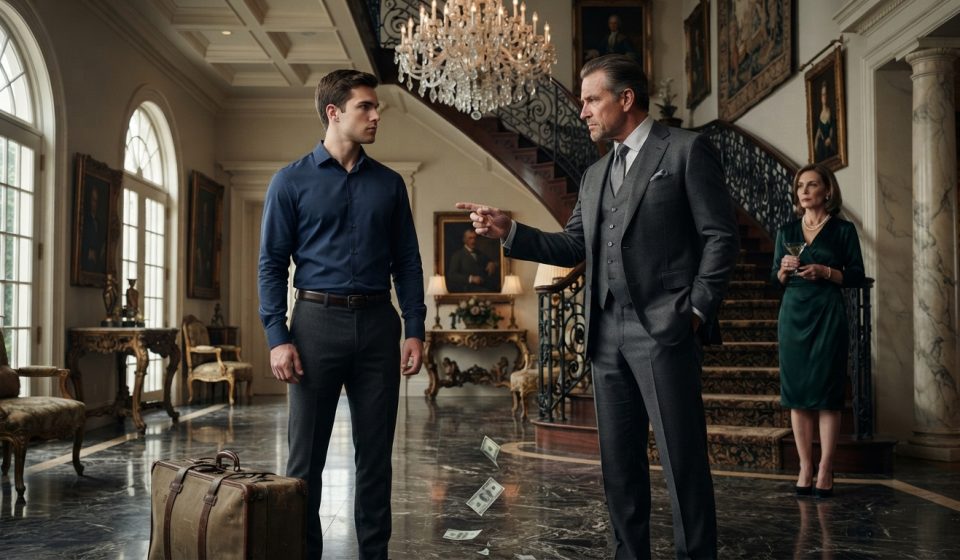
My father always believed money was the only measure of a man’s worth, and on the day I left home, he made certain I understood exactly how little he thought I was worth. He threw a hundred dollars at my feet and told me that was all a failure like me deserved. I was twenty-two, fresh out of college with an engineering degree, standing in the enormous living room of the Harrison family mansion with one suitcase containing everything I owned. My parents hadn’t even bothered attending my graduation.
Around me stood everything the Harrison name represented: crystal chandeliers, antique furniture, priceless artwork, old money, and even older pride. For generations, the men in our family had become investment bankers, each son following his father into Harrison and Sons Investment Group. Then came me. I chose engineering. When I announced my major, my father dismissed engineers as glorified mechanics and insisted no son of his would waste his life tinkering with machines.
But I saw the future differently. While my family counted millions through traditional investments, I believed the next great fortunes would come from technology. They would be created in garages and laboratories by people who understood how to combine innovation with opportunity. My mother stood near the grand staircase with a martini in her hand before noon, urging me to reconsider. There was still time, she said. I could return to the family firm, and my father could smooth everything over with the board.
🎧 Listen to the Complete Story
Press ▶ Play below to enjoy the full narrated story.
I looked at my mother and refused.
I was finished trying to become the person they wanted.
My father’s face turned the dangerous shade of red I’d feared since childhood.
Then he told me to get out.
According to him, I was throwing away the Harrison trust fund, connections, and legacy for a foolish dream.
I bent down and picked up the crisp bills he’d thrown onto the marble floor.
I told him to keep the trust fund.
I would build something of my own.
He laughed.
He mocked my ordinary button-down shirt and slacks compared with his custom-tailored suit and told me that without the Harrison name, I was nothing.
I smiled and told him to watch me.
Then I walked out of the mansion with $100, one suitcase, and the engineering degree my family believed was worthless.
Only after the enormous iron gates closed behind me did the reality of my situation become impossible to ignore.
I didn’t have a car because it belonged to my father.
I didn’t have somewhere to live because my college apartment had been funded by the trust.
All I truly had was that $100.
But I also had something my family didn’t understand.
A vision.
I walked to the bus station and spent $40 on a ticket to Silicon Valley. Another $10 bought me a burger and fries.
Sitting in a greasy diner watching buses arrive and depart, I opened my notebook and wrote three promises to myself: I wouldn’t rely on the Harrison name, I would build something capable of changing the world, and if I ever returned, it would happen on my terms.
That left me with $50.
It wasn’t enough for an apartment and barely enough for food.
But I still had my laptop, my engineering degree, and an idea I’d been developing throughout college.
Renewable energy was advancing rapidly, but there was a major problem: storage.
Solar and wind were becoming cheaper, yet batteries remained inefficient and expensive.
I had developed a theoretical design for a new energy-storage system that I believed could change that.
Building it, however, would require millions of dollars, years of research, and resources I didn’t possess.
My professors called the idea brilliant but impractical.
My father called it delusional.
With almost nothing left to my name, I called it my future.