
5 A.M. My Daughter Was In The ICU With Bruises And Broken Bones. She Whispered: “My Husband And His Family Beat Me…” My Military Training…

At 5 AM, my daughter was in the ICU, and the horrifying truth she whispered about her husband and his family changed everything.
Tap LISTEN TO THE FULL STORY below to reveal the narrated video and start listening.
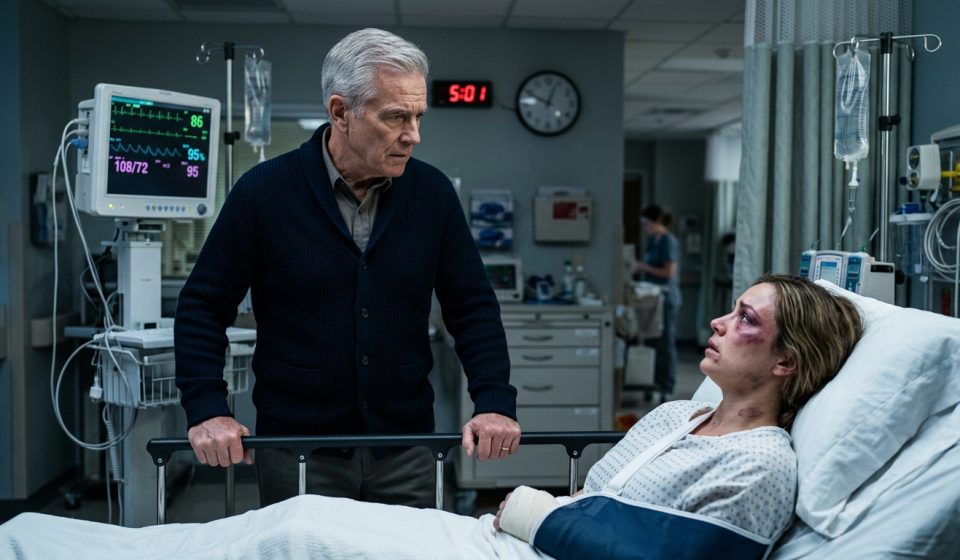
At 5 AM, my daughter was in the ICU with bruises, broken bones, a swollen eye, and fingerprints darkening her neck. Under the fluorescent hospital lights, I gripped the cold metal bed rail and asked Dorothy who had done this to her, already knowing that whatever answer came next would change our family forever.
Dorothy could barely speak. Her shoulders shook before she finally told me it was Timothy, her husband. He had lost badly at the casino again, and this time his mother and sister had helped hold her down. She couldn’t even finish explaining what happened. I was Harold Mitchell, 67 years old, and watching my injured daughter struggle to speak stripped away my shock and replaced it with something colder: determination.
Dorothy begged me not to confront them. She warned me that Timothy and his family would hurt me and Carol, my granddaughter, too. I touched the only part of her face that wasn’t bruised and told her to trust me. They had made one dangerous assumption about me—they believed I was simply an old man who could no longer protect himself or anyone else.
🎧 Listen to the Complete Story
Press ▶ Play below to enjoy the full narrated story.
That assumption had already cost me 18 months of my life. I had been living at Sunset Manor, a nursing facility that felt more like a prison. My stepson Vincent had spent months making comments about my memory, suggesting I was confused whenever I forgot ordinary little things. Eventually, he persuaded me to sign power-of-attorney paperwork supposedly intended to protect me during my “golden years.”
I trusted him. That was my mistake.
Within a week, I was sent to Sunset Manor for what was supposed to be a short stay while the family figured things out. Instead, 18 months passed. My bank accounts were frozen, my freedom disappeared, and Vincent visited only once a month, smiling while telling me how fortunate I was to live in such a nice facility.
But I wasn’t helpless.
Before Sunset Manor, I had spent 25 years in the Army and another 15 working as an IT security consultant. While people around me assumed my age meant I couldn’t understand modern technology, I quietly watched everything. I noticed unattended tablets, observed staff computers, memorized passwords, and kept my mind sharp. Every morning, I maintained the disciplined routine that had stayed with me since boot camp.
That morning was no different. I had already completed my wall pushups and crunches when a nervous young nurse named Ruth entered with medication. One glance told me she was about to give metformin to a hypoglycemic patient. I stopped her immediately and told her to check the chart. She recalculated, went pale, and realized I was right.
Mistakes like that happened regularly at Sunset Manor. The staff were overworked and undertrained, and catching those errors reminded me that experience still mattered—even when everyone around me seemed determined to treat me as incapable.
Then, at 6:15, everything changed.
The receptionist appeared at my door with an apologetic expression. There was a telephone call for me from General Hospital.
Something had happened to Dorothy.
I took the phone, and a careful, professional voice asked whether I was Harold Mitchell, father of Dorothy Brooks.
“Yes,” I answered.
After 18 months trapped inside Sunset Manor, with my finances controlled and my freedom taken away, I suddenly knew one thing with absolute certainty: if my daughter was in the ICU, nobody was going to keep me from finding out why.