
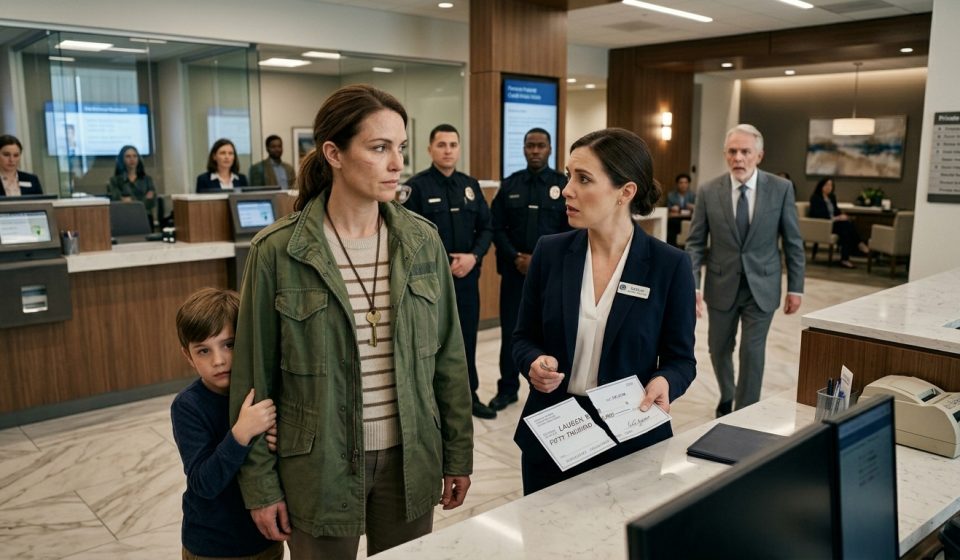
“You’re A Broke Military Failure!” My Sister Hissed, Tearing My Five-Million-Dollar Check In Half. She Called The Cops, Laughing As Bank Guards Cornered Me And My Crying Son.

My sister called me a broke military failure, tore up a $5 million check, and tried to have me arrested in front of my son. She thought she’d destroyed me—until her boss saw the brass key around my neck and whispered two words that wiped the smile off her face.
🎧 Listen to the Complete Story
Tap LISTEN TO THE STORY below to continue the full narrated story.
📖 Prefer to Read?
Scroll down to enjoy the complete written version of this story.
You’re a broke military failure, my sister hissed, tearing my five million dollar check in half. She
called the cops, laughing as bank guards cornered me and my crying son, until her boss sprinted
into the lobby, pale as a ghost. He bowed to me and uttered exactly two words, Welcome home.
My sister Natalie stopped laughing. The two words explained nothing about the torn check, my
crying son, or the guards blocking the doors. They only told Natalie that Graham Bell, the regional
president she worshipped, knew exactly who I was.
Natalie recovered first. She always did when a room threatened to move without her permission.
Mr. Bell, she’s manipulating you, she said.
Lauren has been unstable since she left the service. Look at her. She brought a child here to
make the fraud look sympathetic.
My son Eli lifted his face. My mom didn’t steal anything. Stay out of grown-up business, Natalie
snapped.
I moved Eli behind me. Customers held their phones chest high, already trusting Natalie’s badge
more than my repaired field jacket. Graham did not look at the torn check.
He looked at the small brass key hanging from a cord around my neck. Where did you get that?
He asked. My grandmother gave it to me the night before she died.
Natalie’s face changed for half a second. It was not fear. It was recognition.
Then the police arrived. Only 20 minutes earlier, Eli and I had come to the bank for an
appointment Natalie herself had scheduled. Her text had sounded unusually kind.
I found something of Grandma Rose’s in an old safe deposit file. It may help with Eli’s school
expenses. Come before closing.
Bring identification. Kindness from Natalie was never free, but I needed Eli’s summer program
deposit by Friday. Since leaving the Army Reserve, I had repaired medical transport vehicles at
the county garage.
The work was honest and money was tight. I almost ignored Natalie’s message. Then she sent a
photograph of a cream envelope bearing Grandma’s faded handwriting.
For Lauren, when she is ready to build instead of survive. I knew that handwriting. I also knew the
brass key Grandma had given me did not fit any lock in her house.
For six years, it had lived inside an old blue sewing tin beside her recipe cards and my discharge
papers. Natalie met us in the lobby, not her office. Two Veterans Foundation board members
waited near Charles Montgomery, the developer trying to turn Grandma’s mill into luxury storage.
That should have warned me. Natalie held up the cream envelope, but did not give it to me.
Before we discuss this, she said brightly, I need you to confirm that you have no financial claim
against the Rose Mercer Community Trust.
What trust? Charles smiled as though I had delivered a line he had rehearsed for me. Exactly.
There is no active trust.
Your sister is cleaning up an old clerical problem. Natalie slid over a waiver saying Grandma’s
mill and dormant accounts belonged to her. It also released the bank, Charles, and the Veterans
Foundation from future claims.
You said you found something for Eli. I did. Sign first.
Eli stood on his toes to see the envelope. Is that Great Grandma’s? Natalie leaned closer to him
with a smile that never reached her eyes. It can be, sweetheart.
Your mother just has to stop making everything difficult. I read the waiver again. The notary date
was from the previous Monday, but the signature line was blank.
The document identifier in the footer ended with the letters CM, the same initials stamped on
Charles’s leather portfolio. Who prepared this? Bank counsel. Then why is Charles’s project code
on it? Her sweet expression thinned.
That was the first crack. I folded the waiver once and placed it back on the counter. Open the
envelope.
Natalie glanced toward Charles. He gave a small nod. Inside was a ceremonial check payable to
Rose Harbor Workshop, an organization I had never heard of, for $5 million.
The memo line read, Veterans Transitional Campus. My name appeared beneath it as Authorized
Project Steward. For one second, I saw Grandma’s dream of a job training center.
Then I noticed the check was symbolic presentation stock. Real funds required trust documents
and board approval. Natalie knew that, but she raised her voice before I could say it.
A fake $5 million check with your name on it? You really thought we’d cash this? You brought it
here? I brought an old envelope. You slipped that paper inside. Charles stepped between Eli and
the counter, blocking the phones from seeing his face.
Lauren, sign the waiver and leave. We can call this confusion instead of attempted fraud. That
was when I understood they had not invited me to receive anything.
They needed my signature before Friday, and they needed me frightened enough to give it. I
asked Natalie to show the camera footage from the moment I entered. She refused.
I asked her to call the bank’s trust department. She called security instead. When I reached for
Grandma’s envelope, Natalie grabbed the ceremonial check, tore it down the center, and shouted
the insult that drew every eye in the lobby.
Now, with officers entering through the front doors, Graham Bell kept staring at my brass key.
The senior officer separated us. Natalie talked quickly about fraud and aggressive behavior.
I waited, then handed over my identification, her texts, and the unsigned waiver. Eli confirmed
that he had read her messages aloud while I drove. The guards admitted I had threatened no
one.
No arrest is being requested by the bank, Graham said. Natalie, you are suspended from
authority while we preserve the footage, documents, and your office computer. Then he asked
me to meet him the next morning at Rose Harbor Mill.
On the drive home, Eli kept Grandma’s brass key curled in his fist. He asked why Natalie hated
me. I told him hate was too simple a word.
My sister had always been afraid that anything given to me had been taken from her. Grandma
raised us above her mill after our mother died. Natalie learned to impress donors.
I learned to repair machines. During Grandma’s final year, Natalie controlled her appointments
while Charles advised her. After the funeral, Natalie claimed the mill belonged to a company she
managed.
I received the sewing tin, the key, and one sentence. A closed door is not the same as an empty
room. At home after the bank incident, I opened the blue tin again.
Beneath the recipe cards, I found a narrow groove in the wooden base. The brass key fit into it,
but there was nothing to turn. When I pressed down, the false bottom lifted.
Inside lay a faded employee badge bearing Grandma’s photograph and the words Rose Harbor
Textile Cooperative. On the back, she had written three names, Graham Bell, Maya Jenkins, and
Samuel Ortiz. Maya was the young bank archivist who had watched from behind the counter
while Natalie tore the check.
Samuel had been the mill’s night custodian. I barely slept. The next morning, Graham met us
outside the mill with Maya and an attorney from the state charitable trust division.
No cameras waited. No dramatic crowd. Just four adults, Eli, and a chain across the old loading
entrance.
Grandma had established Rose Harbor Workshop to train veterans, military spouses, and young
adults leaving foster care. The $5 million was a matching commitment, valid only while the mill
remained charitable property. Then why is my name on the check? Rose named you successor
steward, Maya said.
Not because of your rank. Because your letters from deployment contained the entire
apprenticeship model. I remembered writing to Grandma about mechanics leaving the service
with practical skills employers refused to recognize.
I had drawn workshops in the margins. I never imagined she had saved them. The trust file
vanished shortly before Grandma died.
Natalie claimed the trust was dissolved while Charles waited for a Friday deadline to buy the
land. Why didn’t anyone call me? Graham looked ashamed. Natalie reported that you declined
the role in writing.
Maya opened a folder and showed me a scanned letter with my name typed beneath a signature.
The signature looked almost right, but the date placed me at home on a Tuesday when I had
been stationed at Fort Adams for emergency logistics training. I felt something colder than anger.
If you have ever watched a relative use your silence as permission to rewrite your life, you know
how lonely that moment felt. I had spent years wondering if I was too suspicious, too wounded,
too difficult. If you believe I was right to stop signing whatever my sister placed in front of me,
leave a like or a quiet comment.
Sometimes another woman’s judgment is the handrail we need when our own family has made
us doubt every step. The forged refusal was not enough. We needed the trust instrument or
evidence showing where it went.
Graham thought the key opened a cabinet in the mill. We entered through a side door. Dust
covered the work tables, but bright orange survey marks had appeared on the walls.
Charles’s company had already begun measuring for demolition before acquiring legal title. In
grandma’s old office, the records cabinet stood open and empty. The brass key did not fit it.
Natalie had anticipated us. Maya noticed that the employee badge number matched a row
painted above the lockers downstairs. Locker rows seven belonged to grandma.
The brass key turned smoothly in its lock. Inside was an old canvas lunch bag, a wool coat, and a
red metal cash box. The cash box was empty except for a reel of black thread and a handwritten
inventory page.
Three lines had been circled. Trust ledger, founder recording, duplicate seal. She left us a list of
what should be here, I said.
And someone removed all three, the attorney replied. It felt like another defeat until Eli picked up
the lunch bag and heard something tap inside its stiff bottom. A small memory card had slipped
beneath the lining.
It held a video grandma had recorded at her desk. Her voice was weak, but her mind was clear.
She explained that Natalie had pressured her to sell the mill, saying Lauren would waste the
property on broken soldiers and other people’s children.
Grandma refused. She created duplicate evidence and placed each piece with a different
custodian. No single person could activate the trust alone.
The brass key identified the steward. The ledger was entrusted to Samuel. The duplicate seal
went into the bank’s historical archive.
The founder recording remained in the locker. Then grandma looked directly into the camera.
Lauren, if you are watching this, do not fight your sister for the building.
Ask what she promised someone else. That warning changed the target. We found Samuel living
above a bait shop two towns away.
He remembered Natalie arriving at the mill the week after the funeral with Charles and a
locksmith. She dismissed him, but he had already removed the trust ledger because grandma
told him to keep it if anyone changed the locks. He brought it from beneath his bed wrapped in
oilcloth.
The ledger recorded every donation, property restriction, and trustee vote. It also contained a
carbon copy of an option agreement. Charles had promised Natalie a private consulting payment
if she delivered clear title to the mill by Friday.
The amount was not enormous compared with the property value, but there was another clause.
He would appoint her executive director of his new downtown development foundation. Natalie
did not merely want money.
She wanted a public identity no one could question. She planned to erase grandma’s trust, sell
the mill, and present herself as the visionary who replaced an old veterans project with a
fashionable commercial district. My forged refusal made me the selfish sister who had
abandoned grandma’s dream.
Still, the ledger was handwritten. Charles could call it outdated. The recording showed pressure,
not the later theft.
We needed the duplicate seal and the missing archive history. Maya asked Graham for
permission to inspect the bank’s document tracking system. He agreed, but only through an
independent examiner.
The system showed that the trust file had not vanished. It had been reclassified as a closed
commercial account and transferred to an offsite archive under a slightly altered name. The
transfer request came from Natalie’s credentials.
The approval came from Graham’s former deputy who now worked for Charles, but the strongest
sign was a printer record. On the morning Natalie invited me to the bank, her office printer
produced the forged refusal letter, the waiver, and a draft press release titled Local Manager
Stops Military Charity Scam. She had written this story before I arrived.
The final proof sat behind a biometric lock at the bank’s regional archive. Releasing it required a
court order or consent from all living trustees. One remained besides Graham, our estranged
father, Richard Price.
I found him through an old union contact. Richard admitted Natalie had offered to forgive an old
judgment if he resigned as trustee and disappeared. When he refused, Charles’s law office
mailed him papers claiming both daughters wanted no contact.
He had kept the envelope, his trustee certificate, and his right to open the archive. He agreed to
come. The state attorney scheduled an emergency hearing at the civic auditorium.
Charles had booked the same stage to announce demolition, so the foundation, city council,
former workers, and press were already invited. We did not cancel the event. We changed who
would speak.
Natalie arrived wearing a cream suit and the expression she used whenever she expected
applause. Her attorney had told her the meeting concerned a routine delay. Charles sat beside
her with his presentation remote in hand.
A rendering of luxury offices filled the giant screen behind them. Eli and I took seats near the
back. I wore no uniform, medals, or rank insignia.
Grandma’s employee badge rested in my pocket beside the brass key. Charles opened with a
speech about rescuing neglected property. Then he invited Natalie to describe the family’s
support.
She stepped to the microphone and said, my sister could have helped preserve our
grandmother’s legacy, but some people learn how to wear sacrifice like a costume. They want
applause without responsibility. It was the coldest line she had ever aimed at me because it
repackaged my entire life into a character flaw.
Several people turned toward me. I did not answer. Natalie displayed the forged refusal letter.
Charles announced that demolition would begin after the final transfer. He clicked his remote,
expecting another rendering. Instead, the screen showed the bank’s archive access log.
Maya walked onto the stage with the independent examiner. She explained each timestamp in
plain language. Natalie’s credentials had moved the trust file.
Her printer had created the refusal, waiver, and press release. The press release existed before
the alleged crime. Natalie grabbed the microphone.
She is a junior employee with a grudge. Those records can be misunderstood. That was the
answer we expected.
Graham entered from the side aisle carrying a gray archival case. Richard walked beside him. My
sister’s hand slipped from the microphone.
Richard had aged into a narrow, tired man, but I recognized the way he rubbed his thumb across
his knuckles when nervous. He gave the court officer his original trustee certificate and
consented to opening the archive. Inside the gray case lay the trust instrument with grandma’s
raised duplicate seal, the original list of successor stewards, and a notarized restriction
prohibiting sale for private development.
The signature on my supposed refusal was compared with my verified military records. It was not
mine. Charles stood and headed for the aisle.
Samuel blocked neither his path nor his body. He simply handed a state investigator the option
agreement from the ledger. Responsibility shifted exactly where it belonged.
Then grandma appeared on the screen. Her recording did not rant or accuse. She described the
trust, named each custodian, and explained why she divided the proof.
Near the end, she said Natalie had mistaken being seen for being worthy. A title cannot make a
person a steward, grandma said. Only the care they take when no one is clapping can do that.
Natalie stared at the floor. The state attorney announced that the transfer was suspended. The
property restriction remained enforceable and the evidence would be referred for investigation
into forgery, attempted diversion of charitable assets, and coordination with a private buyer.
Graham confirmed Natalie had been terminated for manipulating bank records and staging a
false accusation against a customer. No one bowed to me. No police saluted.
No crowd suddenly became noble. The lobby videos spread, but the people who had judged me
mostly deleted their posts instead of apologizing. The guard who cornered Eli was dismissed.
The one who told the truth kept his job and apologized to my son. Charles’s investors withdrew.
His company lost the option and faced civil claims.
Natalie left through a side door with her attorney, not in handcuffs, her cream suit disappearing
down an empty service hallway while the auditorium remained focused on grandma’s trust.
Outside, Richard asked to meet Eli. I told him to write the full truth first.
A shared wound did not restore his access to my child. Natalie sent one message. We are
sisters.
Please do not let one mistake erase everything. I placed it beside her staged press release.
Forging a letter, hiding an archive, arranging a false accusation, and promising property to
Charles were not one mistake.
They were a system of choices. I replied once. Do not contact Eli.
Any trust communication goes through counsel. Family is not accessed. The bank offered a
personal settlement.
I refused it and required an outside review of Natalie’s charitable accounts instead. The review
restored two scholarship funds and money charged improperly to a food pantry. Maya received
whistleblower protection and moved into compliance.
The $5 million commitment was reissued electronically into controlled construction accounts. I
accepted the steward role temporarily with an independent board of veterans, foster care
advocates, tradespeople, and residents. By spring, Samuel supervised the mill’s restoration.
Richard wrote every week without demanding forgiveness. Natalie surrendered her claim to the
holding company, repaid legal costs, and was barred from fiduciary work. I blocked the relatives
who still called her plan a misunderstanding.
Eli chose the first project for the workshop, repair benches where teenagers could learn to fix
bicycles and small engines. Above his bench, he hung grandma’s employee badge in a plain
wooden frame. On opening morning, former workers, military families, and neighborhood kids
filled the mill.
I stood at the back while Maya unlocked the main doors. There were no giant portraits of me and
no plaque calling me a hero, just grandma’s name above the workshop and a row of clean tools
waiting for hands that needed a beginning. After everyone left, Eli and I walked upstairs to
grandma’s old office.
The red cash box sat on her desk. Inside were her recipe cards, the black thread, and the brass
key. Do we still need it? Eli asked.
I looked through the window at the repaired floor below where sunlight rested across the empty
workbenches. Not for the door, I said. I closed the cash box, but I did not lock it.
Then I placed the key in Eli’s palm. Downstairs, the new front door stood open, and for the first
time in years, no one in my family was waiting beside them to decide whether I was allowed
inside.