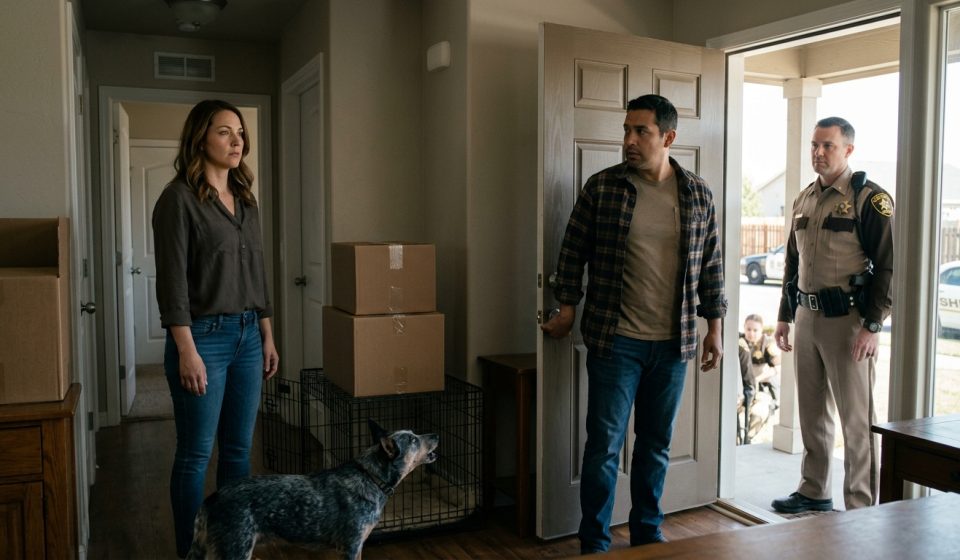
My Husband Said, If You Can’t Stand My Mother Living Here, There’s The Door. So I Used It. 30 Days Later A Sheriff Knocked And He Wasn’t Looking For Me.

My husband told me to leave if I couldn’t tolerate his mother living with us, but thirty days later, when sheriff’s deputies appeared at our door, he finally discovered why I had refused to help her.
Tap LISTEN TO THE FULL STORY below to reveal the narrated video and start listening.
When my husband said there’s the door, I never imagined that thirty days later two sheriff’s deputies would arrive looking for his mother. I was back at our house in Kuna, Idaho, collecting my dog Pepper and the last of my belongings when three firm knocks interrupted the morning. Adrian opened the front door and found a uniformed deputy waiting on the porch, with another officer behind him. They asked for Eustolia Ruelas, his mother. Adrian said nothing. Instead, he turned and stared at me, and I knew the decision I’d made weeks earlier had finally caught up with us.
My name is Jody Ruelas, and at thirty-five I managed a credit union branch in Boise. I’d worked in banking since I was nineteen, learning to notice when financial details didn’t add up. Adrian, my husband of ten years, worked as an estimator for an HVAC company. We lived in a three-bedroom house with a fenced yard, Idaho skies, and our dog Pepper. I loved that house, and I loved Adrian. Then his mother arrived from Tucson in March, carrying two suitcases and a red coffee can sealed with tape. Adrian explained that she’d sold her home and wanted to live near family. Eustolia, whom everyone called Toli, was sixty-four. She hugged her son, gave me an embrace, and carried the can into our guest room. She refused to let anyone touch it. When I asked what was inside, Adrian said it held her money from selling the house.
Within days, Toli began acting in ways I couldn’t explain. She disliked the doorbell and hid in her bedroom whenever visitors arrived. At a birthday dinner, she covered her face whenever someone tried to take a photograph. She never went anywhere alone, though she had a driver’s license. The moment came when a deputy visited our neighbor across the street. The sight of his patrol car sent Toli into the bathroom, where she stayed behind a door until he left. Adrian insisted she was frightened after losing her husband and moving away from home. I tried to be patient, but I noticed that she contributed nothing toward groceries or utilities. My paycheck covered most of our household expenses. Now it supported another adult who criticized my work hours, my cooking, and the fact that Adrian and I had no children. I began to feel like a stranger at home.
🎧 Listen to the Complete Story
Press ▶ Play below to enjoy the full narrated story.
One afternoon, I found a large envelope in our mailbox addressed to Toli. It had been forwarded from Tucson, and the return address belonged to Pima County Superior Court.
Adrian took it from my hand almost immediately, claiming it probably contained paperwork from his mother’s house sale. But I had spent years helping people understand mortgages and property transactions. Closing documents ordinarily came from title companies, not courts.
I asked Toli which title company had handled her sale. She looked over her reading glasses and told me everything was in the coffee can.
That answer only deepened my unease.
In my experience, selling a house meant receiving a check or wire transfer, accompanied by records. I couldn’t understand why Toli supposedly kept the proceeds in a taped coffee can.
Meanwhile, her criticism continued. She believed I should iron Adrian’s shirts, prepare his meals, work fewer hours, and behave according to her expectations of a wife.
Adrian kept telling me to be patient.
One afternoon in June, Toli spoke about her younger sister Norma. She complained that their mother had always favored Norma, even though Toli had spent years providing care.
She described helping with medication, bathing, and appointments, then bitterly remarked that nobody had ever repaid her.
I listened sympathetically, believing she was sharing an old family grievance.
But the suspicious envelope, the hidden cash, and her fear of police remained in my thoughts.
I had no idea how closely those strange details were connected—or why my husband seemed determined to stop me from asking questions.