Put Your Hands Down, Rafael. Nobody’s Paying You To Talk Tonight. My Aunt Laughed Across My Grandfather’s 80th Birthday Dinner. I Said, Okay, Tia Celeste.

My aunt ordered me to stop interpreting for my deaf grandfather at his eightieth birthday dinner, unaware that one quiet decision would expose what she had been hiding from him.
Tap LISTEN TO THE FULL STORY below to reveal the narrated video and start listening.
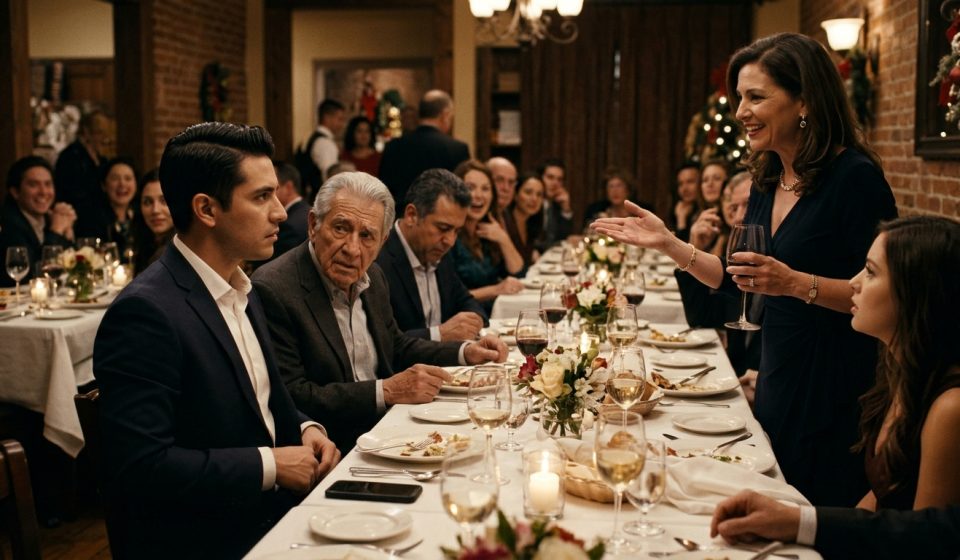
Put your hands down, Rafael. Nobody’s paying you to talk tonight. My aunt Celeste laughed across my grandfather’s eightieth birthday dinner, as though keeping him informed was something I should be ashamed of. I said, “Okay, Tia Celeste,” lowered my hands, and slid my phone across the tablecloth with live captions running. My grandfather could read every word she said next. But the trouble had started long before that dinner. My name is Rafael Ortega, and I had spent years making sure my grandfather understood the conversations happening around him. That evening, my aunt seemed determined to stop me.
I’m twenty-nine and work as a nationally certified sign language interpreter in Sacramento, California. I learned American Sign Language before I could ride a bike because my grandfather, Ernesto Ortega, was born deaf. He spent forty-six years as a cabinetmaker, building kitchens throughout our old neighborhood, and his hands taught me my earliest words. He often compared people to wood, warning that ignoring the grain could make something split. My grandmother Rosa understood that better than anyone. For fifty-two years, she helped him communicate with relatives, doctors, insurance companies, and the world beyond their home. When she died four years earlier, our family lost the person who had always connected everyone. We had three children, nine grandchildren, and plenty of in-laws, but I was the only relative who could hold a full conversation with Grandpa. I had become the bridge Rosa once was, whether anyone acknowledged that responsibility or not.
My father, Victor, lived in Phoenix and knew only about forty signs, most of them involving food. Every Sunday he called Grandpa on video, and I sat beside Grandpa interpreting their conversation. Aunt Celeste lived much closer, only twenty minutes away, yet she had never bothered to learn more than the signs for eat and money. After Rosa’s death, she became the relative who appeared to handle everything. She posted photographs with Grandpa and announced in the family group chat that she was taking care of his affairs. About three months after the funeral, she arrived at his house with a notary and a stack of documents. Grandpa signed a durable power of attorney giving her authority over his finances. Nobody invited me to interpret. Later, Celeste dismissed the papers as a formality. Grandpa explained that she’d written him a note saying she could pay bills if he became ill.
🎧 Listen to the Complete Story
Press ▶ Play below to enjoy the full narrated story.
He trusted Celeste because she was his daughter. I wanted to trust her too, although the paperwork troubled me. I was grieving Rosa, and suspecting family felt impossible. The second warning appeared whenever Grandpa needed medical care. Before cardiology appointments or hearing aid consultations, Celeste sent last-minute messages asking me to translate. She never seemed to understand that interpreting was my profession, not simply a favor she could demand whenever it suited her. I kept going because Grandpa needed to understand his doctors.
I took unpaid mornings off and drove forty minutes each way for Grandpa’s appointments. Celeste never attended, yet she posted cheerful updates afterward, sometimes using photographs from my social media. Then she began discussing Grandpa’s house. He and Rosa had bought their two-story home in Land Park in 1971. He built its cabinets himself and carved his initials beneath the banister. Celeste suggested the stairs were dangerous and that he needed other options, speaking English while he sat nearby, unable to follow most of her words.
At family gatherings, I was just a grandson. Celeste knew crowded rooms made it easier for remarks to pass untranslated. I had allowed that pattern for four years. Then she organized Grandpa’s eightieth birthday dinner at an Italian restaurant, with thirty-four guests, a slideshow, and a surprise gift. I paid my share and asked twice whether she’d hired an interpreter so I could enjoy the evening as family. Her answer revealed exactly how she saw my role.