I’m A Single Father Who Adopted The Baby Girl Twenty Families Had Already Turned Down Because Of Her Diagnosis, And Once I Knew The Truth, It Took Me Less…

I thought I was helping a little girl find a home after twenty families rejected her, but a name hidden in her medical records revealed a family secret I never expected.
Tap LISTEN TO THE FULL STORY below to reveal the narrated video and start listening.
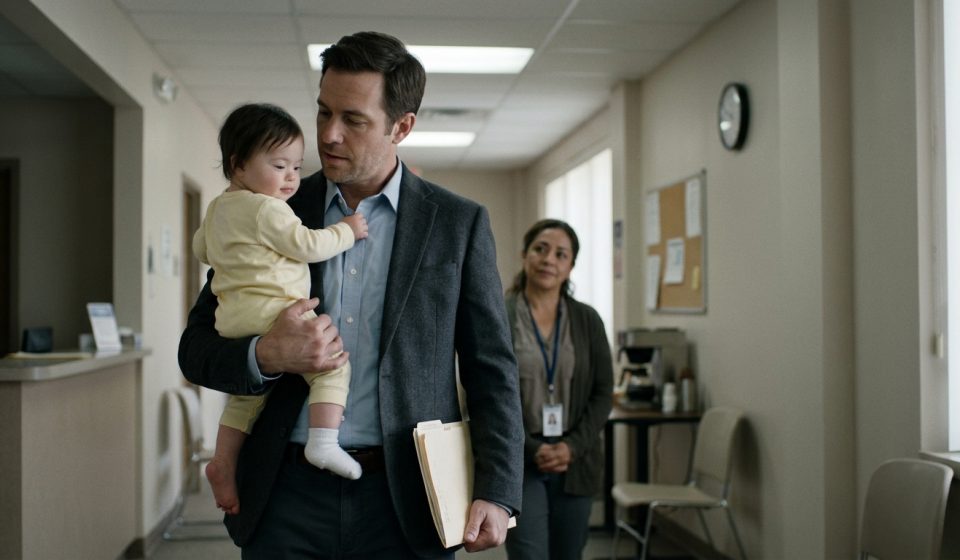
I’m a single father who adopted the baby girl twenty families had already turned down because of her diagnosis. At first, I knew her only as Maya, a fourteen-month-old child waiting at a county placement centre. I went there after my estranged brother told me his family had declined to adopt her. When a social worker placed Maya in my arms, she caught my jacket collar with her tiny fist and refused to let go. I asked to see her file, expecting medical information. I had no idea that one name inside it would change everything I believed about my family.
My name is Marcus, and I work as a claims adjuster, reviewing disability and long-term care files for an insurer in Denver. After twelve years of reading medical records, I have learned that paperwork rarely tells the whole story. But I had not spoken to my brother Greg in nearly ten years, and I never expected his sudden call to lead me toward a child. He asked whether we could catch up, and we met at a diner off Route 9. We talked awkwardly about work, weather, and distant relatives until he stopped turning his coffee cup and admitted something troubling. Greg and his wife had considered adopting a little girl with Down syndrome, then backed away after reading her medical file. They were the twentieth family to decline. The girl had spent fourteen months waiting for a home. Greg suggested I might help pay for her care instead, financially.
I asked Greg how long the little girl had been waiting, though he had already given me the answer. Fourteen months felt impossible to set aside. He told me she was at a placement centre in Colfax and mentioned that I had money, a stable job, and room to help. I said I would think about it, but I could not stop thinking about the child. The thought followed me through dinner, the drive home, and a sleepless night beneath my ceiling fan. By sunrise, I was in my car heading for Colfax without an appointment. The county waiting room was quiet, with peeling posters and stale coffee. A receptionist disappeared into the back, leaving me alone with my doubts. I began imagining how easily I could turn around, go home, and tell myself that merely showing up had been enough. Then a woman entered carrying a very small child.
🎧 Listen to the Complete Story
Press ▶ Play below to enjoy the full narrated story.
The woman wore a lanyard identifying her as Renata Ibarra, a social worker. The little girl in her arms wore a yellow sleeper, and one foot was missing a sock. Renata introduced her as Maya and placed her against my chest.
Before I could settle my grip, Maya reached up and caught my collar. She held on as though she had known me for years. Renata smiled and explained that Maya did that with everyone. I laughed, but I couldn’t explain why the moment felt so important.
I stood there holding her longer than I intended. She was warm, surprisingly heavy, and unaware of the conversations adults had been having about her diagnosis. I kept thinking about the girl twenty families had already turned down after reading her file.
At work, I spend my days reading difficult records and questioning what the pages leave out. I wanted to know what was written about Maya, not because I expected a document to define her, but because I wanted to understand what had frightened so many people.
Finally, I asked Renata whether I could see the file. She hesitated and explained that most of it concerned medical information. I told her that was fine.
As I waited for the folder, Maya’s little fist remained wrapped around my collar. I thought I was about to read the story of a child who needed a home. I had no idea how much of my own story was waiting on those pages.