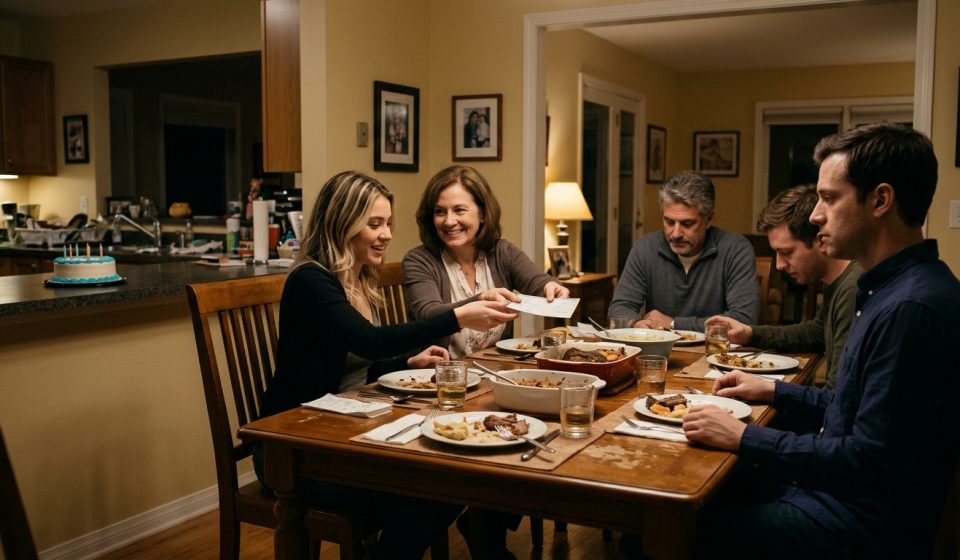
She Needs It More Than You Do, Sweetheart. You’ll Manage, My Mother Said, Sliding a $41,000 Cashier’s Check Across the Table to My Sister. My Money. I Said, Okay, Page Four Then.

My mother handed my $41,000 house savings to my golden-child sister and expected me to accept it quietly—but she’d forgotten about the agreement my parents had signed.
Tap LISTEN TO THE FULL STORY below to reveal the narrated video and start listening.
She needs it more than you do, sweetheart. You’ll manage. Those were my mother’s words as she slid a $41,000 cashier’s check across the table to my younger sister, Brianna. The money was mine, saved through years of sacrifice for a house I desperately wanted to buy. My name is Elliot Brandt, I’m 30 years old, and I work as an insurance claims adjuster in Tulsa, Oklahoma. My job involves reading documents, understanding agreements, and explaining to people what they’ve legally committed themselves to. I’ve always been patient, practical, and careful with money. Unfortunately, my family had spent years interpreting those qualities as permission to put my needs last. When my mother decided my sister deserved my house savings more than I did, she apparently expected me to accept another disappointment without protesting. But this time, I had something she couldn’t dismiss: a signed agreement.
I grew up in Broken Arrow with my parents, Donna and Greg, and my sister, Brianna, who was three years younger. In our household, Brianna’s emotions determined everyone’s priorities. When she was happy, everything was wonderful. When she was upset, the entire family scrambled to fix whatever bothered her. I was always described as independent and responsible, while Brianna was considered sensitive and deserving of extra attention. If I brought home a B, my parents questioned why it wasn’t an A. If Brianna earned a B, they celebrated because she hadn’t received a C. When I graduated from college, my mother posted a single photograph. When Brianna completed a nine-week aesthetician course, my parents organized a catered celebration with a balloon arch. I learned early that my achievements were expected, while hers were occasions for applause. Still, I kept hoping that someday my parents would recognize how much I had accomplished without their help.
For six years, I saved toward buying my first home. I drove my old Toyota Corolla until it finally stopped working, then purchased a used Honda Civic with cash rather than taking on another monthly payment. I lived in a modest one-bedroom apartment above a dry cleaner and prepared chicken and rice every Sunday to keep my food expenses manageable. By spring, my savings had reached $44,000. I was searching for a small three-bedroom house in Tulsa’s Kendall-Whittier neighborhood, and I already had mortgage preapproval. My realtor, Janelle, was enthusiastic about helping me find the right property. For the first time, homeownership felt genuinely within reach. Then my father called with a problem. My parents wanted to downsize from their Broken Arrow house into a smaller home in a retirement community in Bixby. Unfortunately, their new purchase had a deadline, and their existing property hadn’t sold.
🎧 Listen to the Complete Story
Press ▶ Play below to enjoy the full narrated story.
They needed approximately $41,000 to cover the down payment and closing costs until their old house sold.
Dad described it as a temporary bridge loan. He promised they would repay me from the sale proceeds, even offering interest.
I wanted to help, but I understood how easily informal family loans could become painful disputes.
So I agreed on one condition: everything had to be documented.
My mother laughed when I suggested a promissory note. She reminded me that they were my parents.
I explained that being family was exactly why I wanted clear terms.
To my surprise, Dad agreed.
I hired a real estate attorney named Phyllis Okafor, paying $350 for a properly drafted four-page agreement.
The first page identified the $41,000 loan. The second established the repayment deadline and 4% interest.
The third covered addresses and formal notices.
But the fourth page contained two additional protections Phyllis considered essential.
If my parents transferred the proceeds from selling their house to someone else before repaying me, the outstanding balance would become immediately due.
And if I needed an attorney to recover the money, they would be responsible for reasonable legal fees.
My mother questioned why we needed such a clause.
I assured her that if they kept their promise, it would never matter.
Both parents signed the document, and a notary authenticated the agreement.
I believed the paperwork would protect our relationship.
What I didn’t know was how important that fourth page would eventually become.