My New CEO Called My 25 Years Experience Worthless During A Three-Hour Meeting, Saying A 12-Year-Old Could Design Better. I Stayed Calm And Took Notes.

My new CEO spent three hours mocking my engineering experience, but the dangerous changes he proudly presented would eventually face a test no PowerPoint could survive.
Tap LISTEN TO THE FULL STORY below to reveal the narrated video and start listening.
My new CEO called my 25 years experience worthless during a three-hour meeting, insisting that even a 12-year-old could produce a better design. I sat quietly, taking notes while he entertained the board and dismissed everything I knew about structural safety. My name is Patrick Sullivan, although everyone calls me Mack. I’m 48 years old, a structural engineer who has spent decades designing bridges and foundations. I’ve never had a safety failure on my watch. Yet that Tuesday morning, a young executive in an expensive suit seemed determined to convince everyone that experience was a liability.
The man humiliating me was Gavin Ashford, our new 32-year-old CEO. His startup construction company had purchased Morrison & Associates only three weeks earlier. Almost immediately, he began talking about outdated methods, optimization, and replacing experienced judgment with computer algorithms. I had worked in the Army Corps of Engineers, studied while holding construction jobs, and spent my career learning what happened when structures were pushed beyond their limits. Gavin appeared convinced that spreadsheets could replace all of it.
The project at the center of his presentation was the Coastal Bay Bridge, an $80 million suspension bridge connecting the mainland to Harbor Point. My son Ryan attended the state university there and drove the route twice daily. I had spent eighteen months designing a structure that would endure harsh weather, heavy traffic, and decades of use. To me, every calculation represented people who would eventually trust their lives to that bridge.
🎧 Listen to the Complete Story
Press ▶ Play below to enjoy the full narrated story.
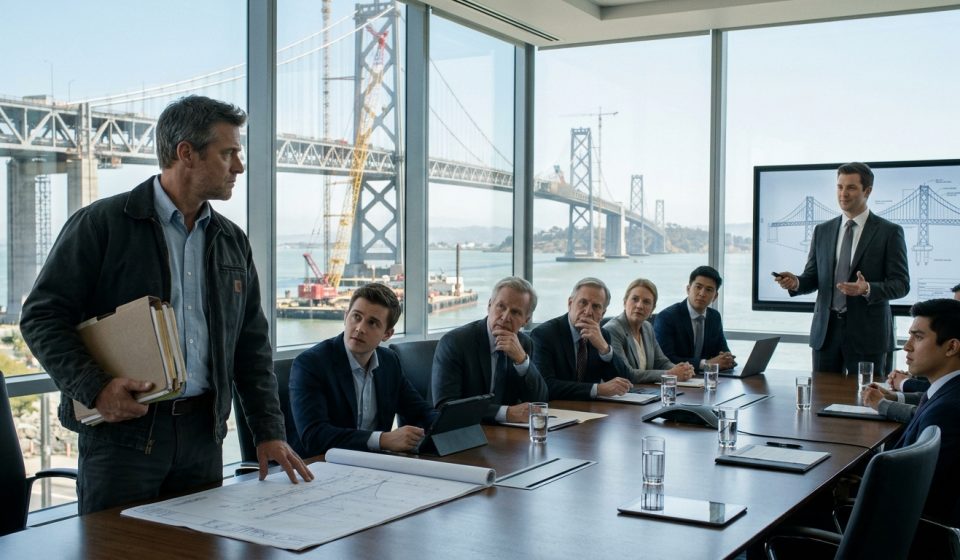
Gavin called the review meeting for nine that morning. Board members and three junior engineers filled a conference room overlooking the construction site. I arrived carrying my tablet and a thick folder of structural reports, including wind analyses, load calculations, seismic projections, and fatigue studies.
Gavin stood beside a large screen displaying my blueprints. He pointed toward the concrete supports, steel specifications, and cable requirements, describing them as examples of everything wrong with modern infrastructure.
I tried to explain that the design reflected actual conditions at the site. He barely acknowledged me.
Instead, he portrayed me as an old-fashioned engineer who feared innovation.
Then he displayed his revised plans.
I immediately noticed something alarming. Six main support pillars had become four. Grade 50 steel had been replaced with cheaper grade 36 material. Cable tensioning requirements had been reduced to minimum standards rather than the calculations developed specifically for the location.
Gavin announced that these changes would save $2.9 million.
Several people around the table appeared impressed.
I wasn’t.
Those specifications weren’t unnecessary expenses. They were protections against forces that would act on the bridge throughout its lifetime.
I warned Gavin that the changes reduced safety margins, especially under sustained wind loading. He ordered me to sit down.
When a board member asked about wind, Gavin dismissed my concerns as an obsession with unlikely disasters. He argued that Northern California wasn’t the Florida coast and that a major hurricane was hardly a realistic concern.
But hurricanes weren’t what worried me.
The bay created particular wind patterns, and I had spent months accounting for them. I tried explaining the difference, but Gavin interrupted again.
He showed the board another cost comparison, contrasting my $80.2 million design with his $77.3 million alternative.
The junior engineers nodded as though the savings settled everything.
My new CEO called the changes progress, but he hadn’t answered the one question that mattered: what would happen when those winds reached the bridge?