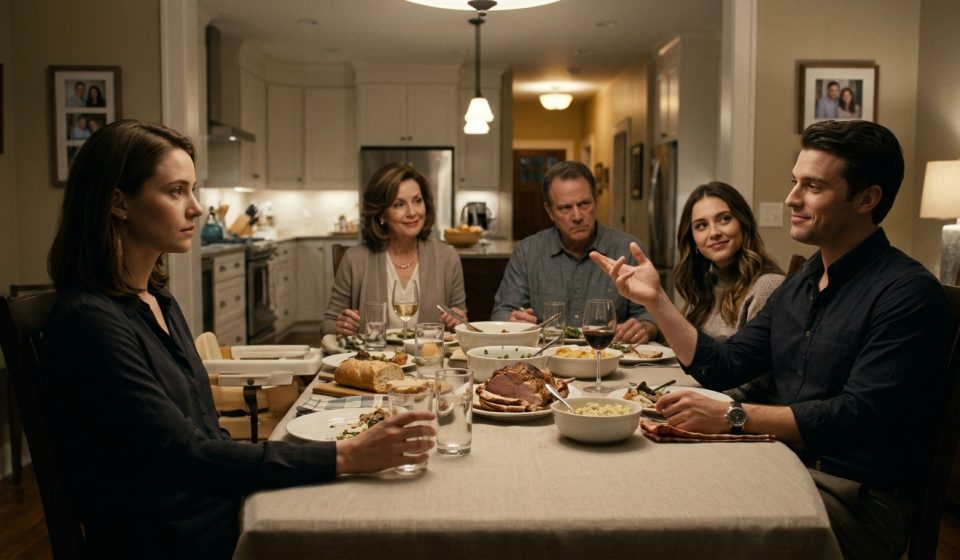
My Sister’s Boyfriend Mocked Me At Dinner, You’re Still Unemployed, Right? Everyone Laughed. Dad Told Me To Stop Making The Family Look Bad.

The whole family laughed when my sister’s boyfriend questioned my career, but one careless detail about his own job made me realize his perfect reputation might be hiding something.
Tap LISTEN TO THE FULL STORY below to reveal the narrated video and start listening.
The night my sister’s boyfriend mocked me at dinner, everyone seemed to think I was the family embarrassment. My name is Joanna Miles, I’m twenty-six, and I’ve spent most of my life being judged by relatives who care more about appearances than the truth. They measure people by job titles, salaries, and impressive stories they can repeat to their friends. I learned long ago that defending myself rarely changed their opinions. But when my sister brought her new boyfriend to dinner, I had no idea his own words would give me a reason to listen more carefully.
He leaned back in his chair and asked whether I was still unemployed.
The question sounded casual, but everyone understood the insult.
My family laughed.
Dad even nodded as though the joke confirmed something he had always believed about me.
I felt the familiar sting of humiliation, the same feeling I had carried since childhood whenever my relatives compared me with people they considered more successful.
For a moment, I considered ignoring it.
That was what I usually did.
I could swallow the embarrassment, let the conversation move on, and pretend the laughter hadn’t hurt.
But something about that evening felt different.
🎧 Listen to the Complete Story
Press ▶ Play below to enjoy the full narrated story.
My sister’s boyfriend seemed completely comfortable judging a woman he barely knew.
He spoke confidently, as though he understood my entire life from a few family conversations.
Then he started talking about his own career.
He described his responsibilities and achievements with the easy certainty of someone accustomed to being admired.
My parents listened eagerly.
My sister appeared delighted that he was making such a strong impression.
But while he continued talking, one particular detail caught my attention.
Something about his explanation didn’t fit.
I couldn’t immediately identify why it bothered me, but I knew enough about professional work to recognize that certain details weren’t aligning.
I kept listening.
I didn’t challenge him or interrupt the conversation.
Instead, I watched him carefully, remembering the things he said.
And as he continued boasting, I began to wonder whether the impressive man sitting across from me was quite who he claimed to be.
The dinner had started on a quiet Sunday evening.
I had driven back to my parents’ neighborhood with the same tight feeling in my chest that always accompanied family visits.
The lawns were neatly trimmed, the mailboxes matched, and the houses looked peaceful from the street.
Everything appeared perfectly respectable.
That was important to my parents.
Inside, Mom was arranging plates on the kitchen island as though preparing a showroom.
She greeted me with a smile, but her first concern wasn’t how I had been.
She wanted to know why I had arrived so close to dinnertime.
Dad barely looked up from the mail he was reading.
I sat down quietly.
A few minutes later, my sister entered with Evan Carter.
He wore a polished smile and carried himself with remarkable confidence.
My parents immediately brightened.
They welcomed him warmly, encouraged him to talk, and laughed enthusiastically at his stories.
The contrast was impossible to miss.
They seemed proud simply to have him at the table.
I was barely part of the conversation.
Looking back, the evening my sister’s boyfriend mocked me was also the evening I noticed how completely my family trusted his image.
They admired his confidence without questioning what lay beneath it.
And when he began describing his work in greater detail, I heard something that made me stop and think.
It was a small inconsistency, easy to overlook.
But I couldn’t forget it.
I had no intention of making a scene.
I simply wanted to understand why his story didn’t add up.
Because sometimes the most revealing thing a person says isn’t an insult.
It’s the detail they never expected anyone to recognize.