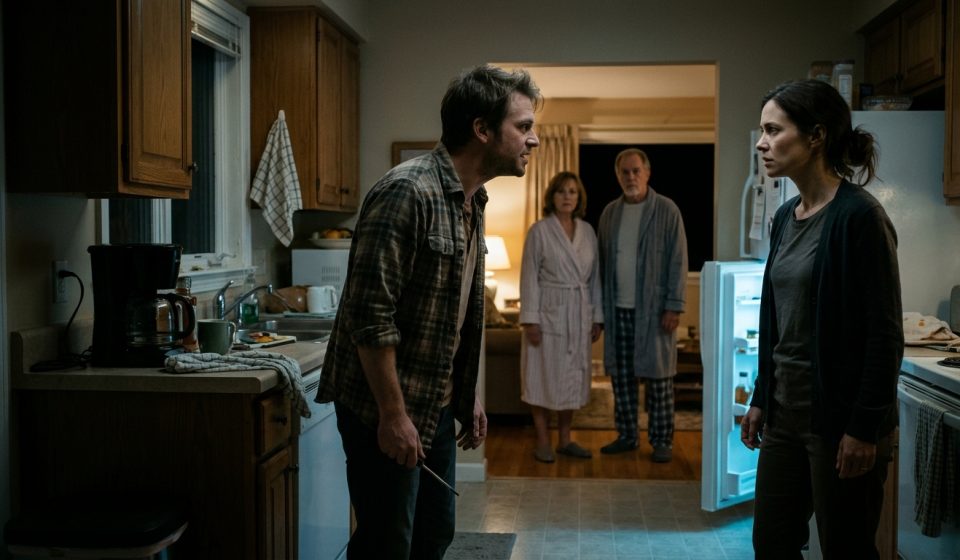
At 4 A.M., My Stepbrother Drove A Screwdriver Into My Shoulder. I Felt The Warmth Of Blood As My Parents Laughed. You’re So Dramatic! Trembling…

At four in the morning, my stepbrother did something unforgivable, and my family’s reaction revealed a truth I could no longer ignore.
Tap LISTEN TO THE FULL STORY below to reveal the narrated video and start listening.
At 4 a.m., my stepbrother drove a screwdriver into my shoulder, and the memory of that night would eventually change everything I believed about my family. My name is Phoebe Jensen, and for years, I had lived quietly beneath the shadow of my mother’s favorite child. My family saw me as overly sensitive, dramatic, and unimportant. They never understood the responsibilities I carried or the work I performed outside their carefully maintained world. To them, I was simply the daughter who never demanded attention. But beneath that silence was someone they had never truly bothered to know.
From the outside, our family looked almost perfect. We had a white picket fence, neatly trimmed hedges, and smiling faces in every Christmas photograph. My mother, Sandra, worked hard to maintain that image. She believed keeping the peace meant avoiding anything uncomfortable, even when the truth was being ignored.
My stepfather, Gary, supported her approach. And my stepbrother Mark was the center of their attention. At family dinners, my mother celebrated his accomplishments as though every promotion deserved a grand announcement. He enjoyed the admiration, smiling confidently while everyone around the table congratulated him.
I usually sat quietly, watching the familiar scene unfold.
🎧 Listen to the Complete Story
Press ▶ Play below to enjoy the full narrated story.
Mark worked as an assistant sales manager, a position my family treated as proof of extraordinary success. Whenever he mentioned his career, my mother listened with obvious pride.
My achievements received a very different response.
I remembered telling them that I had completed a difficult federal certification, one that only a small number of analysts managed to pass.
Gary barely looked away from Mark.
He gave me a distracted smile, patted my hand, and suggested that I should be grateful for my safe little government job.
I didn’t argue.
There were things about my work that I couldn’t discuss openly. My responsibilities involved analyzing sensitive intelligence and handling information that required absolute precision.
I understood the seriousness of those responsibilities. My family, however, saw only an ordinary office job.
Over time, I learned that explaining myself rarely changed anything.
I had become the extra person in a family built around someone else’s importance. I knew when to smile, when to remain silent, and how to make myself smaller whenever attention turned toward me.
My mother preferred it that way.
She often told me that I thought too much and should simply enjoy life. But what she really seemed to want was a daughter who never disturbed the comfortable family image she had created.
The double standards appeared at every holiday gathering.
Mark could arrive late, smelling of alcohol and offering excuses, and my mother would greet him with delighted affection.
If I arrived even slightly behind schedule, she would glance at her watch and remind me that punctuality revealed a person’s character.
I stopped expecting fairness.
Still, a small part of me hoped that one day they might recognize how much effort I put into my work and how carefully I conducted my life.
One memory from a summer barbecue stayed with me.
Mark stood beside the grill, boasting about another promotion while Gary listened approvingly. The smell of smoke and beer drifted across the yard, and my mother laughed at almost everything Mark said.
When I mentioned that my team’s analysis had helped prevent an attack overseas, she dismissed the achievement.
She told me I always made things sound dramatic.
That word followed me long after the gathering ended.
I sat alone on the back porch that night, holding a mug of black coffee while fireflies moved through the darkness.
At work, silence and precision could protect lives. At home, silence seemed to protect people who refused to acknowledge the truth.
I began to wonder how much longer I could continue accepting their version of who I was.
At 4 a.m., my stepbrother drove a screwdriver into my shoulder was the kind of sentence I never imagined would describe my own life. Yet even before that terrible night, the warning signs had been there.
I just hadn’t understood how far my family’s double standards might go.
And when my mother next accused me of being dramatic, it would no longer be a harmless insult at a family dinner.
Something was coming that would force everyone to confront what they had spent years refusing to see.