We No Longer Require Your Services, My Supervisor Called, While I Was Preventing A $40,000 Per Hour Production Shutdown At The Plant. Effective Today…

After 38 years of keeping a factory running, one unexpected phone call threatened to erase everything Douglas had worked for—and his supervisor had no idea what was happening on the production floor.
Tap LISTEN TO THE FULL STORY below to reveal the narrated video and start listening.
I was Fired During a Production Crisis while trying to prevent a $40,000-per-hour shutdown at the manufacturing plant where I had worked for eleven years. My supervisor called to tell me my services were no longer required, even as I stood beside a hydraulic press showing unmistakable signs of mechanical failure. I had spent 38 years maintaining industrial equipment, and I understood exactly what those unstable pressure readings meant. The machinery needed immediate attention, but the man making decisions about my employment seemed completely unaware of the danger unfolding on the factory floor. It was 6:47 on a Tuesday morning, and I had already spent twenty minutes watching a pressure gauge that refused to stabilize. Something was seriously wrong, and I knew from experience that ignoring the warning could turn an expensive repair into a disastrous production shutdown.
My name is Douglas Mai. I was 61 years old, and I had spent 38 years working in industrial maintenance across Ontario. For the past eleven years, I had been the senior maintenance technician at Lakeview Precision Manufacturing, a mid-sized operation outside Hamilton producing stamped metal components for the automotive industry.
Our facility operated three production lines with 42 employees on the floor. The equipment ran twenty hours a day, five days a week, sometimes longer when production demands increased. Keeping those machines operating safely wasn’t simply a job to me. It was a responsibility I had carried throughout my working life.
I had learned my trade under Gerald Kowalik, an experienced technician who taught me that good maintenance workers often went unnoticed when everything operated correctly. But when something went wrong, their knowledge suddenly became indispensable. Those words had stayed with me for decades.
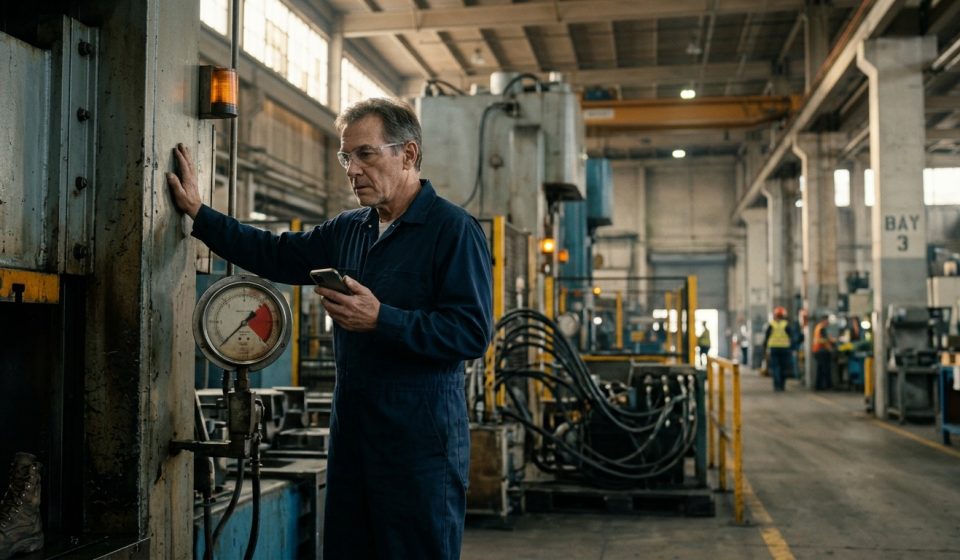
That morning, I was standing beside the hydraulic press in Bay 3. Its pressure gauge had refused to stabilize for twenty minutes. To someone unfamiliar with the machinery, the movement might have seemed insignificant. To me, it was an unmistakable warning that something inside the system was deteriorating.
🎧 Listen to the Complete Story
Press ▶ Play below to enjoy the full narrated story.
The press was approximately twenty years old and had already undergone a major rebuild. I suspected early-stage seal degradation combined with contamination inside the hydraulic fluid circuit. These were problems that could become dangerous if ignored.
What troubled me most was that I had already reported the issue twice during the previous six weeks. My written maintenance reports described the symptoms, the potential mechanical failure, and the repairs I believed were necessary.
My supervisor, Craig Bellows, had reviewed those reports. He had been in his position for approximately eighteen months and, as far as I knew, had never worked directly on a plant floor.
When I explained that the repair would cost roughly $14,000, including replacement parts, a fluid flush, and labor, Craig told me he would raise the matter during the next budget meeting.
That conversation had happened five weeks earlier.
Nothing had been repaired.
Now, with the gauge moving unpredictably in front of me, my supervisor fired me during a production crisis that I had repeatedly warned management about. I could feel the seriousness of the situation growing with every passing minute.
Then my phone vibrated inside my breast pocket.
I expected a call about another production line that had been running behind schedule since the shift change.
Instead, Craig’s name appeared on the screen.
I answered while keeping my eyes on the unstable gauge.
He addressed me formally and explained that management had been reviewing the maintenance department. The company had decided to restructure its operations and move toward a contracted service model.
I remained silent as the pressure reading dropped again.
Then Craig explained what the decision meant for me personally.
My position was being eliminated, effective at the end of the business day.
For a moment, I simply absorbed his words. I had spent eleven years keeping that facility running, and now my employment was ending while I stood beside a machine that desperately needed attention.
I placed my hand against the press housing and felt the unusual vibration beneath my palm.
There was something Craig needed to understand before our conversation ended.
And I wasn’t certain he understood just how little time the plant had left to address the problem.