
Parents Always Called Me the Dumb One, While My Sister Got a Full Ride to Harvard. On Her Graduation Day, Dad Said She’d Inherit Everything, a New Tesla and a 13-Menner’s Mansion.

My parents called me the dumb one for most of my life, but when Dad publicly promised my sister everything our family owned, a stranger approached my table carrying an envelope that seemed to have been waiting for that exact moment.
Tap LISTEN TO THE FULL STORY below to reveal the narrated video and start listening.
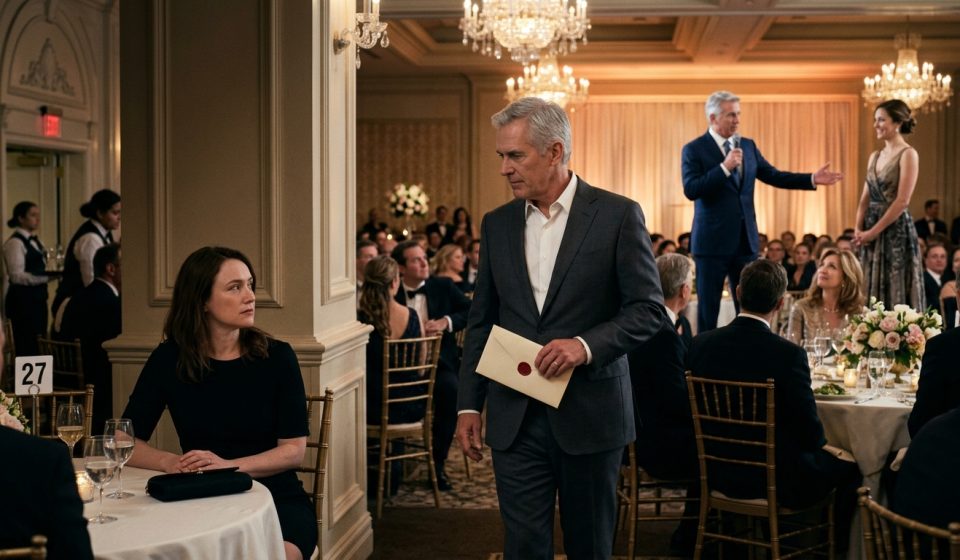
My parents called me the dumb one while celebrating my older sister Miranda as the brilliant daughter who had earned her place at Harvard. I had spent thirty-two years living in her shadow, but nothing prepared me for the night my father stood before 350 guests and announced that she would inherit everything. He named the Westchester mansion, the Tesla Model S, and Whitford Properties LLC, the real estate business my grandmother had built from a single duplex in Queens. At its last independent valuation, the company’s portfolio was worth approximately $92 million. Dad described each asset slowly, clearly enjoying the attention. When he finished listing everything Miranda would receive, he looked toward the audience without mentioning me once. I sat quietly at table twenty-seven, near the service entrance, partly hidden behind a pillar.
I was wearing a simple black Zara dress that had cost seventy-nine dollars, the nicest outfit I owned that still fit. Around me, relatives wore Valentino, Armani, and expensive clothing that made their wealth obvious without anyone needing to discuss money. My mother had personally assigned me to that distant table. When I arrived, she’d taken my arm and quietly instructed me not to draw attention to myself because this was Miranda’s night. The words stung, even though they weren’t surprising. My family had always acted as though my presence was something to manage rather than celebrate. I found my seat, placed my clutch on the table, and folded my hands in my lap. Watching Dad speak, I realized how completely he had accepted the idea that only one of his daughters mattered.
Then I noticed a silver-haired man in a gray suit moving through the crowd. He wasn’t wandering or looking for a seat. He walked with the focused purpose of someone who knew exactly where he was going. Straight toward table twenty-seven. He stopped beside me without smiling or introducing himself. Instead, he placed a heavy cream-colored envelope into my hands. Quietly, he told me that my grandmother had instructed him to wait until my father showed me exactly who he was. He nodded toward the stage, where Dad was still speaking and still ignoring me. The stranger said he believed that moment had arrived. Before I could ask who he was or what he meant, he turned and walked away.
🎧 Listen to the Complete Story
Press ▶ Play below to enjoy the full narrated story.
I stared at the envelope. It was sealed with actual red wax, something I’d only seen in movies, and there was a notary stamp in one corner.
The date was September 12, 2019.
My grandmother had been dead for eleven months. Yet this stranger had apparently been carrying out instructions she had prepared years earlier.
I excused myself from the table and walked through the service entrance into an empty hallway near the kitchen.
The air smelled of clean linen and industrial cleaner. I stood alone, listening to the distant sounds of the celebration, and broke the seal.
My name is Dulcie Ann Whitford. I’m thirty-two years old, and I have dyslexia, diagnosed when I was nine.
Teachers had described me as slow, and my parents had repeated that judgment at home, sometimes in conversations they thought I couldn’t hear.
Miranda, meanwhile, had attended Harvard as an undergraduate and later Harvard Business School. Her achievements were everything my family valued.
I became the daughter whose artwork stayed in a drawer while Miranda’s went on the refrigerator.
Her report cards were displayed proudly. Mine were discussed privately.
In family Christmas photographs, she stood in the center while I was placed slightly behind everyone else.
At business events, Dad introduced Miranda with pride and then introduced me without adding anything about who I was.
Being treated as less intelligent became so familiar that I almost stopped questioning it.
But reading slowly was never the same as understanding slowly.
I knew that distinction, even when my parents refused to see it.
Now I was standing in a quiet hallway, holding an envelope from the one person in my family whose opinion had always felt different.
And I had no idea why she had arranged for it to reach me on this particular night.