
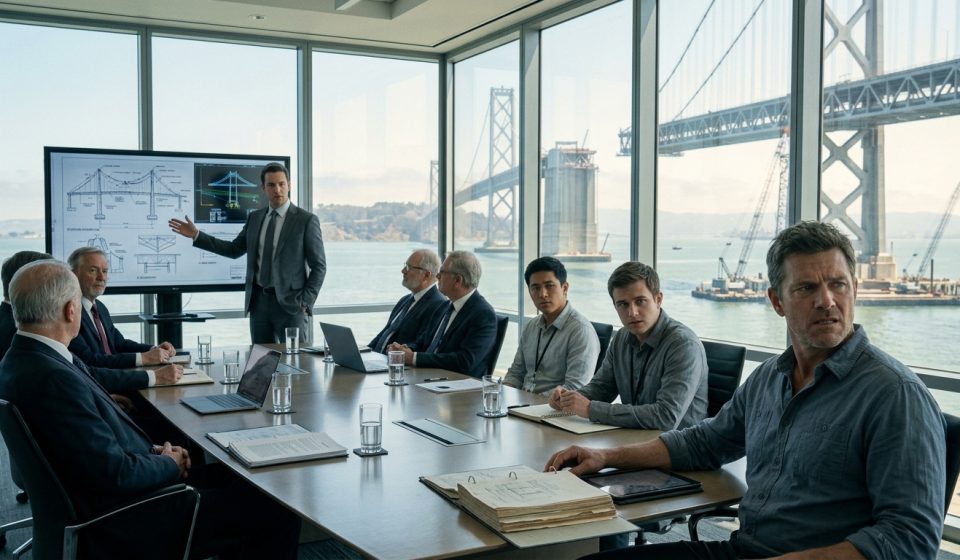
My New CEO Called My 25 Years Experience Worthless During A Three-Hour Meeting, Saying A 12-Year-Old Could Design Better. I Stayed Calm And Took Notes.

After my new CEO mocked my 25 years of engineering experience in front of everyone, I realized his confidence might be hiding a mistake that could put lives at risk.
Tap LISTEN TO THE FULL STORY below to reveal the narrated video and start listening.
I had spent most of my working life building structures people could trust, but nothing prepared me for the morning my new CEO mocked my engineering experience in front of an entire conference room. For twenty-five years, I had worked as a structural engineer, designing bridges, skyscraper foundations, and structures meant to withstand earthquakes and severe weather. I had never experienced a safety failure on a project under my watch. Yet there I was, listening to a thirty-two-year-old executive dismiss decades of hard-earned knowledge as though it meant nothing. He wore an expensive suit, spoke with absolute confidence, and seemed convinced that everything experienced engineers had learned could be replaced by modern software and clever financial calculations. His name was Gavin Ashford, and he had recently become CEO after his startup construction company acquired the firm where I worked. Within weeks, he was already talking about outdated methods, inefficient processes, and the need to change how everything was done. I could sense that people like me were exactly what he wanted to replace.
My name is Patrick Sullivan, although almost everyone calls me Mack. I was forty-eight years old, and construction had been part of my life since childhood. After high school, I served four years in the Army Corps of Engineers. Later, I worked construction during the day while studying at night and on weekends. I had earned my place in this profession through exhausting schedules, difficult projects, and countless lessons that couldn’t be learned from a computer screen. My father had always told me to build things correctly the first time because other people’s lives depended on the result. I carried that advice into every job. Whether I was designing a foundation or calculating the forces acting on a bridge, I never forgot that someone would eventually trust their safety to my decisions.
Gavin saw the profession differently. To him, experienced engineers represented an expensive old guard that needed modernization. He preferred algorithms, spreadsheets, and promises of efficiency. I understood the importance of new technology, but I also understood what could happen when someone reduced engineering to a cost-saving exercise. Gavin had never spent years watching structures respond to real conditions on a construction site. He had never carried the same responsibility for a design that might serve the public for a century. Nevertheless, he seemed eager to lecture the people who had. His confidence was extraordinary, and the people around him appeared increasingly willing to believe that confidence was the same thing as expertise.
🎧 Listen to the Complete Story
Press ▶ Play below to enjoy the full narrated story.
The project closest to my heart was the Coastal Bay Bridge, an eighty-million-dollar suspension bridge connecting the mainland to Harbour Point, where the state university was located. My son Ryan traveled that route twice daily for his engineering classes.
I had spent eighteen months designing the bridge, and every calculation mattered to me. I thought about Ryan using it, but also about the thousands of other people who would depend on its strength.
A bridge must survive more than ordinary traffic. Wind, rain, earthquakes, changing temperatures, and heavy trucks all place demands on its structure. Saving money means nothing if the finished bridge cannot withstand those forces.
That Tuesday, Gavin scheduled a design review for nine in the morning. The meeting room overlooked the construction site through tall windows. He invited the board of directors and three junior engineers.
I arrived carrying my tablet and a thick folder of structural reports. Inside were load calculations, wind analyses, seismic projections, and fatigue studies. I had checked the numbers carefully.
At the front of the room, Gavin stood beside a large screen displaying my bridge blueprints. His expensive suit and confident smile made it obvious that he intended to put on a performance.
When my new CEO mocked my engineering experience, I was prepared to defend my work with facts rather than anger.
But as he began criticizing the design, I wondered whether anyone in that room understood what was really at stake.