
At My Cousin’s Wedding, His Best Man Smirked At Me In Front Of 84 Guests, What Do You Do, Sweetheart, Bake Cookies? I Said, Hades. Look It Up.

My cousin’s wedding best man thought the quiet woman standing near the dessert table would make an easy joke, but he had no idea who he was speaking to.
Tap LISTEN TO THE FULL STORY below to reveal the narrated video and start listening.
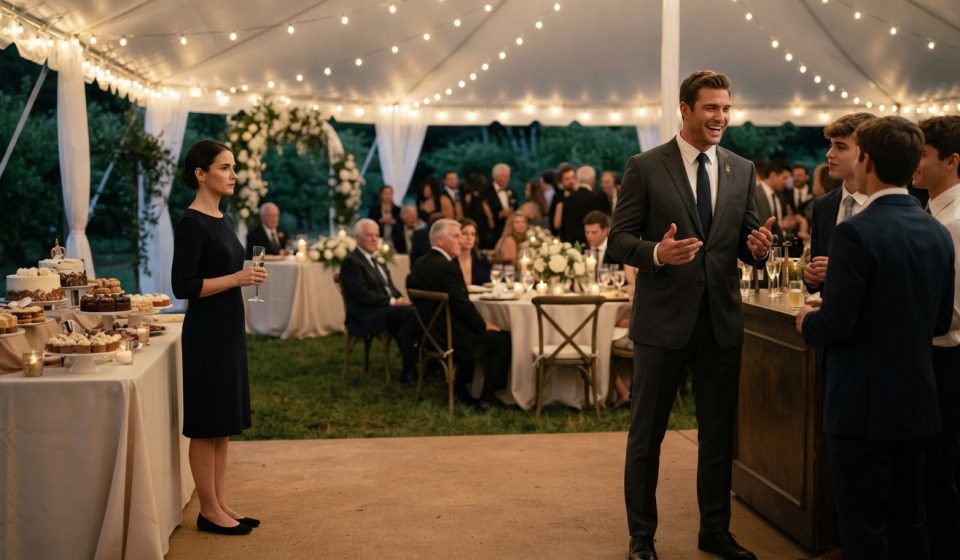
My cousin’s wedding best man, Carson Whitlock, had nearly finished raising a champagne flute to his mouth when he decided to make me part of the evening’s entertainment. I had spent most of the reception standing quietly at the edge of the tent near the dessert table, taking up as little space as possible while keeping a clear view of the exits. Eighty-four guests had come in from the lawn at Stillhaven Orchard after the ceremony. I knew there were eighty-four because I had counted them twice. Counting rooms was an old habit, one that remained even years after leaving behind the kind of work that had taught me to do it.
My cousin Maddox had married that afternoon beneath a white floral arch, which still glowed beneath the string lights when the speeches began. Maddox was a genuinely good man with a soft heart, but he had never been particularly skilled at recognizing when someone was lying to him. That weakness explained how Carson had ended up holding the microphone as his best man.
Carson had delivered an extraordinary toast. Standing beneath the arch, he spoke emotionally about brotherhood, men who had bled beside him, those who had never returned home, and the responsibility of survivors to carry their names. He even spoke three names aloud, giving a first name, rank, and hometown for each. By the end, half the reception tent was crying. The bride wiped her eyes, while her grandfather—the quiet elderly man seated at the head table—lowered his face into his hand and remained that way for a long time.
🎧 Listen to the Complete Story
Press ▶ Play below to enjoy the full narrated story.
At first, I assumed weddings simply affected the old man deeply.
I did not yet understand why those three names had struck him so hard.
I had met Carson only three times before the wedding, but there was something I had noticed every time.
He always wore the same small gold trident lapel pin.
And he always made certain people noticed it.
Carson had a story for every room: Ramadi, a rooftop, a door that went hard, and a team he supposedly could not identify because of an agreement.
He spoke in clipped fragments designed to sound dangerous.
People listened.
Carson was tall, tanned, confident, and carried himself in a way that encouraged strangers to assume competence.
Throughout the reception, my cousin’s wedding best man moved around the tent like a politician.
By the time the cake appeared, three of Maddox’s college friends had gathered around Carson near the bar.
From twenty feet away, I heard him telling another dramatic story.
According to Carson, his element had once been pinned down in a courtyard outside Belugia, where he carried a wounded man four hundred meters under fire.
The college friends were captivated.
One actually called him a hero.
Carson lowered his eyes and shook his head modestly, performing humility as though remembering the experience carried too much weight.
But I wasn’t captivated.
I recognized the story.
Almost word for word.
I had read it on page 204 of a book during a long flight to a place I couldn’t name.
The difference was simple.
The man who wrote that book had actually done what Carson was now describing as his own experience.
Still, I said nothing.
My work had taught me something else long ago: the loudest person in a room is almost never the dangerous one.
Sometimes the most useful thing you can do when someone is lying is simply remain quiet and let them keep talking.
So that was exactly what I did.
I drank my water.
I watched the exits.
And I let Carson talk.