
Stepchildren Told Me To Keep My Opinions To Myself About Their College Plans, So I Kept My Wallet To Myself Too. The Counsellor Called Their Mother First.

When my stepchildren told me to keep quiet about the college decisions I was expected to help fund, eight years of showing up for them suddenly felt very different.
Tap LISTEN TO THE FULL STORY below to reveal the narrated video and start listening.
My stepchildren told me to keep quiet about their college plans after I’d spent nearly a decade helping raise them. I’m Daniel, forty-eight, and I’d been married to my wife Laura for eight years. Her twins, Emily and Josh, were ten when I entered their lives. They were shy, polite kids obsessed with Minecraft and strawberry Pop-Tarts. I never tried to replace their biological father. I simply showed up—for school runs, dentist appointments, sleepless flu nights, and the ordinary responsibilities that gradually turn someone’s presence into something dependable.
Their biological father, Marcus, lived in another state. He called perhaps twice a year and sent birthday cards containing twenty-dollar bills. So I became the constant. Over eight years, I paid $4,000 each for braces, covered summer camps and piano lessons, paid Josh’s basketball expenses, bought new high-school laptops, and helped with Emily’s therapy when her anxiety became difficult during junior year. I tracked our family budget in a spreadsheet, and by senior year I’d contributed roughly $68,000.
Laura worked twelve-hour nursing shifts, while I worked in construction management. Together, we’d built what felt like a stable family. Then senior year arrived, and college conversations began around our dinner table. Emily dreamed about a private art school in Chicago costing $48,000 a year. Josh talked about heading to the West Coast to study film or psychology at schools costing more than $42,000 annually. I was proud of their ambitions—until the acceptance letters arrived and the numbers became impossible to ignore.
🎧 Listen to the Complete Story
Press ▶ Play below to enjoy the full narrated story.
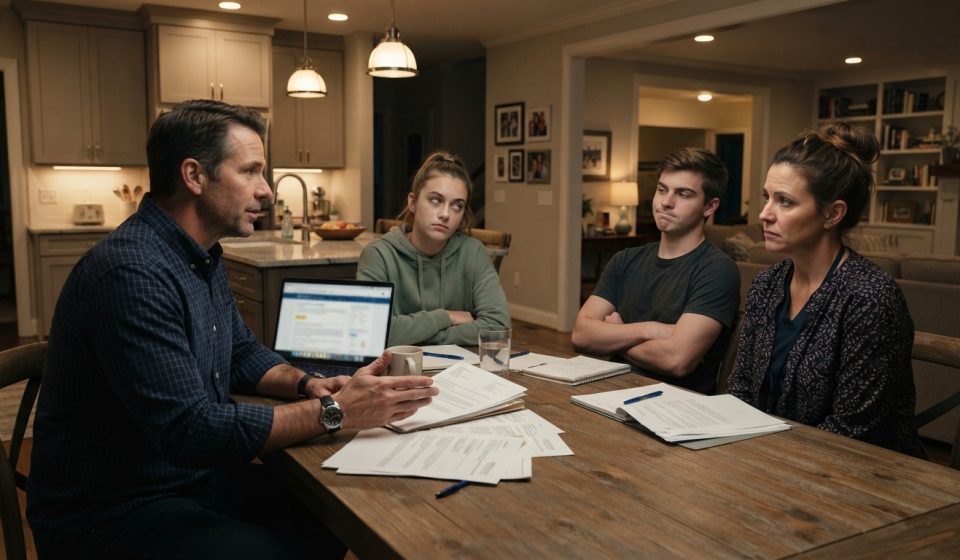
One evening, I sat both of them at the kitchen table.
FAFSA forms, scholarship offers, loan calculators, and cost breakdowns covered the surface.
I wasn’t trying to destroy their dreams.
I wanted them to understand the math.
I explained that attending the state university would allow their scholarships and the money Laura and I had saved to cover almost everything. They might graduate owing roughly $10,000 each—debt that seemed manageable.
Choosing their expensive private schools was completely different.
They could leave college owing around $150,000.
We couldn’t carry that.
Emily rolled her eyes.
Josh leaned back and smirked.
Then Emily told me their college decision was between them and their mother.
I didn’t need to get involved.
At first, I thought it was teenage sarcasm brought on by stress.
Then she leaned forward and made her position unmistakable.
I wasn’t their real father.
According to her, that meant I didn’t get to make decisions about their education.
Josh agreed.
Maybe I should simply keep my opinions to myself.
They would figure everything out with their mother.
The silence afterward felt enormous.
Laura froze with her tea halfway to her mouth.
I wasn’t furious.
I felt hollow.
For nearly a decade, I’d paid bills, attended their activities, sacrificed time, and been present whenever they needed somebody. Yet when an important financial decision arrived, apparently my role had changed.
I was allowed to contribute.
I simply wasn’t allowed an opinion.
I said nothing that night.
I cleared the table, kissed Laura on the temple, and went to bed.
But sleep didn’t silence my thoughts.
Receipts, overtime shifts, Saturdays spent at games instead of golfing with friends—everything replayed in my head.
The next morning, I packed my lunch and went to work as usual.
Nobody there would have known anything was different.
But something inside me had changed.
It wasn’t rage.
It wasn’t revenge.
It was resolution.
After my stepchildren told me to keep quiet, I finally had to decide what that boundary meant for me too.