A Tea, Midnight. My Family Toasted My Future Like They Cared What Happened To Me. My Mom Kept Asking When The Account Would Finally Be Accessible.

As my family toasted my future, I couldn’t stop noticing that my mother seemed far more interested in when my money became accessible than in what I actually wanted for my life.
Tap LISTEN TO THE FULL STORY below to reveal the narrated video and start listening.
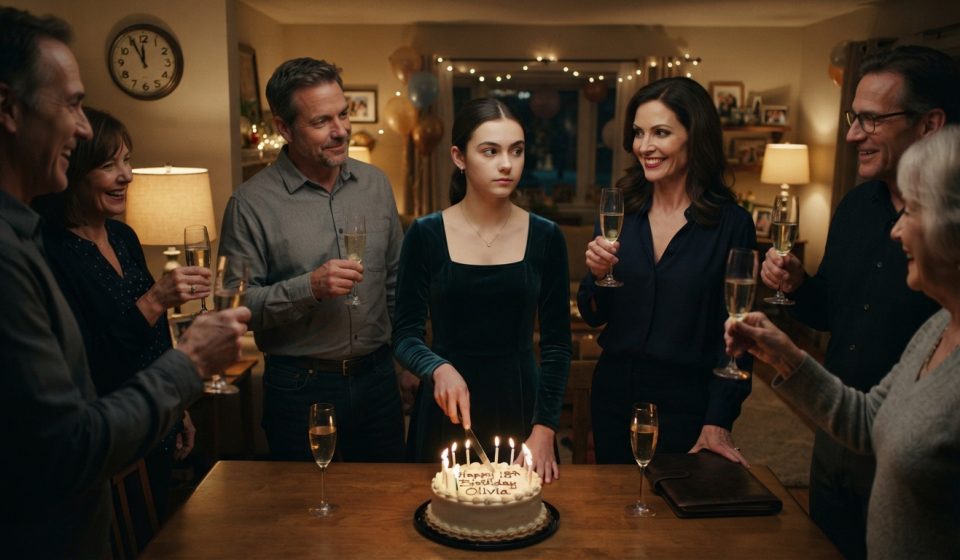
My family toasted my future at midnight as though everyone gathered around that birthday cake genuinely cared about what happened to me. My mother smiled harder than anyone, but there was nothing warm or proud about her expression. Her eyes had the familiar sharpness they always seemed to acquire whenever money was close. She lifted her champagne glass and toasted Olivia—me—for finally becoming an adult. My stepfather Brent joined in, congratulating me for finally being old enough to make “mature decisions.” I smiled, cut the cake, and said nothing while those words hung strangely in the room.
At midnight I was still seventeen for exactly sixty more seconds, and the reason everyone suddenly seemed so invested in my adulthood had little to do with the birthday itself. My grandmother had died two years earlier and left me a trust that became accessible when I turned eighteen. For six months, “accessible” had practically become my mother’s favorite word. She talked about stabilizing things, getting ahead, and finally allowing me to contribute like an adult. What she rarely mentioned was my future, my college education, my safety, or the freedom that money could provide.
My grandmother had used a different word: “protected.” During one of our last private conversations, while she was in hospice, she held my wrist and warned me that my mother believed access meant ownership. At the time, I thought Grandma was talking about emotions. Later, I understood that she meant it legally. The trust was worth $420,000—not fantasy wealth, but enough to pay for college, provide a future condo down payment, and create the kind of financial cushion that could stop one difficult year from turning into five.
🎧 Listen to the Complete Story
Press ▶ Play below to enjoy the full narrated story.
My mother had been circling that money since the funeral.
At first, her suggestions sounded responsible. We should meet with a financial planner. We should consider consolidating things. I was young, after all, and large amounts of money could disappear quickly without proper management.
Then her real priorities started appearing.
There was Brent’s business debt because, according to her, family debt was my debt too. My stepbrother Tyler had legal fees after what everyone described as one stupid mistake. Then there was “household stability,” because I had supposedly benefited from living under their roof all those years.
That argument was difficult to hear after I had already watched rent from my diner job disappear into groceries when I was sixteen. Even college money Grandma had sent for textbooks had once become something my mother called temporary help.
I had learned something important about our household: family support always seemed to travel in one direction.
Toward them.
As my birthday approached, I stopped concentrating on what my mother was saying and started paying attention to what she was preparing.
She bought a leather folder.
She printed forms.
Twice, she asked whether I still had the card for Mr. Keating, the officer who had handled Grandma’s trust from the beginning. Then she asked exactly what time the account would unlock, almost as though my eighteenth birthday were a timer attached to a vault.
That question stayed with me.
The trust represented college, housing, safety, and possibilities Grandma had deliberately preserved for me. Yet while my family toasted my future, my mother seemed to be counting down to something else entirely.
And as everyone raised their glasses around my birthday cake, I began to wonder what exactly she expected to happen once that money finally became accessible.