
My Family Finished Dinner Before I Arrived At My Son And Daughter-In-Law’s 10th Anniversary. She Handed Me A $1,720 Bill, Laughed. You’re Our ATM.

When my daughter-in-law handed me a bill for a dinner they’d already eaten without me and laughed that I was their ATM, I finally wondered how long my family had been planning to treat me this way.
Tap LISTEN TO THE FULL STORY below to reveal the narrated video and start listening.
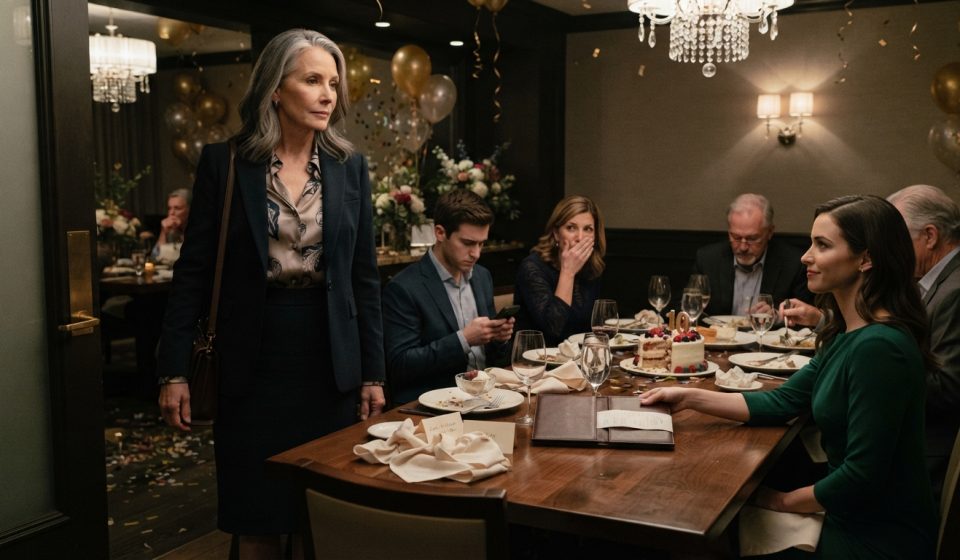
My daughter-in-law handed me a bill at my son and daughter-in-law’s 10th anniversary dinner—but by the time I arrived, my family had already finished eating. I was still beside the hostess stand with my purse on my shoulder when my son Aaron looked up from his phone and casually said, “Mom, you made it.” Nobody said they’d waited. Nobody said they’d saved me a plate. The private room behind him had already been cleared, the cake had been cut, and my place card was tucked beneath used napkins. Evelyn sat at the end of the table with one hand resting on a leather folder, already smiling before I could ask what had happened. I checked the invitation on my phone. Dinner at seven. I had arrived early and had even texted them from the parking lot.
Evelyn pushed the folder toward me and announced loudly that since I’d missed the meal, I could still do the useful part. Several cousins laughed. My sister Brenda stared down at her water. Aaron remained silent. Inside the folder was the restaurant bill—steaks, drinks, cake fee, private-room fee—and at the bottom someone had circled the $1,720 total and written, “Thanks, Mom.” Then Evelyn leaned back and laughed that I was their ATM. What hurt wasn’t simply the money. It was that nobody at the table told her to stop. I looked at Aaron, but he stared at his dark phone screen and pretended to scroll.
I pulled out the bill and tore it once, then again and again. The pieces scattered across the dessert plates. Evelyn’s smile disappeared. She complained that I’d destroyed restaurant property, and I told her she could explain it. Then I walked out before my tears reached my voice. Messages appeared before I’d even left the parking lot. Aaron told me not to make a scene. Evelyn called my behavior “very classy.” Brenda said I should have paid first and discussed it later. I drove home with shaking hands, finally understanding how they seemed to see me—not as a mother, guest, or grandmother, but as a wallet.
🎧 Listen to the Complete Story
Press ▶ Play below to enjoy the full narrated story.
At my kitchen table, I opened the drawer where I kept old receipts and found a brass key with a blue tag.
It belonged to a storage unit Aaron and Evelyn had persuaded me to keep in my name years earlier. They’d promised it would be temporary—six months for wedding keepsakes, extra furniture, and boxes from Evelyn’s party-planning business.
Years later, I was still paying for it.
Then I opened my banking app.
I began reviewing the expenses I’d covered over time: preschool deposits, car insurance, emergency groceries, a late utility payment, even a dress Evelyn had once charged to my card supposedly by accident.
Then one transaction stopped me.
Money had been transferred to a print shop called Paper Lantern.
The note attached to it said “anniversary packet.”
I’d ordered nothing for their anniversary.
I’d been invited as a guest.
I immediately changed my banking password and froze the card Evelyn kept for school emergencies.
The following morning, Evelyn posted a photograph from the anniversary dinner. She and Aaron were smiling beneath a gold banner, while my empty chair remained visible at the edge.
Her caption implied they were learning who truly showed up for them.
Soon relatives began contacting me as though I’d arrived confused and angry. One cousin said Evelyn was worried I was under too much stress. A church friend asked whether I needed support.
Their version of the evening was already changing.
So I drove to the storage facility.
The manager’s expression changed when he saw me. Evelyn had visited the previous week claiming I wanted her added as account manager.
She’d even brought him a form.
And when he showed it to me, I saw my name, my address—and a signature that was supposed to be mine.