
After My Husband Died, His Son From His First Marriage Kicked Me Out Of My Own Home. My Father’s Name, My Father’s House, You’re Nothing Now.

When my husband’s son kicked me out just days after the funeral, the moving van waiting outside told me he’d been planning my removal long before he dared to shut the door in my face.
Tap LISTEN TO THE FULL STORY below to reveal the narrated video and start listening.
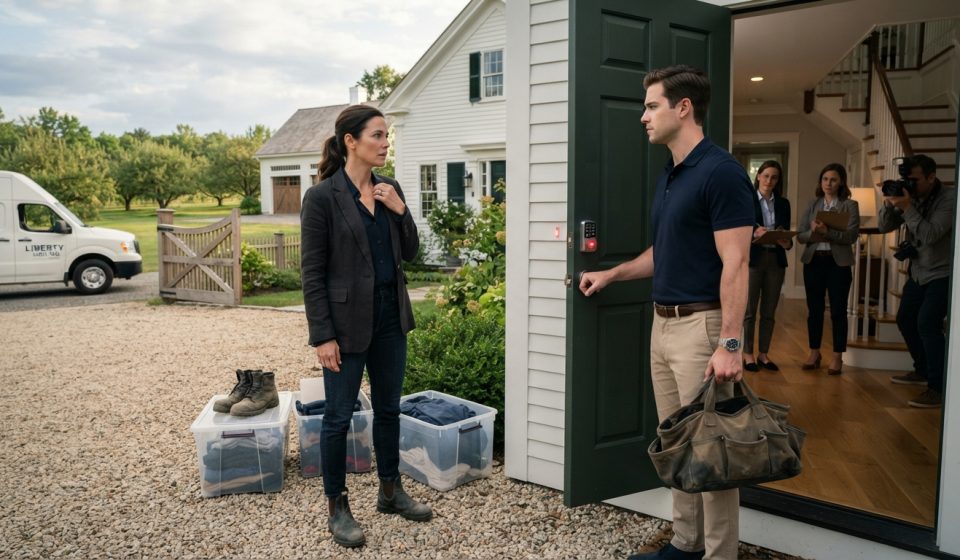
My husband’s son kicked me out of my own home only six days after his father’s funeral. I returned from the funeral home and found a moving van parked beside the orchard gate, while my clothes had already been packed into plastic bins and left on the gravel. My dusty work boots were sitting on top. When I entered my code into the front keypad, it blinked red. Raymond, my late husband’s 32-year-old son from his first marriage, opened the door from inside wearing his father’s watch and holding my canvas tool bag. He calmly told me I could collect the rest of my belongings after probate.
Behind Raymond, two women from the Historical Society stood in the foyer with clipboards while a photographer took pictures of the staircase I had rebuilt. Raymond had already arranged a promotional shoot for Hale Orchard House, the wedding venue Grant and I had opened the previous year. When I asked whether he’d changed the code, he told me the property belonged to the estate. I reminded him that it was my home. He smiled and said it had been his father’s family farm before I turned it into a construction project. Then, loudly enough for everyone to hear, he declared that it was his father’s name and his father’s house—and that I was nothing now.
The photographer lowered his camera. Raymond placed my tool bag on the porch and shut the door. I didn’t pound on it. Instead, I picked up my boots and drove to the small apartment above my company office. But one detail followed me the entire way: the moving van had been booked three days earlier. The confirmation sheet was visible inside its windshield. My husband’s son kicked me out after planning my removal before we’d even buried Grant.
🎧 Listen to the Complete Story
Press ▶ Play below to enjoy the full narrated story.
At 43, I had spent twenty years restoring buildings other contractors considered lost. I knew how to lift a sagging floor and uncover rot hidden behind fresh paint.
What I hadn’t understood was how much could remain hidden inside a family that knew how to embrace each other convincingly in public.
Grant and I had met eight years earlier when he called my company, Mercer Restoration, about a collapsing carriage barn at Hale Orchard.
The property had belonged to his family for generations, but its famous name concealed serious problems. The farmhouse leaked. The orchard barely produced. Two outbuildings had county warnings attached to them, and the land struggled even to pay its taxes.
I initially stabilized the barn.
Then the farmhouse needed electrical work. The septic field failed. A storm tore open part of the roof.
When developers offered to flatten the orchard for storage units, I proposed another solution. My company would finance the restoration, convert the carriage barn into an event hall, restore the farmhouse as our residence, and recover the construction debt from venue income.
Grant provided the land.
I provided labor, materials, permits, credit, and the resources of my company.
Our accountant and separate attorneys formalized everything in a commercial agreement. The debt exceeded $400,000 and was secured by the property. Grant signed before a notary.
We married the following spring, and for several years the arrangement worked.
My crews rebuilt walls, plumbing, and the barn roof while Grant handled tours and couples who dreamed of wedding photographs beneath the apple trees.
Then business slowed.
Repayments to my company stopped, but I allowed it because Grant and I shared the home and the business. Every quarter, our accountant sent the updated balance, and Grant promised that when things recovered, my company would be paid first.
I believed him.
Raymond, however, appeared to see something different.
He returned when the venue began appearing in magazines and started calling himself director of operations, despite arriving late, avoiding vendors, and charging restaurants, golf shops, and hotels to the business card.
Grant kept making excuses for his son.
And the morning after Raymond locked me out, my office manager found me asleep on the sofa upstairs.
He brought me coffee—and news that made the changed locks suddenly seem like only the beginning.