
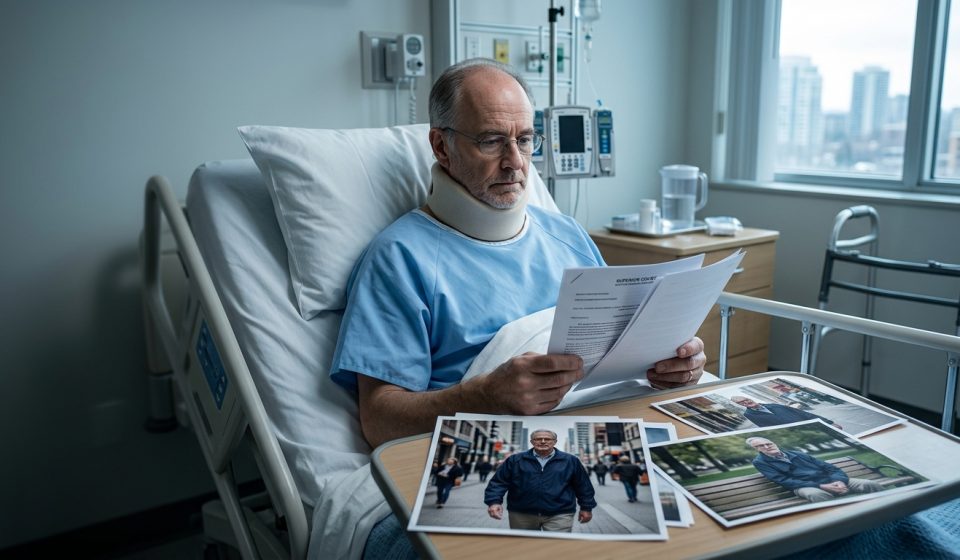
She Filed A Stalking Lawsuit Claiming I Followed Her For Months Across Three Cities. The Problem? I Was Bedridden In Toronto General Hospital The Entire Time.

A stalking lawsuit across three cities should have terrified me, but there was one impossible fact my ex-wife’s accusations couldn’t explain.
Tap LISTEN TO THE FULL STORY below to reveal the narrated video and start listening.
The stalking lawsuit across three cities claimed I’d spent months following my ex-wife from place to place, but when the process server handed me the papers, I laughed. Nothing about the accusation was actually funny. A titanium rod in my spine had kept me flat on my back for the previous four months, and my hands still trembled as I read the words alleging harassment and stalking. Patricia claimed I’d appeared at her workplace in Ottawa, her sister’s cottage in Muskoka, and outside her physiotherapy clinic in Kingston. The dates stretched from March through June 2024—the same months I’d spent recovering from spinal fusion surgery at Toronto General Hospital.
My name is Robert Harrison. I’m sixty-three, and until those papers arrived, I’d believed the worst chapter of my life had already happened. Three years earlier, my construction company collapsed after our largest client went bankrupt owing us $840,000. The fallout took almost everything: my business, our Oakville home, my twenty-eight-year marriage to Patricia, and eventually my health. The stress damaged my spine so severely that by February I could barely stand, leaving surgery as my only option.
That was what made Patricia’s accusations seem so absurd. During every date she claimed I’d been following her, I’d been confined to a hospital bed on the seventh floor of Toronto General. I couldn’t walk more than ten feet without collapsing. My surgeon had warned that I’d need at least twelve weeks before attempting stairs and sixteen before driving. The lawsuit arrived during week seventeen of my recovery.
🎧 Listen to the Complete Story
Press ▶ Play below to enjoy the full narrated story.
I immediately called Graham Chen, the lawyer who’d handled my bankruptcy and knew the painful history of my divorce. After I read him the allegations, he went quiet.
Then he told me this might actually be good news.
I couldn’t understand how my ex-wife accusing me of criminal harassment could possibly qualify as good news. Graham’s reasoning was simple: I had ironclad proof that I couldn’t have done what Patricia alleged.
There were hospital records, nursing logs and security footage. I’d been monitored around the clock for four months. Graham believed the case could collapse almost immediately once that evidence was presented.
I wanted desperately to believe him.
But Graham hadn’t seen everything Patricia had included in the envelope.
There were twelve photographs.
In every one, a man who looked disturbingly like me appeared somewhere in the background. He seemed to be around my height—roughly six-foot-one—with the same general build, the same receding grey hairline, and even the same type of wire-rimmed glasses I’d worn for fifteen years.
One photograph was particularly unsettling.
It had been taken outside a Starbucks in Ottawa, and the man in the background was wearing a navy windbreaker identical to one I owned.
Someone looked exactly like me.
Graham told me to send him the photographs immediately and begin documenting everything. So I went through months of phone records, messages and emails. During my recovery, my daughter Amy had visited twice a week, my son Michael had flown in from Vancouver once, and my brother Thomas came every Sunday. Otherwise, my world consisted almost entirely of nurses, physiotherapists and the elderly patient in the next bed.
Meanwhile, the stalking lawsuit across three cities demanded $200,000 for emotional distress and requested a restraining order.
That night, I couldn’t sleep—not because of my back, but because something about the entire situation felt profoundly wrong.
Patricia and I had endured an ugly divorce, but I had never stalked or harassed her.
So I picked up the photographs again and examined them more carefully.
In the Ottawa Starbucks picture, the man’s face was partially visible in profile. The resemblance was uncanny—the nose, the jawline, the glasses.
Then I noticed something that didn’t fit.
He looked like me, but the way he stood was completely wrong.