
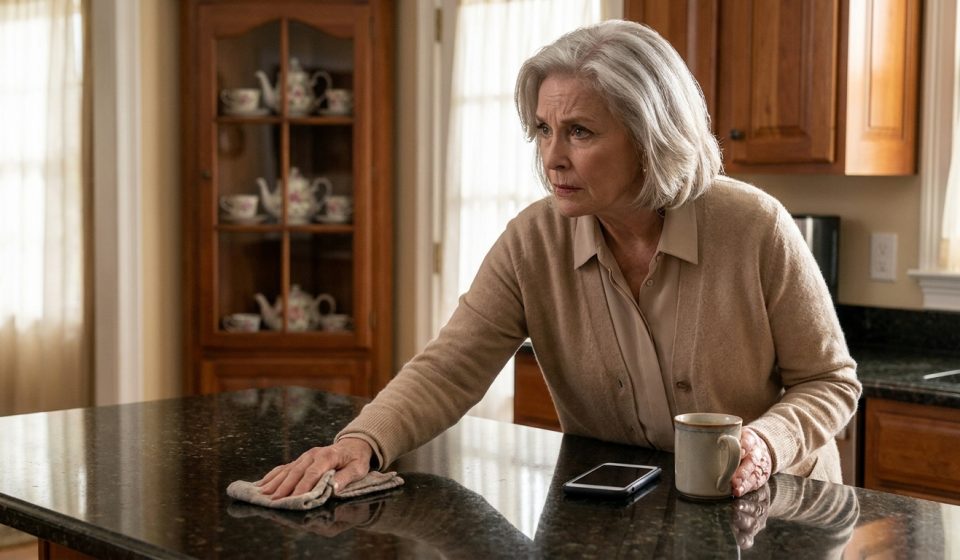
Honey, Your Mom Moved Her Money. I Can’t Access Her Account Anymore. The Shrill Voice, Voice Of My Daughter-In-Law, Rebecca, Echoed From My Son’s Phone Speaker.

My daughter-in-law accessing my money had become so normal to her that losing access sent her into a panic. She had no idea I was quietly listening—or how much I had already discovered.
Tap LISTEN TO THE FULL STORY below to reveal the narrated video and start listening.
My daughter-in-law accessing my money was apparently so important to her that the moment she couldn’t, panic erupted. I heard Rebecca’s shrill voice coming through my son David’s phone, telling him that I had moved my money and she could no longer access my account. I said nothing. Standing at my kitchen island, I calmly wiped the granite countertops and listened, knowing David would soon come storming through my front door. What neither of them understood was that I had already realized something was terribly wrong.
My name is Susan Chandler. I’m 68, widowed for six years, and retired after four decades working in university administration. My husband and I had worked hard for our four-bedroom colonial home, and after his death, his life insurance and my pension gave me a comfortable life. I wasn’t wealthy, but what I had was secure—and, more importantly, it was mine.
David was my only child. Three years earlier, he had married Rebecca, a sharp, ambitious woman who always seemed dressed as though a camera might appear at any moment. When their lease ended six months ago, David asked whether they could temporarily stay with me while saving for a down payment on a house. I wanted to help my son, so I agreed.
🎧 Listen to the Complete Story
Press ▶ Play below to enjoy the full narrated story.
The trouble began during their second month in my home. David suggested creating a joint checking account to simplify household expenses. We would each contribute toward groceries and utilities. It sounded sensible, so I signed the paperwork, gave them access through a debit card, and connected the account to my main savings for overdraft protection.
At first, everything seemed fine. Then I noticed an $85 purchase from an expensive cosmetic store. Another transaction showed $120 spent at a steakhouse on a Tuesday night—the same evening I’d eaten leftover casserole alone at home.
When I gently questioned Rebecca, she said she’d accidentally grabbed the wrong card. David supported her explanation and promised they would reimburse the money after his next payday.
They never did.
Instead, those little “accidents” started happening almost every week. But the money wasn’t the only thing troubling me. Rebecca’s behavior inside my home was beginning to change too. The longer we lived together, the clearer it became that she wasn’t simply trying to feel comfortable there.
One morning, I walked downstairs and discovered that my mother’s vintage floral tea set had disappeared from the glass cabinet. In its place was a row of stark matte-black mugs. Rebecca had packed my treasured tea set into a cardboard box in the basement because, according to her, it created “visual clutter.”
I quietly retrieved it and returned every floral cup to the place where it had sat for twenty years. Rebecca wasn’t pleased. David later cornered me in the hallway and suggested I should allow his wife to make decorating decisions so she could feel more at home.
I reminded him that it was still my home.
That conversation left me with a disturbing realization: David wasn’t going to defend me. He was willing to watch Rebecca push aside pieces of my life rather than risk upsetting her.
That night, I opened my laptop and examined the joint bank account more carefully.
What I found made the problem of my daughter-in-law accessing my money look far worse than a few accidental purchases. My contributions had doubled over four months, while David and Rebecca had stopped contributing altogether. There was a $300 luxury salon visit, a $150 Pilates membership, and $400 spent on a vineyard getaway they had described to me as a budgeting seminar.
They weren’t saving for a house the way they’d claimed.
They were using my money to maintain a lifestyle they couldn’t afford.
Then I noticed something even more alarming: the overdraft protection had already pulled money directly from my personal savings to cover their spending.
I stared at the transactions on the screen, realizing this wasn’t a misunderstanding anymore.
And whatever I decided to do next, David and Rebecca couldn’t know it was coming.