
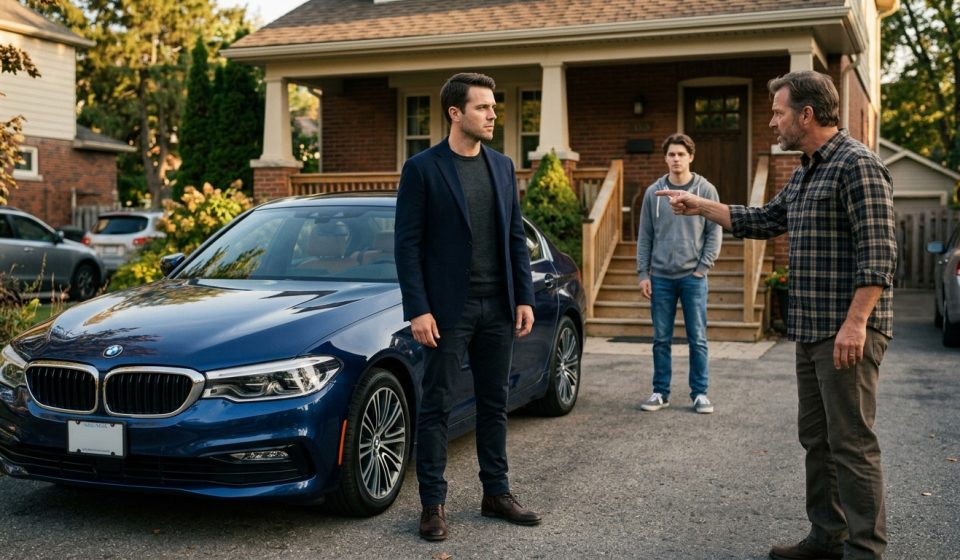
My Dad Pointed At My New Car And Said, “You’re Deliberately Rubbing Your Success In Your Brother’s Face.” I Just Told Him, “We Started The Same, If He Still…

My parents always enabled my brother, yet somehow my success became the problem they wanted me to hide. After years of building everything for myself, one accusation from my dad finally forced me to say what nobody in our family wanted to hear.
Tap LISTEN TO THE FULL STORY below to reveal the narrated video and start listening.
My parents always enabled my brother, but the moment my own hard work began showing results, my father accused me of deliberately rubbing my success in Caleb’s face. I told him the truth we’d avoided for years: we had started from the same family, but Caleb had never been required to stand on his own because our parents were always there to catch him.
From the beginning, I was labeled “the independent one.” It sounded like praise, but I eventually understood what it really meant: my parents didn’t have to pay attention to me. I was expected to be responsible, mature, and capable of practically raising myself, while their emotional and financial energy flowed toward Caleb.
Caleb was the baby—the miracle boy who could seemingly do nothing wrong. If I left my shoes in the hallway, I could be grounded for a week. If Caleb damaged the living-room drywall with a baseball bat during a tantrum, my parents treated it as him expressing his “big emotions.”
🎧 Listen to the Complete Story
Press ▶ Play below to enjoy the full narrated story.
By seven, I had a chore chart.
I mowed the lawn, washed dishes, and took out the trash.
Caleb didn’t even learn to load a dishwasher until he was seventeen.
Birthdays made the difference impossible to ignore. My gifts were practical: a winter coat, socks, maybe a bookstore gift card. Caleb received the newest PlayStation, custom sneakers, and VIP concert tickets.
I still remember my fifteenth birthday.
I was taking AP calculus and genuinely needed a graphing calculator, so my parents gave me a TI-84 Plus. It was useful, and I appreciated having what I needed.
But while I sat on the porch opening it, I watched Caleb rev the engine of the brand-new Yamaha dirt bike my parents had already bought him as an early birthday surprise.
He wasn’t even turning thirteen until the following month.
Eventually, I stopped expecting fairness.
That realization changed me.
Instead of waiting for my parents to level the playing field, I focused on the only future I could control—my own.
I studied relentlessly and earned straight A’s. The moment I turned sixteen, I started working at a local grocery store and saved every penny in a bank account my parents couldn’t access.
At eighteen, whatever financial support might once have existed disappeared completely.
My parents didn’t contribute toward college.
They didn’t help with my first apartment.
They didn’t even buy me a refrigerator for my dorm room.
So I earned a partial academic scholarship and enrolled at a solid state school. I worked thirty hours every week as a night auditor at a hotel, sometimes studying behind the front desk at three in the morning.
Four years later, I graduated with a degree in supply chain logistics and strong grades.
Then Caleb went to college.
Suddenly, the financial rules were completely different.
My parents paid his entire out-of-state tuition in cash. They bought him a brand-new Honda Civic as a going-away gift and covered the rent on a luxury off-campus apartment.
He changed majors repeatedly, spent years partying, and eventually graduated after six and a half years.
His graduation came with a catered taco bar, a DJ, and around eighty guests.
Mine had been acknowledged with a text from my mother inviting me to join them at Chili’s.
But because my parents always enabled my brother, I’d already learned a lesson Caleb hadn’t been forced to learn.
Nobody was coming to build my life for me.
After college, I accepted a junior logistics analyst position earning $48,000 a year. I lived in a terrible studio apartment above a 24-hour laundromat where industrial dryers made the walls vibrate.
I drove a battered Toyota Corolla with a broken driver’s-side window.
And I saved aggressively.
Meanwhile, Caleb eventually returned to our parents’ house, living rent-free in his childhood bedroom.
The contrast between our lives was becoming impossible to ignore.
But I had no idea that once my hard work finally became visible, my family wouldn’t celebrate it.
They would expect me to hide it.