
My Nine-Year-Old Son Held Up His “I Beat It” Sign After His Final Cancer Treatment, But Mom Texted, “Stop Guilting Us. We’re At Your Sister’s Housewarming.”

My son finished his cancer treatment after eleven exhausting months, holding up a handmade sign and hoping his grandparents would finally come celebrate him. Instead, one message from my mother left me struggling to hide the truth from my nine-year-old boy.
Tap LISTEN TO THE FULL STORY below to reveal the narrated video and start listening.
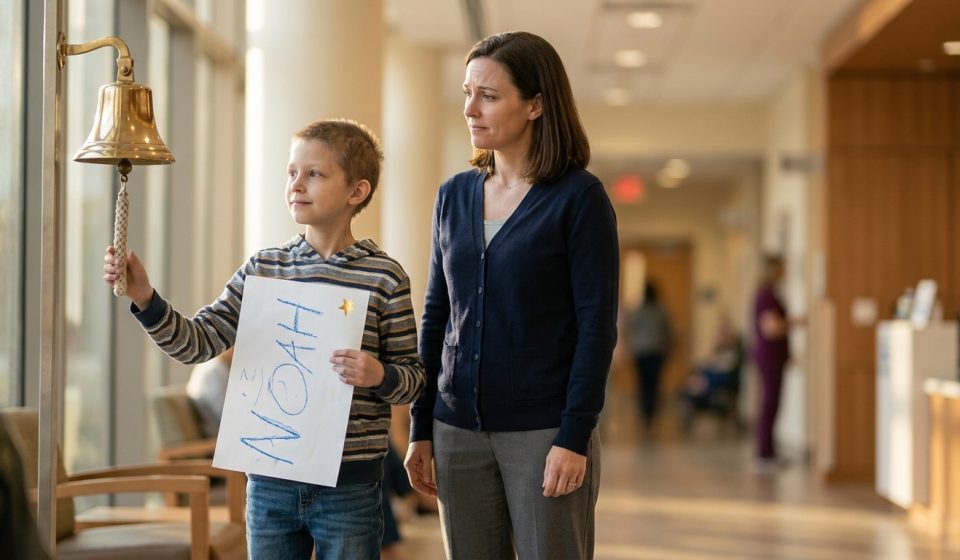
My son finished his cancer treatment after eleven exhausting months, and nine-year-old Noah stood just two feet away holding the handmade sign he had created the night before. In crooked blue letters, with a gold star sticker in one corner, he had written, “I beat it grandma Are you coming.” But instead of celebrating with him, Laura’s mother sent a message accusing her of trying to make the family feel guilty. They were at Laura’s younger sister Melissa’s housewarming, she explained, and the day wasn’t only about Laura’s child.
Laura read the message three times. Then her father added his own response: Noah was alive, so she should be grateful. What more did she want? Noah couldn’t see everything written on the screen, but he was standing close enough to watch his mother’s face. When he asked whether Grandma was coming, Laura swallowed everything she wanted to say and typed a single word into the family chat: “Understood.”
At that moment, Laura believed she had simply reached the end of the worst day of an unimaginably difficult year. She had no idea that only nine hours later, a photograph would appear in the same family chat and begin cracking open a story her mother had apparently spent months constructing. For now, all Laura knew was that Noah had finally reached the brass bell at St. Ann’s Children’s Centre after months of treatment.
🎧 Listen to the Complete Story
Press ▶ Play below to enjoy the full narrated story.
Noah had stared at that bell for months. During one treatment, he asked his nurse when children got to ring it and whether they ever returned afterward. When she told him some came back to visit, Noah immediately formed a plan: finish treatment, ring the bell, and someday return simply to say hello.
His final infusion happened to fall on the same Saturday as Melissa’s housewarming. Laura had known about the scheduling conflict for weeks, but she believed there was room in one day for both children. Noah could ring the bell in the morning, and her parents could attend Melissa’s party afterward. They lived less than 45 minutes away.
It seemed reasonable.
But Laura’s history with her mother and Melissa should have warned her otherwise.
When Laura was seventeen, her high school graduation fell on the same weekend as Melissa’s regional dance competition. Their mother never seriously debated which event deserved her attention. Melissa needed them, she said. Laura would be fine.
So Laura drove herself to graduation. The only photograph she had from that day was taken by a stranger’s mother.
That pattern followed them into adulthood. Melissa needed support; Laura managed alone. Melissa was considered sensitive, while Laura was considered strong. The family treated Laura’s ability to cope as permission to overlook her.
Then Laura had Noah.
After her marriage ended quietly when he was six, Laura promised herself she would tolerate more from her family than she wanted if it meant her son could still have grandparents, cousins, holidays, and somewhere beyond their apartment where he felt he belonged.
She thought she was sacrificing her own pride.
She never imagined Noah might eventually pay the same price.
When Noah became sick, Laura’s life transformed into hospital parking garages, medication alarms, missed work, insurance calls, cafeteria dinners, and nights sleeping upright beside his bed. She worked as a nursing assistant during the day before driving to the hospital to care for her own child.
Her parents never visited.
There was always an explanation. Hospitals affected her mother’s blood pressure. Seeing Noah sick was supposedly too painful. Perhaps, her mother suggested, the doctors didn’t want many visitors anyway.
Then, after eleven months, my son finished his cancer treatment.
Noah finally reached for that bell cord.
His grandparents still weren’t there.